What Dog Food Is Best For Large Breed Puppies: Best Guide
Find out what dog food is best for large breed puppies, including key nutrients, feeding tips, and expert advice for healthy growth.
The best food for a large breed puppy is a complete and balanced puppy diet made for growth, with controlled calories and calcium. Look for a U.S. label that says the food meets AAFCO nutrient profiles for growth, including growth of large-size dogs weighing 70 pounds or more as an adult.
This matters because large puppies grow fast, but their bones and joints may not mature at the same speed. Too many calories, excess calcium, or rapid weight gain can raise the risk of skeletal problems. A good diet supports steady growth rather than the fastest possible growth.
Introduction
For puppies in the United States, the safest starting point is a food labeled for large breed puppy growth or for growth of large-size dogs. Choose a product from a company that provides clear nutrition information, quality control details, and a way to contact a qualified nutrition professional.
Do not choose food only because it says “premium,” “natural,” “high protein,” or “grain-free.” Those terms do not prove that a diet is right for a growing large breed dog.
Your puppy’s breed, expected adult weight, body condition, activity, health, and the food’s calorie content all matter. Your veterinarian should guide the choice if your puppy has diarrhea, poor growth, bone or joint concerns, food allergies, or another health problem.

What makes a large breed puppy food different?
A large breed puppy food controls three main factors: energy, calcium, and the balance of key nutrients.
Large breed puppies need enough nutrients to build muscle, bone, organs, and immune defenses. However, excess energy can make a puppy gain weight too quickly. Extra weight places more force on developing joints.
Large breed formulas also tend to provide controlled calcium and phosphorus levels. Puppies need both minerals for bone growth, but more is not always better. Large breed puppies may have trouble regulating excess calcium during early growth.
The label should state that the food is complete and balanced for one of these purposes:
- Growth, including growth of large-size dogs
- All life stages, including growth of large-size dogs
- A veterinary-directed diet for a specific medical need
A label that says only “for adult maintenance” is not suitable as the main food for a growing puppy.
The U.S. Food and Drug Administration explains that pet food labels use nutritional adequacy statements to show whether a food is intended for growth, adult maintenance, reproduction, or all life stages. The Association of American Feed Control Officials, or AAFCO, sets the nutrient profiles used by many U.S. states when regulating pet food.
See the FDA guide to reading pet food labels and the AAFCO dog and cat food nutrient profiles.
How to choose the best food on the label
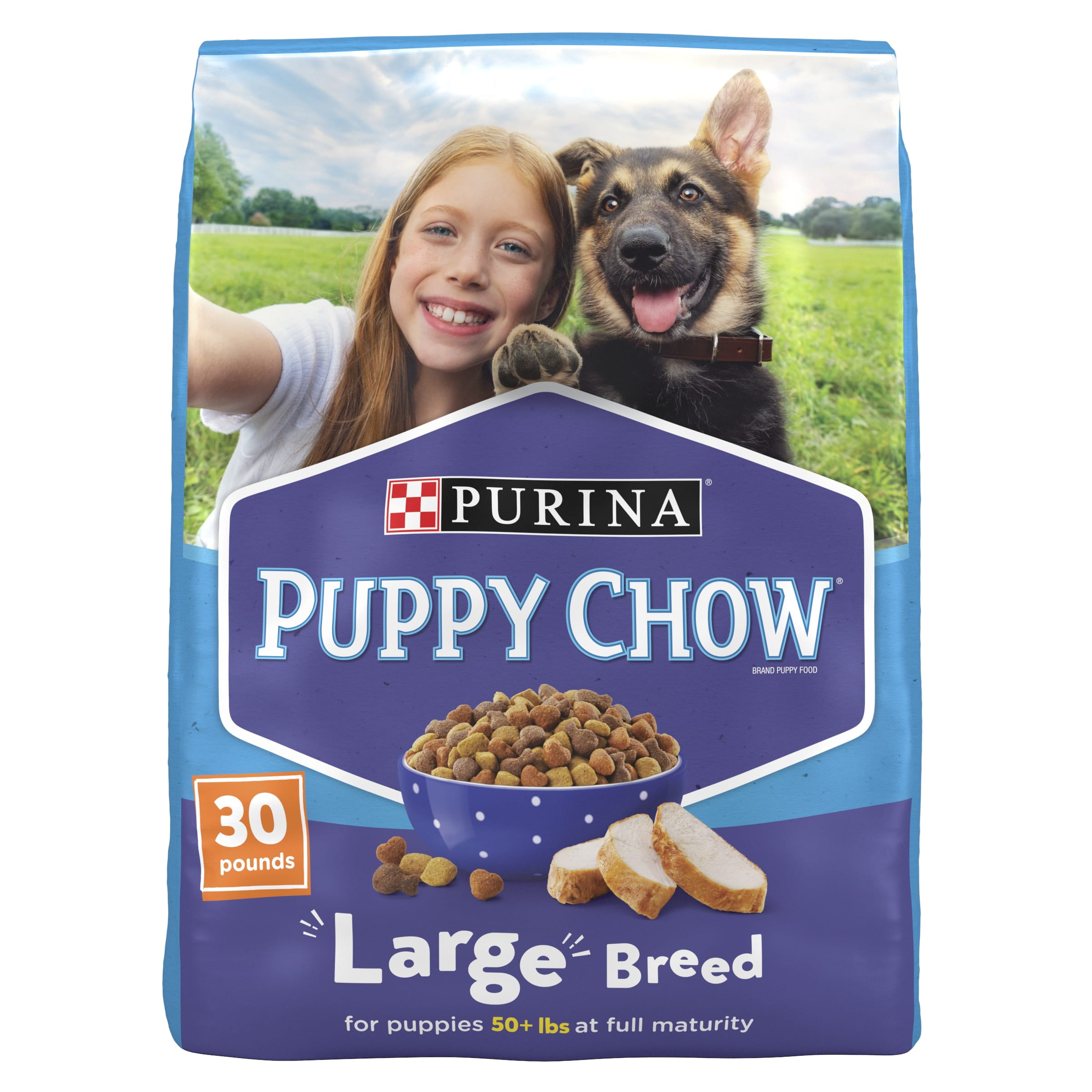
Start with the nutritional adequacy statement, then check calories and feeding guidance. The ingredient list matters, but it should not be your first or only test.
1. Find the right growth statement
For a puppy expected to weigh at least 70 pounds as an adult, look for wording that includes large-size dogs.
Examples of useful wording include:
“Animal feeding tests using AAFCO procedures substantiate that this product provides complete and balanced nutrition for growth, including growth of large-size dogs weighing 70 lb or more as an adult.”
Or:
“This product is formulated to meet the nutritional levels established by the AAFCO Dog Food Nutrient Profiles for growth, including growth of large-size dogs weighing 70 lb or more as an adult.”
The exact wording may vary. The key is that the food is suitable for growth and specifically accounts for large-size dogs.
2. Check the calorie content
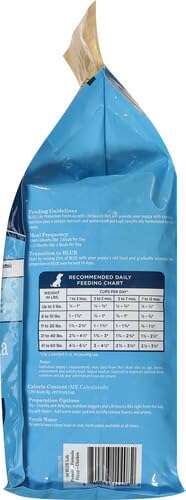
Calorie density affects how much your puppy must eat each day. It is usually listed as kilocalories per cup, kilocalories per can, or kilocalories per kilogram.
A very calorie-dense food may provide more energy in a small serving. That can make overfeeding easier, especially if you follow the cup amount without checking your puppy’s body condition.
Use the feeding chart as a starting point, not a fixed rule. Adjust the daily amount based on weight gain, body shape, stool quality, and veterinary advice.
3. Look for a controlled mineral profile
The label may not show every nutrient detail you need. If calcium, phosphorus, or calorie information is not clear, contact the manufacturer.
Ask for the food’s:
- Calcium level on a dry-matter basis
- Phosphorus level on a dry-matter basis
- Calorie density
- Complete nutrient analysis
- Intended life stage
- Quality-control process
“Dry matter” means the nutrient amount after removing water. This allows a fair comparison between dry food, wet food, and other products.
4. Do not judge quality by ingredients alone
Chicken, beef, fish, rice, oats, corn, peas, and other ingredients can all appear in a balanced diet. The presence or absence of one ingredient does not prove that a food is healthy or unhealthy.
The finished recipe must provide the right nutrient levels. A food with appealing ingredients can still be too high in calories or unsuitable for large puppy growth.

Dry food, wet food, fresh food, or raw food?
The best format is the one that provides complete nutrition, fits your budget, and allows you to control portions.
| Food type | Potential benefit | Main concern |
|---|---|---|
| Dry food | Easy to measure and store; often calorie-dense | A cup can contain many calories |
| Wet food | Adds water and may help picky eaters | Portions can be less convenient; cost may be higher |
| Fresh or gently cooked food | May be appealing and easy to portion | Must be complete and balanced for large puppy growth |
| Raw food | Some owners prefer the feeding style | Greater food safety and nutritional-balance concerns |
A fresh or refrigerated diet is not automatically better. It must still carry a valid nutritional adequacy statement for puppy growth.
Raw diets deserve extra caution. The American Veterinary Medical Association and the FDA warn about risks linked to pathogens and nutritional imbalance. Raw bones can also cause dental damage, choking, or intestinal injury.
Do not add calcium powder, bone meal, vitamin products, or large amounts of meat to a complete puppy food unless your veterinarian directs you to do so. Homemade diets for growing puppies are easy to unbalance, even when the ingredients seem wholesome.

How much should a large breed puppy eat?
Feed enough to support steady growth while keeping your puppy lean. The correct amount depends on the food’s calories, your puppy’s age, current weight, expected adult size, activity, and body condition.
A simple process works well:
- Start with the food maker’s puppy feeding guide.
- Divide the daily amount into several meals.
- Measure food with a standard measuring cup or, more accurately, a kitchen scale.
- Weigh your puppy regularly during growth.
- Reduce or increase the amount in small steps when body condition changes.
- Include treats in the daily calorie budget.
Most young puppies do well with three meals each day. Many move to two meals as they mature, but the timing should fit the puppy and your veterinarian’s advice.
How to check body condition
A healthy puppy should have:
- Ribs that you can feel under a thin layer of fat
- A visible waist when viewed from above
- A slight abdominal tuck when viewed from the side
- Normal energy and firm, formed stools
You should not see sharply protruding ribs, hips, or spinal bones. On the other hand, a round belly, no visible waist, or ribs that are hard to feel may indicate excess body fat.
Body condition is more useful than comparing your puppy with another dog. Two puppies of the same breed can have different frames, growth rates, and calorie needs.
A hypothetical calorie example
Suppose Food A provides 400 calories per cup and Food B provides 300 calories per cup. If a puppy needs 1,200 calories per day:
- Food A would provide about 3 cups daily.
- Food B would provide about 4 cups daily.
The larger volume does not mean Food B is automatically better. The key is the total calorie intake and whether the food is complete and balanced for large puppy growth.

Which ingredients and nutrients matter most?
Protein supports muscle, tissue, enzymes, and immune function. Fat supplies concentrated energy and essential fatty acids. Calcium and phosphorus support bones, but their amount and balance matter more than simply adding more.
DHA, an omega-3 fatty acid found in some fish oils and other ingredients, supports normal brain and eye development. It can be a useful feature, but it does not make an otherwise unsuitable food appropriate for a large puppy.
A suitable food should provide enough of the following:
- High-quality protein from a balanced recipe
- Essential fats and fatty acids
- Controlled calcium and phosphorus
- Vitamins and trace minerals
- Adequate calories for steady growth
- Nutrients required for the puppy life stage
Supplements are rarely needed when a puppy eats a complete and balanced commercial diet. Extra calcium is especially risky because it can disrupt mineral balance during bone development.
“High protein” is not a complete selection rule. Protein quality, total calories, amino acids, minerals, and the full nutrient profile all matter.
When should a large breed puppy switch to adult food?
Large and giant dogs often mature later than small dogs, so they may need a growth diet for longer. The correct switch time depends on the dog’s expected adult size and physical maturity.
Many large dogs remain on a suitable large breed puppy food until roughly 12 to 24 months, but this is a broad range, not a universal rule. Giant breeds may mature closer to the upper end of that range.
Ask your veterinarian when your dog is near adult height and has reached a stable body condition. Switching too early can remove nutrients needed for growth. Keeping a dog on a high-calorie puppy food after growth is complete may promote unwanted weight gain.
Change foods gradually over about seven days unless your veterinarian advises a different plan:
- Days 1–2: mostly old food with a small amount of new food
- Days 3–4: about half old food and half new food
- Days 5–6: mostly new food
- Day 7: all new food
Slow the transition if loose stools, vomiting, or refusal to eat develops. Contact your veterinarian if symptoms are severe, persistent, or paired with weakness or dehydration.
Are grain-free diets safe for large breed puppies?
Grain-free food is not automatically healthier, and grains are not automatically harmful. Dogs can digest properly cooked grains, and many complete diets use them safely.
The FDA has investigated reports of canine dilated cardiomyopathy involving some diets, many of which contained high amounts of peas, lentils, other pulses, or potatoes as major ingredients. The relationship is complex and has not been reduced to a simple “grain-free equals disease” rule.
Do not change a healthy puppy to a grain-free diet without a clear medical reason. If your veterinarian suspects a food allergy or another condition, follow a structured diet trial rather than switching between foods at random.
More information is available in the FDA’s investigation of diet-associated canine dilated cardiomyopathy.

Common mistakes to avoid
The most common mistake is feeding too much. Large breed puppies can look healthy while gaining weight faster than their joints can handle.
Avoid these errors:
- Feeding adult maintenance food as the main diet
- Adding calcium or vitamin supplements without veterinary advice
- Leaving food available all day when the puppy gains excess weight
- Measuring portions by eye
- Counting only meals and ignoring treats, chews, and toppers
- Choosing food because of marketing words alone
- Changing diets often without a reason
- Assuming a large breed puppy needs maximum protein or maximum calories
- Using raw bones or homemade recipes without professional formulation
- Ignoring repeated diarrhea, poor appetite, or slow growth
Exercise also matters. Puppies need regular, age-appropriate movement, but forced running, repeated jumping, and long periods on hard surfaces may strain developing joints. Your veterinarian can help set safe activity limits for your puppy’s breed and condition.
When should you call a veterinarian?
Contact a veterinarian promptly if your puppy has repeated vomiting, bloody diarrhea, severe lethargy, trouble walking, pain, a swollen abdomen, or signs of dehydration.
Make a routine appointment if your puppy:
- Is gaining weight very quickly
- Is not gaining weight as expected
- Has persistent loose stools
- Scratches or develops recurring ear problems
- Refuses food for more than a short period
- Has bowed legs, lameness, or difficulty rising
- Has a known digestive, orthopedic, or inherited condition
A veterinarian can assess body condition, growth rate, orthopedic development, and diet history. For complex cases, a board-certified veterinary nutritionist may be needed to formulate or assess a homemade diet.

Best large breed puppy food: a practical decision guide
Use this quick checklist before buying:
| Question | What you want |
|---|---|
| Is it for puppies? | Growth or all life stages |
| Is large-size growth covered? | Yes, if the adult dog will weigh 70 pounds or more |
| Is it complete and balanced? | A clear AAFCO nutritional adequacy statement |
| Can you find calorie data? | Calories per cup, can, or kilogram |
| Is the company transparent? | Nutrition and quality-control answers |
| Can you control portions? | Clear feeding directions and easy measurement |
| Does your puppy stay lean? | Ribs are easy to feel and a waist is visible |
| Does your puppy tolerate it? | Good appetite, formed stools, normal energy |
If two foods meet these standards, choose the one your puppy eats well, digests well, and can receive in measured portions. Cost, availability, and your ability to feed it consistently also matter.
There is no single best brand for every large breed puppy. The best choice is the diet that meets the correct growth standard and keeps your individual puppy growing steadily at a healthy body condition.

Frequently asked questions
Is large breed puppy food really necessary?
It is strongly preferred for puppies expected to reach a large adult size. These diets are designed around controlled growth, calories, and mineral levels. If a food is labeled for growth of large-size dogs, it is a better fit than a general adult food.
Can a large breed puppy eat regular puppy food?
Only if the label confirms that it is complete and balanced for growth, including growth of large-size dogs. A general puppy formula may not have the same mineral and calorie controls.
Is wet food good for large breed puppies?
Yes, if it is complete and balanced for large-size puppy growth. Check calories carefully because wet and dry foods have different water content and portion sizes.
Should I feed my puppy a supplement for joints?
Do not add a joint supplement automatically. Some products may help specific dogs, but product quality and evidence vary. Ask your veterinarian before using glucosamine, chondroitin, fish oil, calcium, or vitamin supplements.
How long should my puppy stay on large breed puppy food?
Many large dogs need a growth diet until about 12 to 24 months, while giant breeds may mature later. Your veterinarian should base the change on body condition, growth, breed, and physical maturity.
What is the next step if my puppy is gaining weight too fast?
Measure the current food and treats, check the calorie content, and arrange a veterinary weight and body-condition check. Do not sharply restrict food without guidance because a growing puppy still needs essential nutrients.
Conclusion
For most large breed puppies in the United States, the best dog food is a complete and balanced formula for growth that specifically includes large-size dogs. Pick a food with clear calorie information, controlled mineral levels, and reliable manufacturer support.
Feed measured portions, keep your puppy lean, and adjust the amount as growth changes. When your puppy has health problems or unusual growth, use your veterinarian—not marketing claims or internet lists—as the final guide.
Sources and further reading
- U.S. Food and Drug Administration: Pet Food Labels
- AAFCO: Dog and Cat Food Nutrient Profiles
- Merck Veterinary Manual: Nutritional Requirements of Small and Large Dogs
- WSAVA Global Nutrition Guidelines
- FDA: Investigation of Potential Link Between Certain Diets and Canine Dilated Cardiomyopathy

Pet Care Writer & Researcher
Daniel writes practical guides on daily care, feeding, and safety, turning complex topics into simple, actionable advice.