
Can A Dog Bed Be Too Big: Find The Perfect Fit
Can a dog bed be too big? Learn how oversized beds affect comfort, support, and sleep, plus simple tips for choosing the right size.
Yes, a dog bed can be too big if it leaves your dog feeling exposed, cold, or unable to settle.
Choosing the right bed is about more than giving your dog the most space possible. After comparing dog bed sizes, sleep habits, body types, and home setups, I’ve found that the best bed supports your dog’s whole body while still feeling cozy and secure. This guide explains how to tell whether a dog bed is too big and how to choose a better fit.
Can a dog bed be too big?
Yes, a dog bed can be too big. A large bed is not always harmful, but it may fail to provide the warmth, support, and sense of security many dogs need.
Dogs often choose resting places that feel protected. This is why some dogs prefer corners, crates, couches, or beds with raised sides. A very large, flat bed can feel more like an empty floor than a comfortable nest.
A dog bed may be too big when:
• Your dog avoids it or sleeps beside it
• Your dog looks small and exposed in the center
• The bed does not hold body heat well
• Your dog cannot lean against a firm edge
• The bed slides around when your dog lies down
• Your dog keeps circling without settling
Size is only one part of comfort. The bed’s filling, shape, firmness, fabric, and location also matter.

How to tell if a dog bed is too big
The clearest answer often comes from watching your dog. Dogs show comfort through their sleep habits, body position, and willingness to return to the bed.
A dog bed may be too big if your dog regularly chooses another spot. This is especially telling when the other spot is smaller, warmer, or more enclosed.
Look for these signs:
Your dog sleeps near the edge
Some dogs sleep on the edge because they like space. However, if your dog always presses against one side, the bed may offer more room than needed.
This behavior can also mean your dog wants a firm border. A bolster bed may work better than a large mattress-style bed.
Your dog curls into a tight ball
A curled sleeping position helps a dog save body heat. If your dog curls tightly in a large bed, the bed may not feel warm or secure enough.
This does not always mean the bed is too big. Small dogs and cold-natured dogs may curl up even on a well-sized bed.
Your dog sleeps beside the bed
This is one of the strongest clues. Your dog may like the bed’s softness but dislike its size, smell, location, or lack of support.
Try moving the bed near a wall or placing a washable blanket on top. If your dog still avoids it, the shape or size may be wrong.
Your dog keeps moving around
A dog that circles, digs, changes position, and gets up often may not feel settled. The problem could be poor filling or the wrong size.
A bed that is too big may allow the dog to shift around without finding a supportive position. A bed that is too small can cause the same problem.
Your dog looks lost in the bed
Your dog should have room to stretch, but not so much space that the bed feels empty. The dog should look comfortably supported when lying down.
For many dogs, a snug fit feels more inviting than a huge sleeping surface.

How much bigger should a dog bed be than your dog?
A dog bed should usually be about 6 to 12 inches longer and wider than your dog’s sleeping body length. This gives enough room to stretch without creating a large, cold space.
Measure your dog while relaxed. Measure from the nose to the base of the tail, not to the end of the tail. Then measure from shoulder to shoulder or hip to hip while your dog is lying down.
Use these steps:
-
Wait until your dog is resting naturally.
-
Measure the dog from nose to tail base.
-
Measure the widest part of the body.
-
Add about 6 to 12 inches to both measurements.
-
Compare the result with the bed’s inner sleeping area.
The inner area matters more than the outside size. A bed with thick bolsters may look large but have little usable space inside.
For example, a dog that sleeps in a 30-inch stretch may need a bed with an inner length of about 36 to 42 inches. A dog that curls up may prefer a smaller bed with raised sides.

Dog bed size chart
A size chart can help, but it should not replace measuring your dog. Breed names are not reliable size guides because dogs within the same breed can have very different body shapes.
| Dog size | Common examples | Typical bed length |
|---|---|---|
| Small | Chihuahua, Yorkie, Toy Poodle | 18 to 25 inches |
| Medium | Beagle, Cocker Spaniel, French Bulldog | 25 to 35 inches |
| Large | Labrador Retriever, Boxer, German Shepherd | 35 to 45 inches |
| Extra large | Great Dane, Mastiff, Newfoundland | 45 inches or more |
These ranges are general. A long-legged Whippet may need a longer bed than a heavier but shorter French Bulldog.
Also check the manufacturer’s weight range. Weight does not show length, but it helps you judge whether the foam or filling can support your dog.

When a larger dog bed is the right choice
A large dog bed is not automatically a bad choice. Some dogs need extra space because they sleep fully stretched out or change positions during the night.
A bigger bed may be suitable when:
• Your dog sleeps on the side with legs extended
• Your dog changes positions often
• Two dogs share the bed
• Your dog is still growing
• Your dog has long legs or a long body
• Your dog sleeps hot and prefers open space
• Your dog needs room for a blanket or toy
Large dogs often need a large bed because their joints need full support. A bed that is too small can force the dog to curl up or let the hips and shoulders press against the floor.
The goal is not the smallest bed possible. The goal is a bed that gives your dog room to stretch while keeping the body supported.

When a smaller or more enclosed bed may be better
Some dogs feel safest in a smaller, more contained space. This is common in puppies, toy breeds, anxious dogs, and dogs that enjoy sleeping in crates.
A smaller bed can provide:
• Better warmth
• A stronger sense of security
• Easier access for small or older dogs
• More support around the neck and back
• Less movement inside the bed
• A cozy place to rest
Donut beds, bolster beds, cave beds, and covered beds can help dogs that curl up or lean against something while sleeping.
However, do not choose a bed so small that your dog cannot stretch, turn around, or lie on the side. A snug bed should feel cozy, not cramped.

Why some dogs prefer a bed that feels snug
Dogs often rest better when their bodies touch a soft boundary. A raised edge can act like a pillow and give the neck a stable place to rest.
This design may also help dogs feel protected. In nature, many animals select sleeping areas that offer warmth and cover. Household dogs still show some of these comfort preferences.
A snug bed can be especially useful for:
• Nervous dogs
• Rescue dogs adjusting to a new home
• Dogs that sleep curled up
• Small dogs that lose heat quickly
• Dogs that lean against furniture
• Dogs that enjoy crate training
A snug bed is not a treatment for anxiety. If your dog shows severe fear, pacing, shaking, or destructive behavior, speak with a veterinarian or qualified behavior professional.

Problems caused by a dog bed that is too big
A dog bed that is too big usually does not cause serious harm by itself. Still, it can create comfort and practical problems.
Poor warmth
Large beds have more open surface area. A small dog may not generate enough body heat to warm the entire bed.
This matters most in cold rooms, during winter, or for dogs with thin coats. A washable blanket can help, but a smaller bed may work better.
Less body support
If the filling spreads too far, your dog may sink unevenly. This can be uncomfortable for older dogs or dogs with joint pain.
Orthopedic foam should support the body without allowing the hips and shoulders to sink to the floor. Look for dense foam and a level sleeping surface.
Reduced sense of security
An open bed may not feel safe to a dog that likes a den-like space. Raised edges or a wall nearby can make a large bed feel more inviting.
Wasted floor space
A giant bed can block walkways or crowd a room. This may cause people to move it often, which can make the dog less likely to use it.
Difficulty getting on and off
Size alone does not cause this issue, but a tall, oversized bed may be hard for puppies, senior dogs, or dogs with arthritis. A low-entry design is often safer.

Can a dog bed be too big for a puppy?
Yes, a dog bed can be too big for a puppy. A very large bed may provide too much open space and may not feel warm or secure.
Puppies also have accidents. If the bed is oversized, you may need to clean a much larger area. A washable, moderate-size bed is often easier to manage during house training.
For a growing puppy, choose a bed that allows room to grow but does not feel enormous. Measure the puppy often and replace the bed when the sleeping area becomes tight.
A crate divider can help create a smaller sleeping zone. The puppy should have enough room to stand, turn around, lie down, and stretch comfortably.
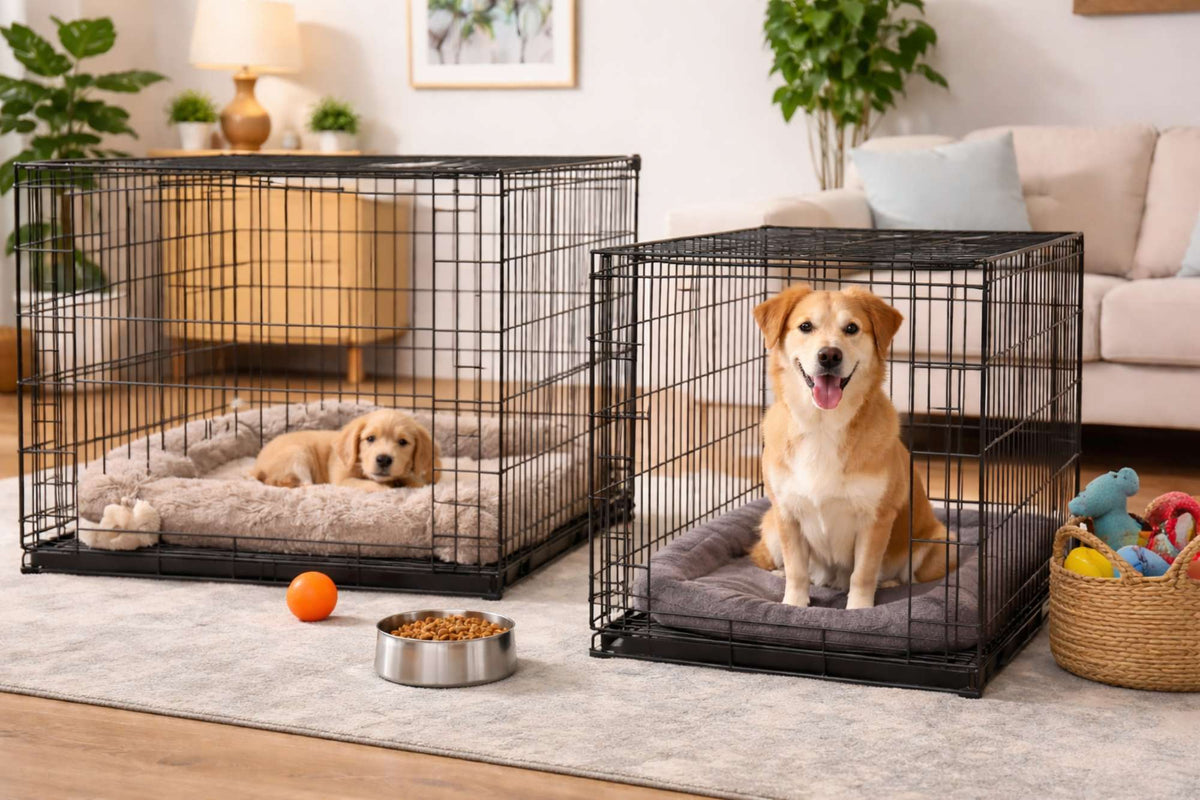
Can a dog bed be too big for a crate?
Yes, a dog bed can be too big for a crate. The bed should fit inside the crate while leaving enough room for your dog to move safely.
A bed that bunches against the crate door can create a trip hazard. It may also reduce usable space and make the crate feel crowded.
Choose a crate bed that:
• Fits flat without curling at the edges
• Does not block the door
• Allows your dog to turn around
• Provides enough padding for the dog’s body
• Has a cover that can be washed
Do not use a thick bed that raises your dog high enough to push against the crate roof. Your dog should be able to sit and stand without touching the top.
Does dog breed affect the best bed size?
Breed can offer a rough starting point, but body shape and sleep style matter more. A Dachshund needs a different bed shape from a Boston Terrier, even if their weights are similar.
Consider these traits:
• Long body: Choose a longer sleeping area.
• Broad chest: Choose extra width.
• Short legs: Choose a low-entry bed.
• Heavy body: Choose firm, durable support.
• Thick coat: Choose a breathable fabric and avoid excessive warmth.
• Curling sleeper: Choose a round or bolster bed.
• Stretched-out sleeper: Choose a rectangular mattress.
Mixed-breed dogs may not fit standard breed charts. Measuring the dog is more accurate than relying on a label such as small, medium, or large.
The best dog bed size for senior dogs
Senior dogs need enough space to change position, but they also need strong support. A bed that is too big may be difficult to enter if it has tall sides or a deep center.
Look for:
• Firm orthopedic foam
• A low step-in edge
• A flat, stable surface
• A non-slip bottom
• A waterproof inner liner
• A washable cover
Memory foam can reduce pressure on joints, but it should not be excessively soft. Your dog should not sink so deeply that standing becomes hard.
If your senior dog suddenly avoids a favorite bed, contact a veterinarian. Pain, arthritis, weakness, or another health problem may be the real cause.
How bed shape changes the right size
The shape of a dog bed changes how much usable space your dog receives. Two beds with the same outside measurements may feel very different.
Rectangular beds
Rectangular beds work well for dogs that sleep stretched out. They are also easy to place against a wall.
Round beds
Round beds suit dogs that curl into a ball. The circular edge can help the dog feel surrounded.
Bolster beds
Bolster beds have raised sides. They are useful for dogs that like to rest their head on an edge.
Cave beds
Cave beds provide cover and warmth. They may suit small, nervous, or cold-sensitive dogs.
Mattress beds
Mattress beds offer open space and easy access. They are often useful for large dogs, hot sleepers, and dogs with limited movement.
When comparing beds, measure the inner sleeping area. The outer dimensions can be misleading.
Common mistakes when buying a dog bed
Many owners buy a bed based on appearance or weight alone. That can lead to a poor fit.
Avoid these mistakes:
• Choosing a bed by breed name only
• Measuring the outer edge instead of the inner area
• Ignoring your dog’s sleeping position
• Buying the softest bed without checking support
• Forgetting the dog’s age and mobility
• Selecting a tall bed for a dog with joint pain
• Ignoring the room temperature
• Skipping the return policy
One practical lesson is to watch where your dog already sleeps. If your dog chooses a corner, a blanket pile, or a narrow space beside you, those habits reveal useful information about the bed shape and size your dog may prefer.
How to make an oversized dog bed more comfortable
You may not need to replace a large bed right away. A few changes can make it feel smaller and more secure.
Try these options:
-
Place the bed against two walls.
-
Add a folded blanket to create a smaller nest.
-
Use a bolster insert around part of the edge.
-
Add a warm cover during cold weather.
-
Put a familiar blanket on the bed.
-
Move the bed to a quiet area.
-
Keep the bed away from strong drafts.
Watch your dog for several days after making changes. If your dog still avoids the bed, the problem may involve foam firmness, fabric texture, heat, smell, or location.
Do not force your dog onto the bed. Positive rewards and calm encouragement work better than restraint.
How to choose the right dog bed
Use this simple process before buying:
-
Measure your dog while lying down.
-
Add 6 to 12 inches to the body length and width.
-
Check the inner dimensions of the bed.
-
Match the bed shape to the dog’s sleep style.
-
Choose support based on age, weight, and joint health.
-
Consider room temperature and coat type.
-
Check whether the cover is removable and washable.
-
Confirm the return policy.
A good dog bed should let your dog stretch, turn, curl, and rise without trouble. It should also stay in place and keep its shape under the dog’s weight.
Comfort is personal. If possible, allow your dog to test the bed at home for several nights.
Frequently Asked Questions About Can a Dog Bed Be Too Big
Can a dog bed be too big for a large dog?
Yes, even a large dog bed can be too big if it leaves the dog cold, unsupported, or uneasy. Measure your dog’s sleeping length and compare it with the bed’s inner dimensions.
Is a bigger dog bed always better?
No. A bigger dog bed gives more room, but it may not provide the cozy support some dogs prefer. The best bed gives your dog space to stretch without feeling empty or unstable.
How do I know if my dog’s bed is too small?
A bed may be too small if your dog’s legs hang over the edge, the body touches the floor, or the dog cannot turn around. Restlessness and frequent bed avoidance are also useful clues.
Should a puppy have a large dog bed?
A puppy needs room to stand, turn, stretch, and sleep, but a huge bed may feel exposed and can be harder to keep clean. Choose a washable bed with moderate extra space and reassess the fit as the puppy grows.
Do dogs prefer round or rectangular beds?
Dogs that curl up often like round beds, while dogs that stretch out often prefer rectangular beds. Your dog’s usual sleeping position is a better guide than breed alone.
Is an orthopedic bed good for every dog?
Orthopedic beds can benefit older dogs, large dogs, and dogs with joint concerns, but not every dog needs thick memory foam. The bed should still be firm, stable, easy to enter, and comfortable for the individual dog.
Can a dog sleep safely in an oversized bed?
Usually, yes, if the bed is stable, clean, supportive, and easy to enter. However, an oversized bed may be less comfortable, less warm, or harder to use for puppies, small dogs, and dogs with limited mobility.
Conclusion
A dog bed can be too big when it leaves your dog cold, exposed, unsupported, or unwilling to use it. The right size should provide room to stretch and turn while still offering warmth, stability, and a sense of comfort.
Measure your dog while resting, check the bed’s inner dimensions, and match the shape to your dog’s sleep style. If your dog avoids the bed, try changing its location or adding a blanket before replacing it.
A comfortable bed can improve daily rest, especially for puppies, senior dogs, and dogs with joint needs. Watch your dog’s behavior, make small adjustments, and share your experience or questions in the comments.

Pet Care Writer & Researcher
Daniel writes practical guides on daily care, feeding, and safety, turning complex topics into simple, actionable advice.


One Comment