How To Stop A Dog From Barking Constantly: Fast Tips
Learn how to stop a dog from barking constantly with proven training tips, practical solutions, and expert guidance for a calmer, quieter home.
Use calm training, remove barking triggers, meet your dog’s needs, and reward quiet behavior every day.
Learning how to stop a dog from barking constantly starts with one key idea: barking is communication, not simply bad behavior. Your dog may bark from fear, boredom, excitement, pain, loneliness, or a strong wish to alert you. The right plan finds the cause, changes the setting, and teaches a better response. This guide combines reward-based training, practical home changes, and trusted animal behavior advice to help you create a quieter, calmer home.
Why Dogs Bark Constantly
Dogs bark for many reasons. Some sounds are normal alerts, while repeated barking can signal stress or an unmet need. Before you try to stop a dog from barking constantly, watch what happens just before each barking episode.
Common causes include:
• Attention seeking: Your dog learns that barking brings petting, food, play, or eye contact.
• Territorial behavior: Your dog barks at people, cars, dogs, or animals near the home.
• Fear or anxiety: Loud sounds, strangers, new places, or other dogs may feel unsafe.
• Boredom: A dog with too little exercise or mental activity may bark to fill the day.
• Excitement: Some dogs bark when they see a leash, toy, visitor, or another pet.
• Frustration: Your dog may bark when blocked from reaching a person, dog, or object.
• Separation distress: Barking may begin soon after you leave and continue while you are gone.
• Pain or illness: Sudden barking can be a sign that something hurts or feels wrong.
Barking is like a smoke alarm. It tells you that something is happening, but it does not explain the cause. If you silence the alarm without finding the smoke, the problem may continue.
For example, a dog barking at the window may not need a harsher correction. The dog may need less access to the window, more distance from passing triggers, and training that rewards looking at the trigger without reacting.

Find the Cause Before You Train
Keep a simple barking diary for three to five days. Write down the time, location, trigger, length of barking, and what you did next. This small record often reveals a clear pattern.
Ask yourself:
• What does my dog bark at?
• Does barking happen inside, outside, or in both places?
• Does it occur when my dog is alone?
• What body signals appear before the barking?
• Does my dog seem playful, tense, fearful, or frustrated?
• What makes the barking stop?
Body language matters. A loose body, wagging tail, and playful movement may suggest excitement. A stiff body, tucked tail, lip licking, whale eye, hiding, or growling may point to fear or stress.
If the barking starts suddenly, becomes intense, or appears with other changes, schedule a veterinary exam. Hearing loss, pain, cognitive decline, skin problems, and other medical issues can affect behavior. A qualified veterinarian can rule out health problems before you focus only on training.
Separation-related barking deserves special care. If possible, use a phone or pet camera to see what happens after you leave. Pacing, drooling, scratching doors, destruction, or nonstop vocalizing may indicate separation anxiety rather than simple disobedience.

How to Stop a Dog From Barking Constantly
Once you know the trigger, use a clear training plan. The goal is not to demand silence all day. Dogs need to communicate. The goal is to reduce unnecessary barking and teach your dog what to do instead.
1. Meet Basic Needs First
Training works better when your dog has enough sleep, movement, food, and social contact. A tired but content dog is often more able to focus.
Provide:
• Daily walks that allow safe sniffing
• Short play sessions with tug, fetch, or chase games
• Food puzzles and scent games
• Safe chew items
• Regular rest in a quiet area
• Predictable meal, walk, and sleep times
Mental work can be as useful as physical exercise. Hide small treats around a room and let your dog search. Scatter part of a meal in a snuffle mat. Practice simple cues such as sit, touch, and down.
Do not increase exercise suddenly. A dog with joint pain, heart disease, or another health issue may need a gentler plan. Ask your veterinarian about suitable activity if you have concerns.
2. Reduce Access to Barking Triggers
Management is not a shortcut. It prevents your dog from practicing the behavior while new skills develop.
Try these changes:
• Close curtains or use removable window film.
• Move furniture away from windows.
• Use a baby gate to block busy areas.
• Keep your dog farther from the front door.
• Play soft music or white noise to cover outdoor sounds.
• Bring your dog inside before barking becomes intense.
• Choose a quieter walking route during early training.
Every bark can strengthen the habit. Think of barking as a path in grass. The more your dog walks that path, the clearer it becomes. Management helps the old path fade while training builds a new one.
3. Teach a Quiet Cue
Choose a calm word, such as “quiet.” Do not shout it over loud barking. Your dog may think you are barking too.
Follow these steps:
-
Wait for a low-level trigger, such as a soft knock or distant sound.
-
Allow one or two barks.
-
Place a treat near your dog’s nose.
-
When your dog pauses to smell, say “quiet” in a calm voice.
-
Give the treat during the silent moment.
-
Repeat several times.
-
Slowly increase the length of quiet before you reward.
At first, reward one second of silence. Later, ask for three seconds, then five. Small wins matter. If your dog begins barking harder, the trigger is too strong or the session is moving too fast.
4. Reward the Behavior You Want
Many owners reward barking by accident. They open the door while the dog barks, give attention during whining, or offer a toy to stop noise. The dog may learn, “Barking works.”
Instead, reward calm choices before barking begins. Give a treat when your dog:
• Looks at a person without barking
• Walks away from the window
• Lies on a mat
• Waits quietly at the door
• Turns toward you after hearing a sound
• Settles after play
Keep treats small. Praise, petting, play, or access to the yard can also work. The reward should matter to your dog and arrive within a second or two of the good behavior.
5. Teach an Alternative Response
A quiet dog needs a job. Teach your dog to go to a mat, touch your hand, sit, or look at you when a trigger appears.
For example, when someone approaches the door:
-
Ask your dog to go to a mat.
-
Reward staying on the mat.
-
Open the door only if your dog remains calm.
-
If barking starts, close the door and wait for a pause.
-
Repeat without rushing.
This method changes the routine. Instead of “person arrives, bark at the door,” your dog learns “person arrives, go to the mat and earn rewards.”
6. Practice With Controlled Triggers
Do not begin with the hardest situation. If your dog barks at other dogs, start far away from a calm dog. Reward your dog for noticing the dog and staying quiet. Gradually reduce the distance only when your dog remains relaxed.
This process is called desensitization and counterconditioning. It changes the emotional response by pairing a trigger with something good. Progress may take weeks or months, especially when fear or anxiety is involved.
Avoid flooding, which means forcing a dog to face a frightening trigger until the dog stops reacting. A dog may appear quiet because it has shut down, not because it feels safe. Reward-based methods are safer and more humane.
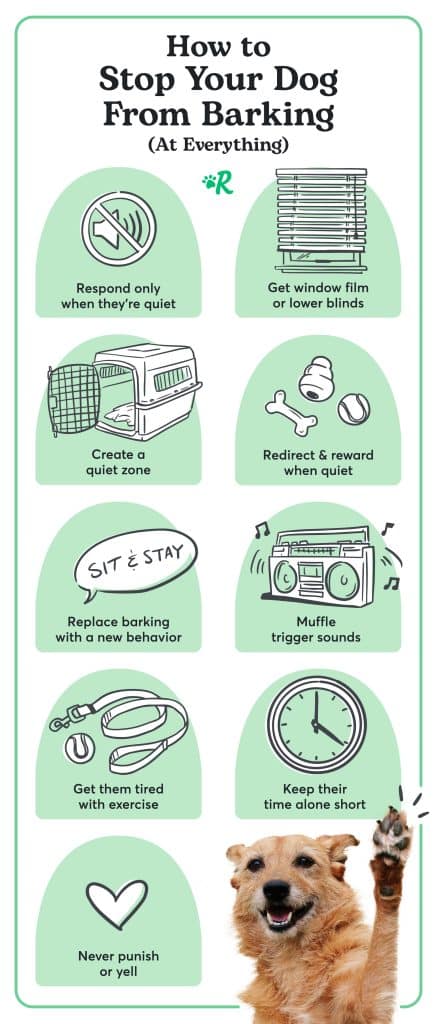
What Not to Do
Some popular barking solutions can increase fear, stress, or aggression. They may also damage trust between you and your dog.
Avoid:
• Yelling “quiet” repeatedly
• Hitting, shaking, or using physical punishment
• Rubbing a dog’s nose in anything
• Using shock collars without expert guidance
• Leaving a bark collar on an unsupervised dog
• Punishing growling or other warning signals
• Making your dog face a trigger up close
Yelling often adds energy to the moment. A worried dog may hear your loud voice as proof that danger is real. Punishing a growl can also remove an important warning without removing the fear behind it.
The American Veterinary Society of Animal Behavior supports reward-based training and advises against aversive methods. Positive training is not permissive training. It still uses rules and limits, but it teaches the dog what to do instead of relying on pain or fear.
A common mistake is expecting a perfect result after one session. Barking is a habit, and habits change through repeated practice. Train for two to five minutes at a time, several times per day, rather than holding one long session.

Helpful Tools for Barking Problems
The right tool can make training easier, but no product replaces a behavior plan.
Useful options include:
• A front-clip harness for calmer walks
• A standard leash for safe distance control
• A baby gate for home management
• Window film to block visual triggers
• A treat pouch for quick rewards
• A mat or bed for settle training
• A food puzzle for quiet mental activity
• A camera to monitor barking when you are away
Use crates carefully. A crate can provide a safe resting space, but it should never become a place where a panicked dog is confined for long periods. Dogs with separation anxiety may injure themselves when confined.
Bark collars have limits. They may reduce sound without addressing fear, boredom, or loneliness. Some devices also react to other dogs’ barking, which can create confusion. Speak with a veterinarian or certified behavior professional before using any correction-based device.
For dogs who bark at passing people, a combination of window film, a mat, and high-value treats often works better than one gadget. Simple changes can be powerful when you use them consistently.

A Simple Seven-Day Training Plan
A short plan can help you begin without feeling overwhelmed. Adjust the pace to your dog. If your dog shows fear or cannot take treats, make the trigger easier.
Day 1: Observe
Record when barking happens. Do not try to fix every barking episode at once. Find the most common trigger.
Day 2: Change the Environment
Block window views, add background sound, and move your dog away from the front door. Prevent as much practice barking as possible.
Day 3: Teach Attention
Say your dog’s name once. When your dog looks at you, reward it. Practice in a quiet room first.
Day 4: Teach the Mat
Reward your dog for stepping onto a mat. Then reward lying down and staying there for short periods.
Day 5: Add a Mild Trigger
Use a low-level sound or distant sight. Reward calm behavior before barking begins.
Day 6: Practice the Quiet Cue
Reward brief pauses. Keep the session easy and end while your dog is successful.
Day 7: Review
Look for small changes. Your dog may still bark, but perhaps it recovers faster, looks at you sooner, or needs less help. These are real signs of progress.
Repeat the week as needed. Keep a record of what works. If the problem worsens, stop and seek professional help rather than increasing pressure.

When to Contact a Veterinarian or Behavior Expert
Professional help is wise when barking involves fear, aggression, injury, or severe distress. Contact your veterinarian if barking begins suddenly or comes with changes in appetite, sleep, movement, bathroom habits, or mood.
Seek help from a qualified behavior professional when:
• Your dog lunges, snaps, or bites
• Your dog panics when left alone
• Your dog cannot settle after a trigger is gone
• Barking lasts for hours
• Training makes the problem worse
• You feel unsafe or exhausted
• Neighbors are filing complaints
A veterinarian can check for health problems and discuss treatment when anxiety is severe. In some cases, medication can lower panic enough for training to work. Medication does not replace training, but it may help a distressed dog learn.
Look for professionals who use reward-based methods and have recognized education in animal behavior. Ask what tools they use, how they measure progress, and what happens if the first plan fails.
There are limits to home advice. A written guide cannot observe your dog’s body language, home setting, medical history, or exact trigger. Expert support is not a failure. It is often the fastest and kindest path forward.

How to Stop a Dog From Barking Constantly at Night
Night barking may come from outdoor sounds, loneliness, discomfort, fear, or an irregular routine. First, check that your dog has access to water, a comfortable sleeping area, and a chance to relieve itself.
Close blinds and use gentle background noise. Keep the sleeping area away from windows and doors if outside movement causes alerts. Before bedtime, offer a calm walk, a toilet break, and a quiet food puzzle.
Do not turn nighttime barking into playtime. Respond calmly and briefly. If your dog is safe and has no urgent need, wait for a pause before giving attention.
If barking begins after a move, schedule change, illness, or loss of another pet, stress may be involved. A veterinarian can help rule out pain and age-related confusion, especially in older dogs.

How to Stop a Dog From Barking When Home Alone
First, determine whether the barking happens only when your dog is alone. A camera can help. Avoid leaving a distressed dog alone for long periods while you work on the problem, because repeated panic can make the pattern stronger.
Start with very short absences. Step outside for a few seconds, return before barking begins, and reward calm behavior. Slowly add time. If barking starts after ten seconds, the next practice should be shorter, not longer.
Give your dog a safe activity, such as a stuffed food toy, before you leave. Keep departures and arrivals calm. Do not punish barking you discover later, because dogs do not connect delayed punishment with an earlier action.
Severe separation anxiety often needs a structured plan from a veterinarian or behavior professional. Do not use “cry it out” methods when a dog is panicking, trembling, drooling, or trying to escape.

Frequently Asked Questions About How to Stop a Dog From Barking Constantly
How long does it take to stop a dog from barking constantly?
Some dogs show improvement within days when you remove triggers and reward calm behavior. Fear, separation anxiety, and long-standing habits may take several weeks or months.
Should I ignore my dog when it barks?
Ignore barking that seeks attention only when you know your dog is safe and its needs are met. Do not ignore possible pain, fear, separation distress, or an urgent need to go outside.
Do bark collars work?
Bark collars may reduce noise, but they do not always solve the reason for barking. Some can increase fear or stress, so reward-based training and professional advice are safer first choices.
Why does my dog bark at everything outside?
Your dog may be alerting, guarding territory, feeling afraid, or reacting to movement. Block the view, increase distance, and reward your dog for noticing outdoor activity without barking.
Can exercise stop constant barking?
Exercise can help when boredom or excess energy is part of the problem. It may not solve pain, fear, territorial behavior, or separation anxiety by itself.
Should I teach my dog to speak before teaching quiet?
Teaching “speak” is not required. If you do teach it, pair it with a strong alternative behavior, such as looking at you or going to a mat, and reward quiet pauses.
Is constant barking a sign of anxiety?
It can be, especially when barking comes with pacing, trembling, drooling, destruction, escape attempts, or distress when alone. A veterinarian or qualified behavior professional can help identify anxiety.
Conclusion
To stop a dog from barking constantly, first find the cause. Then reduce triggers, meet daily needs, reward quiet choices, and teach a useful alternative such as going to a mat or looking at you. Avoid yelling and punishment, which can increase fear and make barking harder to change.
Progress often arrives in small steps: one less bark, a faster recovery, or a calm glance in your direction. Start today with a barking diary and one short reward-based session. If your dog is fearful, aggressive, suddenly different, or distressed when alone, contact your veterinarian or a qualified behavior professional for support.

Pet Care Writer & Researcher
Daniel writes practical guides on daily care, feeding, and safety, turning complex topics into simple, actionable advice.