Do Dogs Communicate With Each Other Through Barking: Why?
Do dogs communicate with each other through barking? Learn what different barks mean and how dogs use sound, tone, and body language to connect.
Yes, dogs communicate through barking, but each bark also depends on tone, rhythm, and context.
If you have watched two dogs meet, you have likely noticed that barking is rarely random. A dog may bark to greet, warn, invite play, show fear, or ask for space. Understanding whether do dogs communicate with each other through barking requires looking at the whole message, including body language, distance, facial expression, and the situation. This guide explains how canine communication works and how you can read it more accurately.
How Do Dogs Communicate With Each Other Through Barking?
Yes, dogs communicate with each other through barking. However, barking is only one part of a much larger canine language system. Dogs also use growls, whines, yelps, body posture, scent, eye contact, and movement.
A bark does not have one fixed meaning. The same dog may use a sharp bark to warn another dog but use a softer, repeated bark during play. Dogs learn to read small changes in pitch, speed, volume, and rhythm.
Think of barking as a word that changes meaning based on tone. A short, high bark may mean, “Look over here.” A deep, repeated bark may mean, “Stay away.” The body gives the rest of the sentence.
Dogs often communicate through barking in these ways:
• Alerting another dog to a person, animal, or sound
• Asking for attention or interaction
• Showing excitement during play
• Warning another dog to keep distance
• Expressing fear, stress, frustration, or pain
• Calling to a dog that is out of sight
• Responding to another dog’s bark
Barking can also spread through a group. One dog starts barking, and nearby dogs join in without knowing the original cause. This response may help dogs share information across distance, much like a neighborhood alarm.
:max_bytes(150000):strip_icc()/heres-what-your-dog-is-trying-to-tell-you-3-92b9d839b7044908b5cd4e95092afdcb.png)
What Different Types of Dog Barks Mean
To understand do dogs communicate with each other through barking, it helps to study the sound and the setting together. Experts in animal behavior often assess bark type, pitch, timing, and the dog’s physical state.
Alert barking
Alert barking is often loud, quick, and repeated. A dog may use it when a stranger approaches, a gate opens, or another animal enters its view.
The dog may stand tall, lean forward, raise its ears, and stare at the trigger. This bark often tells other dogs, “Something has changed.”
Warning barking
Warning barking tends to sound deeper and more serious. It may occur with a stiff body, hard stare, raised hackles, or a low growl.
A warning does not always mean the dog will attack. In many cases, it is a request for more distance. The dog is saying, “I am uncomfortable. Please back off.”
Play barking
Play barking often sounds higher and less steady. Dogs may bark while bowing, running in curves, bouncing, or taking turns chasing each other.
A play bow is a useful clue. The dog lowers its front legs while keeping its rear end up. This posture often means, “This is play, not a real threat.”
Fear or stress barking
Fear barking may be sharp, rapid, or mixed with whining. The dog may move backward, tuck its tail, lower its body, lick its lips, or avoid eye contact.
This kind of barking can look aggressive to people, but the dog may be trying to create space rather than start a fight. Forcing a fearful dog closer to another dog can make the fear worse.
Frustration barking
A frustrated dog may bark at another dog it cannot reach. A fence, leash, window, or barrier can create this problem.
The dog may pull forward, jump, pace, or bark in a steady pattern. Frustration barking does not always mean the dog dislikes the other dog. It may simply want access and lack the skills to handle the barrier calmly.
Greeting barking
Some dogs bark when they see a familiar dog. The sound may be short and excited, with a loose body and wagging tail.
Still, a wagging tail alone does not prove that a dog feels friendly. Tail speed, height, body movement, and facial tension all matter.
Does Barking Have a Universal Meaning Among Dogs?
Dogs communicate through barking, but barking does not work like a universal human language. There is no simple dictionary in which one bark always means one exact thing.
Dogs recognize patterns. They may learn the usual sounds of a familiar dog, but they also use context. A bark from behind a fence can sound different from a bark during a relaxed greeting.
Research on canine vocal behavior suggests that dogs can notice differences in emotional tone. They may respond differently to a high-pitched, excited bark than to a low, harsh bark. Yet researchers cannot translate every bark with complete certainty.
Several factors change the meaning of a bark:
• The dog’s age, breed, and personality
• The dog’s past experiences
• The distance between the dogs
• Whether the dog is loose, leashed, or behind a barrier
• The presence of food, toys, people, or territory
• The dog’s posture and facial expression
• The number and speed of the barks
For example, a terrier may bark often because selective breeding encouraged vocal work. A quiet hound may use fewer barks but rely more on scent and body signals. Breed can shape behavior, but it never tells the whole story.
:max_bytes(150000):strip_icc()/how-do-dogs-communicate-with-each-other-1103009684-ffc441dbf43e4410b8b9ade0e4777dc6.png)
How Dogs Use Body Language With Barking
When asking do dogs communicate with each other through barking, never study the sound alone. Body language acts like punctuation. It can confirm the message or change it completely.
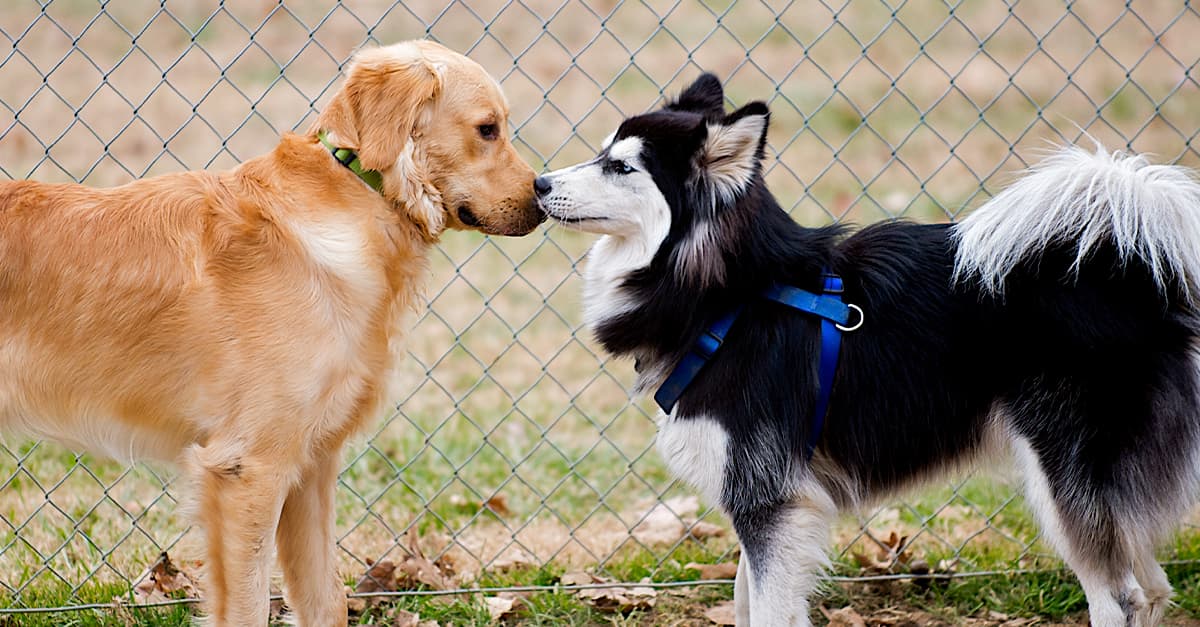
A dog with a loose body, open mouth, curved movement, and play bow may be inviting interaction. A dog with a stiff body, closed mouth, fixed stare, and forward weight may be warning another dog.
Watch for these signals:
• Loose muscles often suggest comfort
• A stiff body may show tension or a threat
• A tucked tail can signal fear or uncertainty
• A high, rigid tail may show arousal or confidence
• Lip licking and yawning may show stress
• Turning away may be an attempt to avoid conflict
• A lowered body may show fear or submission
• Quick, relaxed movements often appear during play
• Slow, direct movement can increase social pressure
Dogs also communicate through scent. They gather information from urine, feces, skin odor, and the scent glands around the body. Scent can tell a dog about another animal’s identity, health, sex, and emotional state.
This is why interrupting every sniff during a walk may remove a valuable form of social information. Safe sniffing helps dogs understand their surroundings.
Why Dogs Bark at Other Dogs
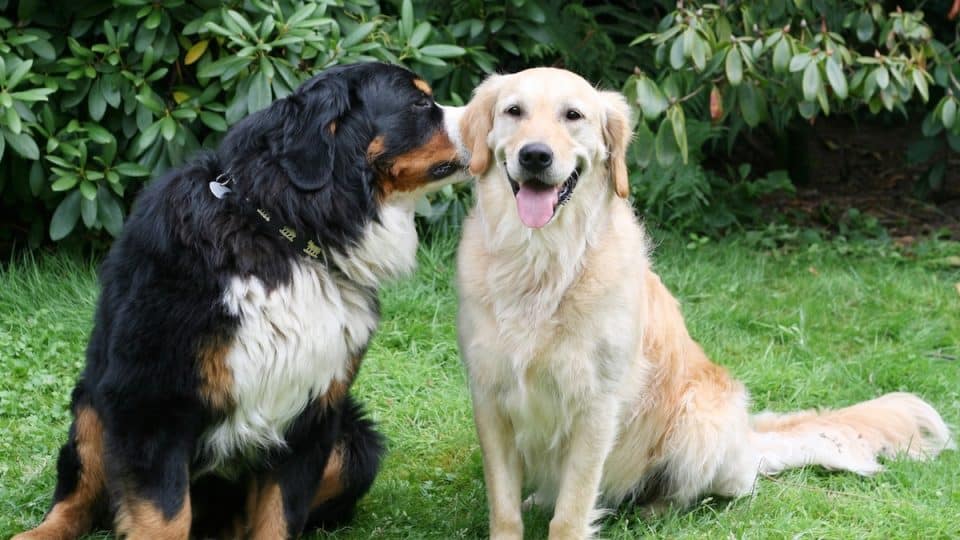
Dogs communicate through barking for many reasons, and the cause matters more than the noise itself. Two dogs may bark at each other because they are excited, worried, protective, or frustrated.
Common causes include:
Social excitement
Some dogs bark because they want to greet or play. Their barking may increase when they see a favorite dog at the park.
Territorial behavior
A dog may bark when another dog enters its yard, hallway, home, or usual walking area. The dog may believe it must protect valuable space.
Fear and uncertainty
A dog that had poor social experiences may bark first to keep another dog away. This response can become a habit if barking makes the other dog leave.
Leash frustration
A leash prevents normal movement. A dog cannot choose to walk away or approach in a wide curve. This lack of control can lead to loud barking.
Learned behavior
If barking causes another dog to move away, the barking dog may learn that it works. Each successful attempt strengthens the habit.
Pain or illness
A sudden change in barking can signal discomfort. Joint pain, hearing loss, vision changes, or illness may affect how a dog responds to other animals.
A behavior change deserves attention, especially in an older dog. A veterinarian can check for medical causes before you treat the problem as simple disobedience.

Can Dogs Understand Each Other’s Barking?
Dogs can understand some information in another dog’s bark, but their understanding is not perfect. They may detect emotion, urgency, distance, and general intent.
A dog may recognize that another dog is scared without knowing why. It may hear alarm without seeing the person or animal that caused it. In this way, barking can act like a signal flare. It carries useful information but not every detail.
Dogs that live together often become skilled at reading each other. They learn one another’s normal sounds and notice small changes. A dog may respond when its housemate gives a specific bark for food, a door, or a strange noise.
Studies of dog vocalizations also show that pitch can matter. Higher sounds often occur with excitement, uncertainty, or distress. Lower sounds may appear during warnings or serious tension. These patterns are helpful clues, not strict rules.
Do dogs communicate with each other through barking in the same way people use words? No. Dogs rely less on exact vocabulary and more on emotional signals, body language, scent, and learned social patterns.

Do Dogs Bark to Talk Over Long Distances?
Yes, barking can help dogs communicate across distance. A dog may bark when another dog is outside its view or far down a street.
The sound carries farther than small body signals. This makes barking useful when trees, fences, darkness, or buildings block visual contact.
Long-distance barking may signal:
• Location
• Excitement
• Alarm
• A desire to join or find another dog
• A response to a nearby bark
However, distance communication has limits. A dog may hear a bark but misunderstand its cause. This can lead to group barking, especially in neighborhoods where dogs cannot see what started the noise.
Environmental conditions also affect sound. Wind, walls, traffic, and indoor spaces can change how a bark travels. A dog behind glass may sound more intense because the barrier changes the sound and increases frustration.

Is Barking Always Friendly Communication?
No. Dogs communicate through barking, but the message may be friendly, fearful, defensive, or aggressive. Barking alone cannot prove that a dog wants to interact.
Look at the dog’s overall behavior before allowing a greeting. A relaxed dog may approach in a curve, pause, sniff, and move away. A tense dog may rush forward, stare, freeze, or hold its tail rigidly.
Safe dog greetings usually include:
• Enough space for both dogs to move freely
• Loose leads when possible
• Short pauses instead of forced face-to-face contact
• Room for either dog to leave
• Supervision from calm adults
• No toys, food, or tight spaces that may cause conflict
Avoid pushing dogs together because they “need to say hello.” Social pressure can turn a mild concern into a defensive reaction. A polite walk past another dog is also a successful interaction.
A practical lesson from observing many dog encounters is simple: give dogs more space than you think they need. Early distance keeps arousal low and makes calm behavior easier.
How to Read Barking During a Dog Encounter
When dogs communicate through barking, use a step-by-step approach. This can help you avoid guessing from one sound.
-
Check the setting. Is the dog behind a fence, on a leash, in a home, or in an open area?
-
Watch the body. Look for loose movement, stiffness, lowered posture, tail position, and facial tension.
-
Listen to the bark. Notice pitch, volume, rhythm, and pauses.
-
Watch the other dog’s response. Does it approach, retreat, freeze, or bark back?
-
Look for recovery. Can the dog stop barking, sniff, eat a treat, or turn away?
-
Create space if needed. Distance is one of the safest tools for reducing tension.
A dog that can quickly recover may be excited but still able to cope. A dog that remains stiff, frantic, or unable to disengage needs more distance and careful training.
Do dogs communicate with each other through barking in ways humans can always read? No. When the signs conflict, choose caution. A qualified veterinary behaviorist or certified behavior consultant can help with serious fear, aggression, or chronic reactivity.
How to Reduce Problem Barking Safely
The goal is not to stop every bark. Barking is normal communication. The goal is to reduce unnecessary barking and help the dog feel safe and in control.
Try these steps:
• Identify the trigger. Record when, where, and why the barking happens.
• Increase distance. Move away before the dog reaches a frantic state.
• Reward calm looks. Give a small treat when the dog notices another dog and stays quiet.
• Teach a simple cue. “Look,” “this way,” or “find it” can redirect attention.
• Use visual barriers. Curtains, privacy film, or fencing can reduce window barking.
• Provide daily enrichment. Sniff walks, food puzzles, and short training sessions lower boredom.
• Avoid punishment. Yelling or shock-based methods can increase fear and may suppress warning signs.
• Practice in small steps. Start where the dog can notice another dog without losing control.
A common mistake is waiting until the dog is already barking hard. At that point, learning becomes difficult. Begin when the dog can still think, eat, and respond to you.
If barking appears suddenly, becomes extreme, or includes snapping and biting, seek professional help. A veterinarian should assess sudden behavior changes, while a qualified behavior professional can create a safe plan.
What Research Says About Canine Barking
Animal behavior research supports the idea that barking carries information, but it also warns against simple translations. Bark meaning depends on context, the individual dog, and the listener.
Scientists have found that dogs can respond to differences in vocal tone and may distinguish familiar from unfamiliar sounds. Research also shows that human listeners often make mistakes when they judge a dog’s emotional state from barking alone.
This limitation matters. People may label a bark as “aggressive” when the dog is fearful, or “friendly” when the dog is highly aroused. A professional assessment considers movement, history, environment, and risk.
Organizations such as the American Veterinary Medical Association and veterinary behavior specialists generally support reward-based training and careful management. These methods address the cause of barking instead of simply suppressing the sound.
The most accurate answer to do dogs communicate with each other through barking is therefore yes, with an important qualification: barking is meaningful, but it is not a complete language on its own.
Frequently Asked Questions About Do Dogs Communicate With Each Other Through Barking
Do dogs understand what another dog’s bark means?
Dogs can recognize useful information in another dog’s bark, such as excitement, fear, or alarm. They also use body language, scent, and the situation to interpret the message.
Can one dog’s barking cause other dogs to bark?
Yes. Dogs may bark in response to a nearby bark, even when they cannot see the original trigger. This group response is common in homes, shelters, apartment buildings, and neighborhoods.
Does barking mean a dog wants to fight?
Not always. Barking may show fear, play, frustration, territorial concern, or a need for distance, so you must read the dog’s posture and movement too.
Why does my dog bark at other dogs on walks?
Leash frustration, fear, excitement, past experiences, and limited social skills can all cause barking on walks. Increasing distance and rewarding calm behavior can help, but severe reactions may need professional support.
Do dogs communicate through barking more than body language?
Barking is important, but body language often gives clearer information about comfort and intent. Dogs combine vocal sounds with posture, facial signals, movement, and scent.
Should I stop my dog from barking at other dogs?
You should manage excessive or unsafe barking, but do not punish every bark. First identify the cause, then teach an alternative behavior with distance, rewards, and gradual practice.
Conclusion
Do dogs communicate with each other through barking? Yes, but barking is only one piece of canine communication. Dogs combine sound with body language, scent, movement, and context to share warnings, invitations, emotions, and requests for space.
Listen to the bark, but always watch the whole dog. Give dogs room, avoid forced greetings, reward calm behavior, and seek expert help when fear or aggression is involved. With careful observation, you can better understand what your dog is saying and help it communicate more safely. Share your dog’s most unusual barking pattern or explore more evidence-based dog behavior guides to keep learning.

Pet Care Writer & Researcher
Daniel writes practical guides on daily care, feeding, and safety, turning complex topics into simple, actionable advice.