How To Understand Dog Barks: Decode Every Woof
Learn how to understand dog barks by recognizing pitch, rhythm, and body language. Decode what your dog means and respond with confidence.
A dog’s bark can mean many things. In the United States, dogs bark to greet people, warn of change, ask for help, show fear, release energy, or respond to other dogs. The best way to understand a bark is to listen to the sound and watch the dog’s body, surroundings, and behavior before and after the bark.
There is no universal “dog bark dictionary.” A short bark at the front door may mean “Someone is here,” while the same bark at a dog park may mean “Come play.” Context gives the sound its meaning.
This guide explains how to read common dog barks, spot stress, avoid common mistakes, and respond in a safe and useful way.
What Does a Dog’s Bark Mean?
A dog’s bark usually communicates one of five broad messages:
- Alert: “I noticed something.”
- Distance-increasing: “Stay away.”
- Attention-seeking: “Look at me or help me.”
- Excitement: “Something is about to happen.”
- Social communication: “I want to interact.”
These groups overlap. A dog may bark at a delivery driver because the driver is unfamiliar, because the dog feels protective, or because the sound of the door creates excitement.
Research supports the idea that people can hear differences in dog barks, but people do not always interpret them correctly. A study published in Animal Cognition found that bark meaning changes with the situation and the dog’s emotional state. The sound matters, but the setting matters just as much.
A bark is not the same as aggression
Barking alone does not prove that a dog is aggressive. A scared dog may bark to make a person or animal move away. A friendly dog may bark during play. A dog that feels trapped may bark because it wants more space.
Look for the full pattern:
- Loose body, soft eyes, relaxed mouth: often friendly or playful.
- Stiff body, hard stare, weight shifted forward: possible threat or high arousal.
- Crouched body, tucked tail, ears back: fear or discomfort.
- Pacing, panting, lip licking, yawning, or turning away: stress may be present.
- Barking followed by retreat: the dog may want distance rather than contact.
A bark tells you that the dog is activated. Body language helps explain why.
How to Read a Dog Bark Step by Step
Use the same short process each time. First, identify what changed. Then study the dog’s body. Finally, watch what happens after the bark.
1. Identify the trigger
Ask what happened just before the barking began:
- Did someone knock or enter?
- Did the dog see another dog?
- Did you pick up a leash, food bowl, or toy?
- Did the dog wake from sleep?
- Did the dog hear a noise outside?
- Did the dog lose access to a person, room, or object?
- Did the dog start barking when left alone?
The trigger often provides the clearest clue.
2. Listen to the sound
Notice the bark’s pitch, length, rhythm, and number of repetitions.
A single sound means less than a repeated pattern. For example, one sharp bark may signal surprise. A steady series of sharp barks may signal alertness or frustration.
3. Watch the body
Check the dog from nose to tail:
- Is the body loose or stiff?
- Is the tail moving freely, held high, tucked, or still?
- Are the ears forward, sideways, or pinned back?
- Is the mouth open and relaxed, or tightly closed?
- Does the dog move toward the trigger, away from it, or back and forth?
- Can the dog respond to its name or take a treat?
A dog that cannot eat or respond may be too stressed to learn in that moment.
4. Check the result
What does the dog gain after barking?
- A person looks at the dog.
- The door opens.
- The owner gives food.
- Another dog moves away.
- The dog gets released from a crate.
- The owner throws a toy.
- The dog is allowed outside.
If barking repeatedly produces a result, the behavior may become stronger. This is learning, not spite.
5. Look for a pattern
Keep a simple record for several days:
| Situation | Bark pattern | Body language | What happened next |
|---|---|---|---|
| Person at the door | Fast, repeated barks | Stiff, forward | Person entered |
| Owner prepares dinner | Short, repeated barks | Loose, pacing | Food arrived |
| Left alone | Long bursts with pauses | Pacing, whining | Owner returned |
| Dog across the street | Deep barks | Leaning forward or barking behind owner | Dog passed |
Patterns are more reliable than one isolated event.
Common Dog Bark Sounds and Their Likely Meanings
The following categories can help you form a reasonable first guess. They are not fixed rules. Always confirm the sound with context and body language.
Short, sharp barks
One or two sharp barks often show surprise, alertness, or a request for attention.
Examples include:
- A noise outside
- A person entering the room
- A dropped object
- A sudden movement
If the dog looks toward the sound and then relaxes, the bark may simply mean, “I noticed that.”
Repeated, fast barks
Fast, repeated barking often means the dog is highly alert or excited. The cause may be a person at the door, another dog, a squirrel, or a desired activity.
A dog with a loose body may be excited. A dog with a stiff body may feel threatened or defensive.
Do not focus only on how loud the dog is. A loud bark can reflect a small dog’s voice, a close trigger, or high arousal. Volume alone does not reveal intent.
Deep, slower barks
A low bark can occur when a dog wants something to stay away. It may also appear during territorial behavior or serious alerting.
Look for signs such as:
- Stiff legs
- A closed mouth between barks
- Direct staring
- Raised hackles
- Forward weight shift
- Growling or snarling
These signs call for space and careful management. Do not move closer to “test” the dog.
High-pitched barks
A high bark may reflect excitement, frustration, fear, or a request for help. Some dogs naturally have higher voices, so pitch must be compared with that individual dog’s normal sound.
High-pitched barking during play may come with play bows, loose movement, and quick pauses. High-pitched barking with crouching, hiding, or escape attempts may signal fear.
Barking with whining
Barking mixed with whining often points to conflict or distress. The dog may want something but feel unable to reach it.
Common examples include:
- Wanting to greet a person but being behind a gate
- Wanting to leave a crate
- Seeing another dog while on leash
- Waiting for food
- Being separated from an owner
The solution depends on the cause. Giving attention during every burst can maintain attention barking, but ignoring genuine distress can make the problem worse.
Barking during play
Play barking is often intermittent. The dog may bark, pause, bow, run, and return. A playful dog usually has a flexible body and can switch activities.
Play can become too intense. Stop or lower the energy if one dog tries to escape, hides, freezes, repeatedly turns away, or cannot pause.
Barking at people or dogs
Barking at a person or dog may come from fear, excitement, frustration, guarding, or a desire to interact.
Distance is a major clue. If barking stops when the trigger moves farther away, the dog may be over its comfort limit. If barking grows as the trigger approaches and the dog becomes stiff, treat the situation as a safety concern.
Barking at night
Night barking can happen because of outdoor sounds, wildlife, changes in the home, boredom, fear, or discomfort. In older dogs, new nighttime vocalizing may relate to pain, sensory loss, or canine cognitive decline.
A new pattern deserves attention, especially if it comes with confusion, restlessness, house-soiling, changes in appetite, or altered sleep.
Dog Barking by Situation
The same bark can mean different things in different settings. The situation is often more useful than pitch alone.
At the front door
Door barking commonly combines alerting and excitement. A dog may hear a vehicle, footsteps, or a knock before anyone enters.
Helpful steps:
- Keep the dog behind a gate or on a leash before opening the door.
- Teach a “go to mat” or “place” cue when the home is calm.
- Reward quiet pauses and calm body language.
- Ask visitors to avoid staring at or reaching for the dog.
- Give the dog a safe room if visitors cause fear.
Do not punish the dog after the visitor arrives. The dog may connect the punishment with the visitor and become more worried.
In the yard
Yard barking may be triggered by people, dogs, vehicles, wildlife, or sounds. A fence can increase frustration because the dog can see a trigger but cannot approach or leave.
Supervise outdoor time. Reduce visual access with privacy screening when appropriate, bring the dog inside during busy periods, and reward the dog for turning away from triggers.
A dog left outside for long periods may practice the same barking pattern again and again. Rehearsal can make the habit harder to change.
On walks
Leash barking often comes from fear, excitement, or frustration. The leash limits normal movement and may prevent a dog from approaching or moving away.
When you see a trigger:
- Create more distance early.
- Cross the street or turn around.
- Keep the leash steady but not tight.
- Offer small treats if the dog can eat and respond.
- End the interaction before the dog loses control.
Do not force a dog to greet another dog. Calm passing is a useful goal.
When left alone
Barking that begins soon after departure may be linked to separation-related distress. It may occur with pacing, destruction near doors or windows, escape attempts, drooling, house-soiling, or repeated vocalizing.
This is different from ordinary boredom. A camera can help show what happens after you leave, but avoid using it to diagnose the cause by itself.
A veterinarian or qualified behavior professional can help create a gradual departure plan. Do not use long absences as a test if the dog is panicking.
Around food or toys
Barking near food or toys may show excitement, frustration, or guarding. If the dog stiffens, freezes, growls, lifts its lip, or snaps when someone approaches, give the dog space.
Do not take food or toys away to “prove who is in charge.” That can increase conflict. Use management and professional guidance for resource guarding.
How to Tell Fear Barking From Excitement Barking
Fear and excitement can sound similar because both raise a dog’s energy. Body language and movement help separate them.
| Sign | More consistent with fear | More consistent with excitement |
|---|---|---|
| Body | Crouched, tense, or trying to hide | Loose, wiggly, or bouncing |
| Tail | Tucked or held low | Moving freely or held high |
| Ears | Pinned back or flattened | Forward or changing position |
| Movement | Retreating, freezing, or circling away | Moving toward the event |
| Mouth | Tight, lip licking, yawning | Open and relaxed |
| Food | Often refuses treats | May take treats quickly |
| Recovery | Takes a long time to settle | Settles when the event ends |
These are clues, not a diagnosis. Some dogs show mixed signals. A dog may rush forward while barking because fear and frustration are driving the same behavior.
If you are unsure, assume the dog needs more space. Distance is usually safer than closer inspection.
How to Respond to a Barking Dog
Your response should address the cause, not just silence the sound.
If the dog is alerting
Check the trigger, then calmly guide the dog away. Reward quiet behavior after the dog notices the event.
A practical sequence is:
- Acknowledge the bark with a calm cue.
- Move the dog away from the window or door.
- Ask for an easy behavior, such as looking at you.
- Reward the quiet pause.
- Reduce the trigger when possible.
This teaches the dog what to do next.
If the dog wants attention
Avoid giving the exact reward during barking when safety allows. Wait for a brief pause, then provide attention or ask for a calm behavior.
The pause may be only one second at first. Reward small improvements, then gradually expect longer quiet periods.
Do not withhold water, bathroom access, medical care, or help when those are genuine needs.
If the dog is fearful
Increase distance and remove pressure. Do not force contact, corner the dog, yell, or use a shock collar.
Pair the trigger with something positive at a distance where the dog can remain calm. This process is called desensitization and counterconditioning. It works best when progress is gradual.
If the dog is frustrated
Change the setup. Use more space, visual barriers, shorter sessions, and rewards for calm behavior. Teach an alternative action, such as turning toward you or walking to a mat.
A dog cannot learn well while barking continuously. Lower the intensity first.
If the dog may be in pain or distress
Arrange a veterinary examination when barking is sudden, unusual, or paired with other changes. Possible concerns include pain, illness, hearing loss, vision changes, anxiety, or age-related cognitive changes.
Seek urgent help for breathing trouble, collapse, severe pain, repeated vomiting, poisoning concerns, or signs of immediate danger.
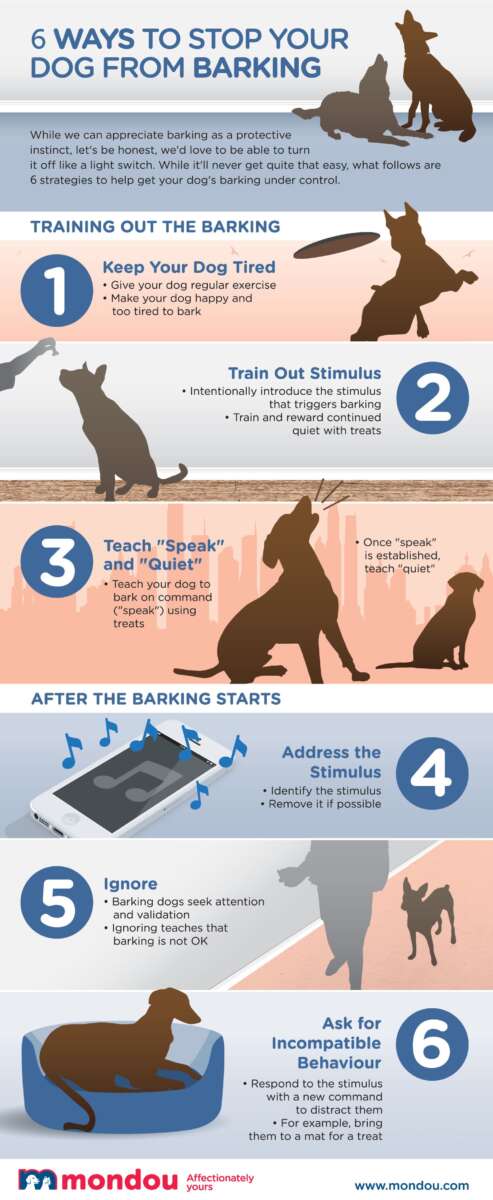
How to Reduce Problem Barking Without Punishment
The most effective plan combines management, training, and cause-based care.
Manage the trigger
Management prevents the dog from practicing the behavior while training takes place.
Options may include:
- Closing blinds
- Moving furniture away from windows
- Using a baby gate
- Playing steady background sound
- Changing walk times
- Using a quieter route
- Bringing the dog inside from the yard
- Providing a safe resting area
Management is not failure. It is part of behavior treatment.
Reward the behavior you want
Reinforce quiet observation, eye contact, turning away, settling on a mat, and calm walking.
Reward early. Waiting until the dog has barked for several minutes makes learning harder.
Teach a replacement behavior
Useful behaviors include:
- “Look at me”
- “Come”
- “Touch”
- “Find it”
- “Place”
- “Leave it”
- Calm leash walking
Practice these behaviors without the trigger first. Then add mild distractions and slowly increase difficulty.
Avoid punishment-based shortcuts
Yelling can sound like barking to the dog. Punishment may also increase fear or arousal. Aversive tools can suppress sound without fixing the emotion behind it.
The American Veterinary Society of Animal Behavior recommends reward-based training and advises against methods that rely on pain, fear, or intimidation. Read its position statement on humane dog training.
Track improvement correctly
Success does not always mean complete silence. Better signs include:
- Fewer bark bursts
- Lower intensity
- Faster recovery
- More response to cues
- Greater distance from triggers
- Less need for management
A dog that notices a trigger, looks at you, and settles within seconds is making progress even if one bark still occurs.
When to Contact a Veterinarian or Behavior Professional
Contact your veterinarian if barking is new, suddenly worse, or linked to changes in sleep, appetite, movement, house habits, or mood. Medical problems can change behavior.
Ask for professional help when the dog:
- Lunges, snaps, or bites
- Guards food, toys, rooms, or people
- Panics when alone
- Tries to escape
- Cannot settle after the trigger is gone
- Shows repeated fear in normal settings
- Has injured itself or another animal
A veterinary behaviorist is a veterinarian with advanced training in behavior medicine. A certified applied animal behaviorist or a qualified reward-based trainer may also help, depending on the problem. The American College of Veterinary Behaviorists and IAABC provide professional directories.
No directory listing alone guarantees a good fit. Ask what methods the professional uses, what risks they see, and how they will measure progress.
Common Mistakes When Interpreting Dog Barks
Mistake 1: Treating every bark as aggression
Barking may signal fear, play, excitement, or frustration. Labeling every bark as aggression can lead to unsafe or overly harsh responses.
Mistake 2: Reading the sound without reading the body
Pitch and volume help, but they do not tell the full story. A deep bark is not automatically dangerous, and a high bark is not automatically friendly.
Mistake 3: Approaching a barking dog
Do not approach an unfamiliar dog that is barking, stiff, cornered, or restrained. Give the dog space and ask the handler before making contact.
Mistake 4: Rewarding barking by accident
If barking reliably opens the door, starts play, or produces food, the dog may repeat it. Build a short calm behavior into the routine.
Mistake 5: Waiting too long to get help
Long-term barking can strain the dog, household, and neighbors. Early support is often easier than trying to change a behavior that has been practiced for months.
Mistake 6: Ignoring local rules
Noise laws differ across cities, counties, apartment communities, and homeowners associations in the United States. If barking creates a dispute, review the local rule and focus on humane behavior management. Legal requirements vary by location.
Frequently Asked Questions About Dog Barks
Can dogs understand human words while barking?
Dogs can learn words and cues, but barking usually reflects an emotional state or immediate goal. A dog may understand “quiet,” yet still be unable to respond when highly fearful or excited. Train the cue in calm settings before using it around strong triggers.
Why does my dog bark at nothing?
Your dog may hear, smell, or notice something you cannot detect. Other possibilities include attention seeking, anxiety, pain, sensory changes, or age-related confusion. If the behavior is new or frequent, schedule a veterinary check.
Why does my dog bark at me?
Your dog may want food, play, access, attention, help, or a change in the environment. Look at what happens after the bark. If the bark consistently produces a reward, it may have become a learned request.
Should I ignore my dog’s barking?
Ignore attention barking only when the dog is safe and the need is not urgent. Reward a quiet pause instead. Do not ignore signs of pain, panic, separation distress, illness, or danger.
Do bark collars solve barking?
Bark collars may reduce sound in some situations, but they do not identify or treat the reason for barking. Punishment-based devices can increase fear and may worsen behavior. Start with management, reward-based training, and veterinary or behavior support when needed.
Key Takeaways
- Understand a bark by combining sound, body language, trigger, and outcome.
- A bark does not automatically mean aggression.
- Short barks often signal alertness, while repeated barks may reflect excitement, frustration, or distress.
- Give fearful or stiff dogs more space.
- Reward calm behavior and teach a replacement action.
- Manage windows, doors, yards, and walks to reduce repeated rehearsal.
- Seek veterinary help for sudden changes or possible pain.
- Get qualified behavior support for aggression, panic, guarding, or escape attempts.
Conclusion
Learning how to understand dog barks takes observation rather than guesswork. Listen to the bark, but treat the dog’s body and the surrounding event as equally important.
When you find the trigger, give the dog enough space, and reward a calm alternative, barking becomes easier to interpret and manage. Start by tracking one common barking event for a few days. That simple record can reveal what your dog is trying to say—and what support it needs next.

Pet Care Writer & Researcher
Daniel writes practical guides on daily care, feeding, and safety, turning complex topics into simple, actionable advice.