Large Breed Vs Regular Dog Food: Key Differences
What is the difference between large breed and regular dog food? Learn about nutrition, calories, joint support, and choosing the right formula.
In the United States, large-breed dog food is made to support the different growth, calorie, and joint needs of bigger dogs. “Regular” dog food usually means a standard formula for adult dogs or puppies that do not need large-breed nutrition.
The biggest difference matters during puppyhood. Large-breed puppies grow quickly, but their bones and joints need controlled growth. A food that is too rich in calories, calcium, or certain minerals may increase the risk of abnormal bone development. Large-breed adult food may also have fewer calories per cup and larger kibble, but the differences vary by brand.
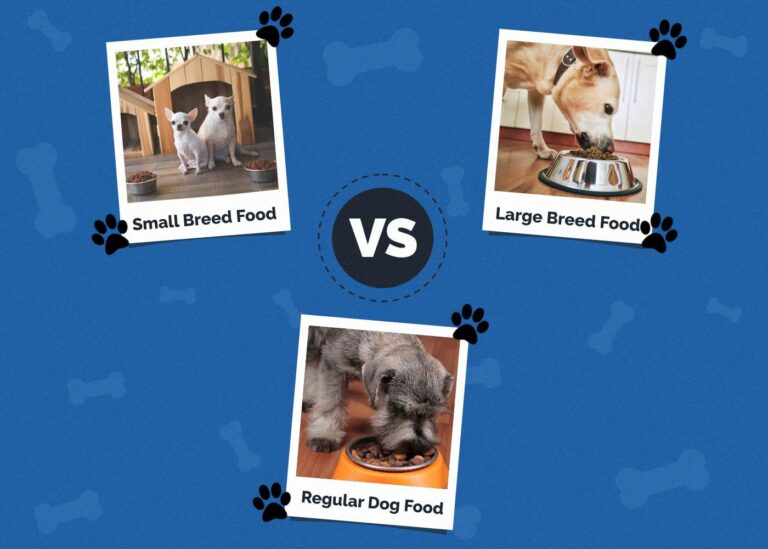
Large-breed dog food vs. regular dog food at a glance
Large-breed food is not simply “stronger” or “better” dog food. It is a formula designed around a dog’s expected adult size, life stage, and energy needs.
| Feature | Large-breed dog food | Regular dog food |
|---|---|---|
| Main purpose | Supports dogs expected to reach a large adult size | Supports dogs within a general size range |
| Most important use | Large-breed puppies and some large adult dogs | Small, medium, or general adult dogs and puppies |
| Calories | Often controlled to help prevent rapid weight gain | May be more calorie-dense, depending on the formula |
| Calcium and phosphorus | More carefully controlled in puppy formulas | May not be designed for large-breed growth |
| Kibble size | Often larger, but not always | Usually standard-sized |
| Feeding goal | Slow, steady growth and healthy body weight | Complete nutrition for the listed life stage |
| Label wording | May say “large breed,” “growth of large-size dogs,” or similar | May list “growth,” “adult maintenance,” or “all life stages” |
The label matters more than the front of the bag. In the United States, the nutritional adequacy statement is the best starting point. Look for wording that says the food is complete and balanced for the dog’s life stage and, for a large puppy, specifically supports growth of large-size dogs.
What counts as a large-breed dog?
There is no single worldwide rule for the term “large breed.” In U.S. nutrition guidance, a dog expected to weigh about 70 pounds or more as an adult is commonly treated as a large-size dog for growth nutrition.
This may include breeds such as:
- Great Danes
- Mastiffs
- Saint Bernards
- Newfoundlands
- Bernese Mountain Dogs
- German Shepherd Dogs
- Labrador Retrievers
- Golden Retrievers
- Rottweilers
Breed names alone do not settle the question. A mixed-breed puppy may need large-breed nutrition if its expected adult weight is around 70 pounds or more.
A 60-pound adult dog may still benefit from a formula made for large dogs, especially if the food has useful calorie control or a kibble size the dog prefers. However, the puppy-specific nutrient rules are most important for dogs expected to reach the large-size range.

Why large-breed puppies need different food
Large-breed puppies need steady growth, not the fastest possible growth. Their bones develop over a long period, and excess energy can make a puppy gain weight faster than its skeleton can safely support.
Large puppies are also sensitive to mistakes in mineral intake. Calcium and phosphorus help form bone, but more is not always better. A puppy food made for small or medium dogs may contain nutrient levels that are acceptable for those dogs but not suited to large-size growth.
The Association of American Feed Control Officials (AAFCO) provides nutrient profiles used on U.S. pet food labels. Its growth guidance includes special limits for puppies expected to weigh 70 pounds or more as adults. These limits help control calcium and other nutrients during a sensitive stage of development.
This does not mean large-breed food prevents every joint or bone problem. Genetics, body weight, exercise, injury, and overall health also matter. The practical goal is simple: feed a complete diet that supports slow, even growth while keeping the puppy lean.
Key nutrients to understand
Calories: Too many calories can cause fast weight gain. A large puppy should not be overfed just because it is growing.
Calcium: Large puppies need calcium, but excess calcium can disrupt normal bone development. Do not add calcium supplements unless a veterinarian directs you to do so.
Phosphorus: Phosphorus works with calcium in bone formation. The balance between these minerals matters more than focusing on one number alone.
Protein: Large puppies need adequate protein for muscle and tissue growth. High protein is not automatically harmful, but the whole diet must be balanced for growth.
Fat: Fat supplies concentrated energy. A very rich food can make portion control harder, especially for a puppy with a low activity level.
Omega-3 fatty acids: Some formulas contain fish oil or other sources of DHA and EPA. These fats may support normal brain, eye, and joint function, but they do not replace proper calorie control.
How large-breed adult food differs from regular adult food
The difference is usually less dramatic once a dog reaches adulthood. A healthy adult large dog can often eat any food that is complete and balanced for adult maintenance, provided the calories and portions fit its needs.
Large-breed adult formulas commonly focus on:
- Moderate calorie density
- Support for a lean body condition
- Larger kibble for some dogs
- Nutrients used in joint-support formulas
- Feeding instructions for heavier dogs
Some large-dog foods include glucosamine, chondroitin, fish oil, or added antioxidants. These ingredients may be useful in certain diets, but their presence does not prove that a food will prevent arthritis or repair damaged joints.
A standard adult formula may work well for a large dog if it meets the dog’s nutritional needs and helps maintain a healthy weight. The term “large breed” on the package is helpful, but it is not a guarantee of superior quality.

The label test: how to choose the right food
Use this order when comparing dog foods in a U.S. store.
1. Check the life stage
Choose food that matches the dog’s age:
- Puppy or growth: for dogs that are still developing
- Adult maintenance: for mature dogs
- All life stages: designed to meet requirements for growth and adulthood, but check whether it is suitable for large-size growth
For a large-breed puppy, look for an adequacy statement that specifically includes growth of large-size dogs. If the statement only says “for intermittent or supplemental feeding,” it is not a complete main diet.
2. Check the expected adult weight
Do not base the choice only on the puppy’s current weight. A four-month-old Great Dane may not look large yet, but its expected adult size determines which growth formula is appropriate.
Ask your veterinarian to estimate adult size when the puppy is a mixed breed or its parent sizes are unknown.
3. Compare calorie information
Calorie content is usually listed as kilocalories per cup, can, or kilogram. Two foods can have very different calorie levels even when their ingredient lists look similar.
A simple example:
- Food A: 400 kcal per cup
- Food B: 320 kcal per cup
If a dog needs 800 kcal per day, that equals:
- Food A: 2 cups per day
- Food B: 2.5 cups per day
This is only a hypothetical calculation. The actual amount depends on age, body condition, activity, health, and the food’s feeding guide.
4. Check the ingredient and nutrient information
Ingredients can help you understand the formula, but they do not tell the whole story. The guaranteed analysis, calorie statement, and adequacy statement are also important.
A named meat ingredient does not automatically make one food healthier. Likewise, the presence of grains does not make a food unsuitable. Judge the complete formula and the dog’s response to it.
5. Look at kibble size
Large kibble may slow down a dog that gulps food. It can also be easier for some large dogs to pick up and chew.
However, kibble size is not the same as nutritional quality. A large dog can eat standard kibble if it chews comfortably and does not have a medical or swallowing issue.

Can a large dog eat regular dog food?
Yes, in many cases. A healthy adult large dog can eat regular adult dog food when the food is complete and balanced for adult maintenance and provides the right number of calories.
The situation is different for puppies. Do not assume that a general puppy food is suitable for a puppy expected to weigh 70 pounds or more. Choose a food labeled for large-size growth or ask a veterinarian to review the product.
A large adult dog may need a different formula if it:
- Gains weight easily
- Has a very low activity level
- Has dental or swallowing problems
- Has a sensitive stomach
- Has a diagnosed joint, kidney, heart, or other health condition
- Needs a veterinary therapeutic diet
The dog’s body condition is a useful check. You should be able to feel the ribs under a thin layer of fat. From above, the dog should have a visible waist. If the ribs are hard to feel or the waist has disappeared, the dog may be getting too many calories.
Can a small or medium dog eat large-breed food?
Usually, an adult small or medium dog can eat a large-breed adult formula if the food is complete and balanced and the portions are correct. However, the larger kibble may be hard for a small dog to chew.
Large-breed puppy food is a different matter. It is made for the needs of large-size growth, not as a universal puppy food. A small puppy may not need the same nutrient limits or calorie pattern.
Always match the food to the dog’s life stage first. Then consider size, activity, health, and eating habits.

Common mistakes to avoid
Feeding for the dog’s current size
A large-breed puppy may start life at a small weight. Choose food based on expected adult size, not today’s scale reading.
Free-feeding a growing large puppy
Leaving food out all day can make calorie control difficult. Measured meals are usually easier to manage.
Adding calcium supplements
Complete commercial puppy foods already contain calcium. Extra calcium can create an unhealthy nutrient imbalance, especially in large-breed puppies.
Trusting the front of the package alone
Words such as “premium,” “natural,” or “with joint support” do not replace the adequacy statement and calorie information.
Changing food too quickly
Switch foods over about seven days unless a veterinarian gives different instructions. Start with a small amount of the new food and slowly increase it while reducing the old food.
Watch for vomiting, diarrhea, refusal to eat, or marked tiredness. Contact a veterinarian if signs are severe, last more than a short time, or affect a young puppy.
Ignoring weight gain
A puppy can be growing normally and still be too heavy. Ask your veterinarian to check body condition at routine visits.
When should you ask a veterinarian?
Ask a veterinarian before choosing a diet if your dog has a chronic illness, poor growth, repeated digestive problems, food allergies, or a history of bone or joint disease.
Professional advice is also useful when:
- The puppy’s adult size is uncertain
- The dog is gaining weight quickly
- The dog is underweight
- The dog has trouble chewing
- You are considering homemade food
- You want to add supplements
- The food label does not clearly state nutritional adequacy
For homemade diets, a veterinary nutrition specialist can help create a balanced recipe. General online recipes often lack key vitamins or minerals.

Frequently asked questions
Is large-breed dog food necessary?
It is most important for puppies expected to reach about 70 pounds or more as adults. For large adult dogs, it may offer useful calorie control or kibble size, but a standard complete adult food may also be suitable.
Is large-breed puppy food lower in protein?
Not necessarily. Large-breed puppy food is designed around balanced growth, calorie control, and mineral levels. Do not judge it by protein percentage alone.
What happens if a large-breed puppy eats regular puppy food?
One meal is unlikely to cause a problem. The concern is regular, long-term feeding of a formula that is not designed for large-size growth. Ask your veterinarian whether the food is appropriate and switch diets gradually if needed.
When can a large-breed puppy eat adult food?
Large dogs mature later than small dogs. Many remain on a puppy or growth formula until they are close to skeletal maturity, often around 18 to 24 months, but the right timing depends on the breed and individual dog. Follow advice from your veterinarian and the food maker.
Does large-breed food prevent hip dysplasia?
No food can guarantee prevention. Keeping a large dog lean, avoiding overfeeding, and providing appropriate exercise may support healthy development, but genetics and other factors also affect hip dysplasia.
Key takeaways
- Large-breed food is designed around size, life stage, calories, and nutrient balance.
- The distinction matters most for large-breed puppies.
- For a puppy expected to weigh about 70 pounds or more, look for a statement supporting growth of large-size dogs.
- Do not add calcium unless a veterinarian tells you to.
- Large adult dogs may eat standard adult food if it is complete, balanced, and portioned correctly.
- Use body condition, not the food label alone, to guide feeding amounts.
- When in doubt, ask a veterinarian to review the dog, expected adult size, and exact food label.
Conclusion
The difference between large-breed and regular dog food is mainly about controlled growth, calorie density, mineral balance, and feeding size. Large-breed puppy food deserves the most attention because fast weight gain and excess nutrients can place stress on developing bones.
For adult dogs, the choice is more flexible. Select a complete and balanced food that fits the dog’s life stage, energy needs, body condition, and health. The next practical step is to read the food’s nutritional adequacy statement, check calories per cup, and discuss the choice with your veterinarian if the dog is still growing or has a health concern.

Pet Care Writer & Researcher
Daniel writes practical guides on daily care, feeding, and safety, turning complex topics into simple, actionable advice.