What Size Dog Needs Large Breed Food: Find The Right Fit
Learn what size dog needs large breed food, plus weight guidelines and feeding tips to choose the right formula for your pet.
A dog usually needs large-breed food when its expected adult weight is about 50 pounds or more. However, the exact cutoff depends on the food maker. For large-breed puppy food, the more important guide is an expected adult weight of 70 pounds or more, because growing large dogs need tighter control of calcium, calories, and growth speed.
Do not choose food by weight alone. Also consider your dog’s age, body shape, activity, health, and expected adult size. A 55-pound adult dog may do well on a regular adult formula, while a 90-pound puppy often benefits from a diet made for large-breed growth.

Quick answer: What weight counts as a large-breed dog?
In the United States, there is no single legal weight cutoff that every pet food company must use for the words “large breed.” Most brands use one of these ranges:
| Dog’s expected adult weight | Usual food category |
|---|---|
| Under 20 pounds | Small breed |
| 20 to 50 pounds | Medium breed |
| About 50 pounds or more | Large breed |
| About 70 pounds or more | Giant breed or large-breed puppy category |
These ranges are general guides, not strict rules. One brand may define large breed as over 50 pounds. Another may start at 55 or 60 pounds.
For puppies, read the label more closely. The Association of American Feed Control Officials (AAFCO) recognizes a specific nutrient profile for growth of large-size dogs, generally covering dogs expected to weigh 70 pounds or more as adults. That category helps control mineral levels during rapid bone growth.
Best rule: Choose a large-breed puppy food if your puppy is expected to reach at least 70 pounds as an adult, unless your veterinarian gives different advice. For adult dogs, use the brand’s size guide and your dog’s body condition as the final checks.
How to tell whether your dog is a large breed
Your dog’s expected adult weight matters more than its current puppy weight. A four-month-old puppy may weigh 40 pounds but still have much more growth ahead.
Use these steps:
-
Identify the breed or likely breed mix.
A Great Dane, Labrador Retriever, German Shepherd, Rottweiler, Mastiff, and Saint Bernard are common large or giant breeds. Mixed-breed dogs can be harder to classify. -
Estimate adult size.
Ask your veterinarian, breeder, or rescue group for an estimate. Growth charts can help, but they are not exact. -
Check the food label.
Look for wording such as “large breed,” “large-size dogs,” or “for puppies expected to weigh over 70 pounds at maturity.” -
Assess body condition.
Your dog should have a visible waist when viewed from above. You should be able to feel the ribs with light pressure, but the ribs should not be sharply visible in a healthy adult dog. -
Ask your veterinarian if the estimate is unclear.
This is especially useful for mixed-breed puppies, dogs with poor growth, or dogs with joint or digestive problems.
A dog’s breed name can mislead you. For example, a small dog with a large-breed parent may not need large-breed food if its adult weight will remain below the label’s range.

Why large-breed dogs may need a different food
Large-breed food is designed to support a bigger body without supplying too much energy or certain minerals. The goal is not to make a dog grow as fast as possible. The goal is steady, controlled growth.
Controlled calories
Large puppies can gain weight quickly. Too many calories may make them grow faster than their bones and joints can safely support. Excess body weight also adds stress to developing hips, elbows, knees, and other joints.
Large-breed puppy foods often have a lower calorie density than some standard puppy foods. This lets owners feed enough volume for nutrients while reducing the risk of overfeeding calories.
Balanced calcium and phosphorus
Calcium and phosphorus help build bones, but more is not always better. Growing large-breed puppies may have difficulty regulating excess calcium. An unbalanced diet can affect normal skeletal development.
Large-breed puppy food should provide the right balance of these minerals and meet the AAFCO nutrient profile for growth of large-size dogs. Avoid adding calcium supplements unless a veterinarian specifically prescribes them.
Appropriate protein and fat
Large puppies still need high-quality protein and essential fat. The answer is not to severely restrict protein. Instead, the full diet should provide suitable amounts of protein, fat, calcium, phosphorus, and energy.
The nutrient profile matters more than a single ingredient. Meat listed first on the label does not prove that a food is complete or appropriate for large-breed growth.
Support for adult weight and joints
Large adult dogs place more force on their joints with every step. A complete diet, a lean body condition, regular exercise, and weight control all help reduce unnecessary strain.
Ingredients such as glucosamine or fish oil may appear in some diets. Their presence does not guarantee joint protection, and they do not replace veterinary care or a healthy body weight.

Large-breed puppy food versus adult large-breed food
The correct food depends first on life stage, then on body size.
For puppies
Choose a food labeled for:
- Growth
- Puppies
- All life stages that meet growth needs
- Growth of large-size dogs, when the adult weight will be at least 70 pounds
A food labeled only for adult maintenance is not the right main diet for a growing puppy. Puppies need different nutrient levels than adult dogs.
For adults
Choose a food labeled for:
- Adult maintenance
- Large-breed adult dogs, if your dog fits the brand’s size range
- All life stages, if it meets your veterinarian’s advice and your dog’s needs
A 75-pound adult dog does not always need a large-breed formula. Many healthy adult dogs can thrive on a complete and balanced adult diet that is not marketed by size.
Large-breed adult foods may offer larger kibble, adjusted calories, or nutrients aimed at joint and weight support. These features can be useful, but the label and your dog’s response matter more than the word “large.”

A simple size guide for common dogs
The table below gives general examples. Individual dogs can fall outside these ranges.
| Dog type | Typical adult weight | Likely food choice |
|---|---|---|
| Chihuahua | 2–6 pounds | Toy or small breed |
| Beagle | 20–30 pounds | Small or medium breed |
| Border Collie | 30–55 pounds | Medium or large, based on the brand |
| Labrador Retriever | 55–80 pounds | Large-breed adult food may fit |
| German Shepherd | 50–90 pounds | Large-breed food often fits |
| Great Dane | 110–175 pounds | Large or giant breed |
| Saint Bernard | 120–180 pounds | Large or giant breed |
| Mixed-breed puppy expected to reach 75 pounds | About 75 pounds | Large-breed puppy food |
These are not feeding prescriptions. A dog’s ideal portion depends on its calorie needs, activity, age, reproductive status, and body condition.
How to read the pet food label
The label can answer more than the front of the bag.
1. Find the nutritional adequacy statement
Look for a statement that says the food is complete and balanced for a specific life stage. For example, it may say the food is complete and balanced for:
- Growth
- Adult maintenance
- All life stages
- Growth of large-size dogs
For a large-breed puppy, the statement should support growth of large-size dogs. A regular puppy food may meet general puppy needs but still not be the best choice for a puppy expected to become very large.
2. Check the calorie content
The calorie statement is usually given as kilocalories per cup or can. Compare this with the feeding guide, but treat the guide as a starting point.
Two foods may have different calorie densities. Feeding the same cup amount of both foods could cause very different calorie intake.
3. Review the feeding directions
Start with the amount for your dog’s current weight and age. Then adjust based on body condition and weight change.
Do not increase food simply because your puppy seems hungry. Some puppies eat quickly and continue begging after they have had enough.
4. Check whether the product is for growth or maintenance
A large-breed adult food is not automatically suitable for a large-breed puppy. The life-stage statement must match the dog’s needs.
5. Look for feeding trials or nutrient formulation claims
AAFCO-related wording may state that the food meets nutrient profiles or passed feeding trials. These statements describe different types of support for nutritional adequacy. They do not prove that one product is ideal for every dog.
How much should a large-breed dog eat?
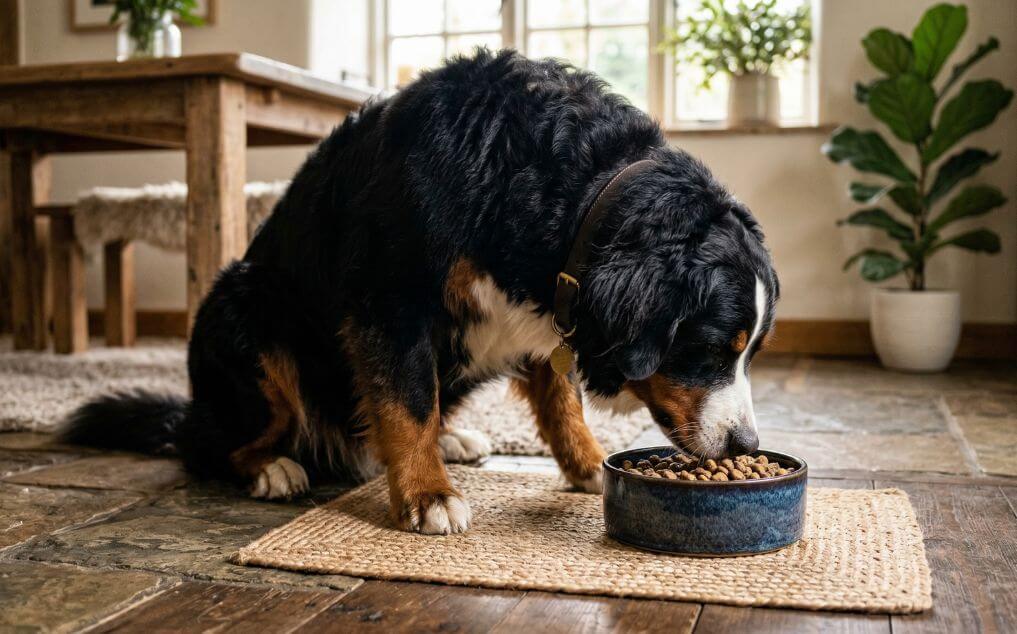
Feed based on calories and body condition, not cups alone.
For a hypothetical example, imagine two large adult foods:
- Food A: 350 calories per cup
- Food B: 450 calories per cup
If a dog needs 1,000 calories per day, it would need about:
- 2.9 cups of Food A
- 2.2 cups of Food B
The exact number is only an example. Your dog’s calorie needs may be higher or lower.
Adjust the portion when:
- Your dog gains or loses weight
- Activity changes
- Your dog is spayed or neutered
- Treats make up a large share of daily calories
- Your veterinarian changes the diet
- The dog reaches adulthood
Treats, chews, table scraps, and food used for training all add calories. Keep them within a reasonable share of the daily intake, and reduce the meal portion when needed.
What body condition should a large dog have?
A healthy dog should usually have:
- Ribs that are easy to feel under a thin layer of fat
- A visible waist from above
- An abdominal tuck when viewed from the side
- Muscle over the hips and shoulders
- No heavy fat pad over the ribs or base of the tail
A heavy dog may look “big boned,” but extra fat still increases joint load. Large dogs can have serious health risks from excess weight even when the weight gain seems modest.
If you cannot tell whether your dog is too thin or too heavy, ask your veterinarian to score its body condition. A hands-on check is more useful than relying on the scale alone.

Common mistakes when choosing large-breed food
Choosing by current weight instead of adult weight
A young dog’s current size does not tell you how large it will become. Use expected adult weight for puppy food decisions.
Feeding a large puppy to grow as fast as possible
Fast growth is not the same as healthy growth. Follow the food’s feeding guide and keep the puppy lean.
Adding calcium supplements
Complete commercial puppy foods already contain planned mineral levels. Extra calcium can upset that balance. Use supplements only under veterinary direction.
Comparing brands by ingredient order alone
Ingredient lists do not show the full nutrient profile or calorie density. Check the adequacy statement, calories, and feeding directions.
Changing food too quickly
A sudden change can cause vomiting, loose stool, or refusal to eat. Unless a veterinarian tells you to switch at once, change foods over about seven days by mixing increasing amounts of the new food with the old.
Assuming grain-free means better
Grain-free food is not automatically healthier for large dogs. Some dogs need a specific diet for a diagnosed allergy or medical condition, but food choices should follow veterinary advice rather than marketing claims.
Ignoring unusual growth or pain
Food cannot correct every growth or joint problem. Contact your veterinarian if a puppy has limping, pain, repeated digestive upset, poor weight gain, extreme thirst, or a major change in appetite.

When to ask a veterinarian before changing food
Speak with a veterinarian before changing your dog’s diet if your dog:
- Is a large-breed puppy with poor growth
- Is underweight or overweight
- Has repeated vomiting or diarrhea
- Has kidney, liver, heart, or digestive disease
- Has suspected food allergies
- Shows limping, stiffness, or pain
- Takes prescription medicine
- Is pregnant or nursing
- Has been told to follow a therapeutic diet
A veterinarian can estimate adult size, assess body condition, review the current food, and suggest a safe transition plan. Puppies with orthopedic concerns may need closer weight and growth checks.
Key takeaways
- Large adult dogs usually weigh about 50 pounds or more, but food brands set their own size ranges.
- Large-breed puppies are often those expected to weigh at least 70 pounds as adults.
- Choose puppy food that meets the nutritional needs of growth of large-size dogs.
- Control calories and keep growing dogs lean.
- Do not add calcium unless your veterinarian tells you to.
- Read the nutritional adequacy statement, calorie content, and feeding guide.
- Adjust portions based on body condition, not the bag’s suggested amount alone.
FAQs
Does a 50-pound dog need large-breed food?
Not always. Fifty pounds is a common starting point for large-breed labeling, but some brands use 55 or 60 pounds. Check the product’s size guide and choose a complete and balanced adult food that keeps your dog at a healthy body condition.
Does a 60-pound puppy need large-breed puppy food?
It depends on expected adult weight, not current weight. If the puppy is expected to reach 70 pounds or more, a food made for growth of large-size dogs is generally the safer category to discuss with your veterinarian.
Can a large dog eat regular dog food?
Yes, many healthy large adult dogs can eat a regular adult-maintenance food if it is complete and balanced and their weight stays healthy. Large-breed food may be useful when its calorie level, kibble size, or nutrient design fits the dog better.
Is large-breed food needed for mixed-breed dogs?
Use expected adult weight as the guide. A mixed-breed puppy likely to exceed 70 pounds should generally be considered for large-breed puppy food. If adult size is uncertain, your veterinarian can help estimate it.
When should a large-breed puppy switch to adult food?
Large dogs mature later than small dogs, so many switch between about 12 and 24 months, depending on breed and growth. Do not use age alone. Ask your veterinarian when growth is nearly complete and choose a food labeled for adult maintenance.
Conclusion: choose by adult size, life stage, and body condition
A dog generally fits the large-breed food category when its expected adult weight is around 50 pounds or more. For puppies, use the stricter guide: choose food formulated for large-size growth when the dog is expected to reach at least 70 pounds.
The best next step is to check your dog’s expected adult weight, read the food’s nutritional adequacy statement, and compare the calorie content with your dog’s body condition. If your dog is still growing, has health concerns, or falls near a size cutoff, ask a veterinarian before making the change.

Pet Care Writer & Researcher
Daniel writes practical guides on daily care, feeding, and safety, turning complex topics into simple, actionable advice.