
Best Bark Collar For Multiple Dogs: Top Safe Picks
Find the best bark collar for multiple dogs with safe, effective options for homes with two or more dogs. Compare features and choose confidently.
The best bark collar for multiple dogs combines safe bark detection, adjustable training modes, comfort, and reliable battery life.
If two or more dogs bark at the door, fence, squirrels, or one another, the noise can spread fast. A good bark collar can help break that cycle without shouting across the yard. I look for collars that detect the wearer’s bark, offer gentle settings first, fit several dog sizes, and keep working during normal outdoor play. For homes with multiple dogs, a two-pack or three-pack can also save money and keep training more consistent. Still, no collar replaces exercise, calm training, and a check for pain, fear, or separation stress.
FAFAFROG Smart Bark Collar

The FAFAFROG rechargeable collar is a simple choice for owners who want automatic bark control without carrying a remote. It uses five sensitivity levels, so I can start low and raise the setting only if needed. The collar combines beep and vibration training, which gives many dogs a clear warning without relying on harsh correction. Its design suits small, medium, and large dogs when the strap and contact points fit correctly.
This model makes sense for a home with several dogs when each dog needs an individual collar. I like the rechargeable design because I do not need to keep buying batteries for every unit. The bark sensor should still be tested on each dog, since a quiet dog and a deep-chested dog may need different settings. It is a practical, low-fuss entry point for the best bark collar for multiple dogs.
Pros:
- Five sensitivity levels allow more careful setup
- Beep and vibration modes support gentle training
- Rechargeable battery lowers long-term battery costs
- Works with a broad range of dog sizes
- Automatic operation needs no handheld remote
- Useful option when each dog needs a separate unit
Cons:
- The package provides one collar, so multi-dog homes need several units
- Automatic collars may react poorly if dogs bark close together
- Fit and sensor position need regular checking
My Recommendation
I recommend the FAFAFROG for owners who want a gentle, automatic collar for one dog or a matched set for several dogs. It is best for families that prefer beep and vibration before considering stronger training tools. The rechargeable battery and five sensitivity levels give it useful everyday value. For a multi-dog home, buy one for each barking dog and introduce them one at a time.
Koguzl Two-Pack Bark Collar
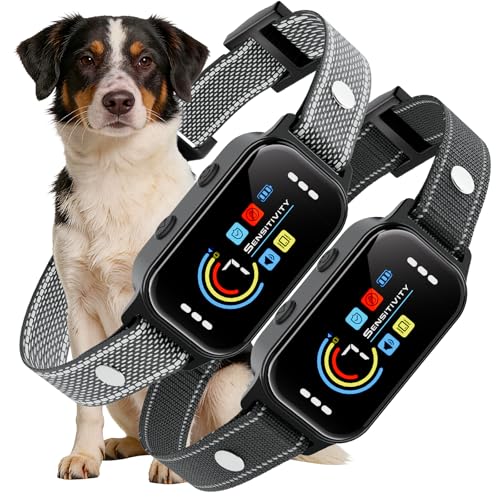
The Koguzl two-pack targets the biggest problem in a multi-dog home: buying two collars at once. It is listed for dogs from 11 to 120 pounds and offers seven sensitivity levels. Five training modes let owners choose among warning sounds, vibration, and other available corrections. I see this as a value-focused set for homes where two dogs bark at the same trigger.
Two matching units can make training more even, but I would not assume both dogs need the same setting. A small dog may respond to a low vibration, while a large dog may need a different warning pattern. The automatic bark function helps during times when nobody can hold a remote. As with any bark collar, the sensor should recognize the wearer’s bark rather than every sound in the yard.
Pros:
- Two collars support two-dog households from the start
- Seven sensitivity levels offer fine adjustment
- Five modes provide more training choices
- Wide stated weight range fits many family dogs
- Automatic bark control works without a remote
- Matching units simplify setup and replacement
Cons:
- Two dogs barking together can challenge automatic detection
- The correct mode may take several short training sessions
- Owners should confirm fit for dogs near the size limits
My Recommendation
The Koguzl two-pack is best for two dogs that share a yard, fence line, or door-barking habit. It gives owners useful control over sensitivity and training modes while avoiding the cost of two separate purchases. I would choose it for a budget-minded family that wants the best bark collar for multiple dogs in a ready-to-use pair. Begin with sound or vibration, watch both dogs closely, and adjust slowly.
Smart Two-Pack Beep and Vibration Collar

This two-pack is built for owners who want automatic bark control with five adjustable sensitivity levels. The title highlights beep, vibration, and a harmless shock option, so the main appeal is flexibility. I prefer to treat the sound and vibration settings as the starting point for training. The two-collar package makes it easier to work with a pair of dogs without mixing brands or controls.
The useful feature here is choice. Some dogs stop after a beep, while others need a brief vibration paired with a quiet command and a reward. I would reserve any stronger setting for a carefully controlled training plan, and never use it to punish fear, pain, or distress barking. The collars work best when owners also remove the trigger, add exercise, and reward calm behavior.
Pros:
- Two-pack fits homes with two barking dogs
- Five sensitivity settings support gradual adjustment
- Beep and vibration allow less intrusive training
- Automatic design works when owners are busy
- Broad dog-size description improves buying flexibility
- One product line keeps multi-dog setup simple
Cons:
- Extra correction options require responsible handling
- Dogs with sensitive skin need careful contact checks
- It may not solve barking caused by separation anxiety
My Recommendation
I would choose this collar for two dogs with the same basic barking problem and owners who want more than one training mode. It is a good fit for people who will use positive reinforcement alongside the collar. The pair offers practical value, but it needs thoughtful setup rather than a “put it on and forget it” approach. Used well, it can serve as a flexible best bark collar for multiple dogs on a modest budget.
Ollapet Two-Dog Remote Collar

The Ollapet two-pack adds a color-screen remote for training two dogs. It includes beep, vibration, and shock modes, plus an automatic anti-bark function. The listing states an IP67 waterproof rating and support for dogs from 5 to 120 pounds. That combination makes it more versatile than a basic automatic collar, especially for owners who train in a yard or open space.
A remote gives me better timing than an automatic collar when I can see the dog and the trigger. I can interrupt fence running, then reward quiet behavior at once. The remote also helps keep the dogs separate in training, which matters when one dog copies the other. I would still begin with beep or vibration and follow humane training guidance before considering any higher setting.
Pros:
- Two collars and one remote support two dogs
- Color screen can make controls easier to read
- Automatic and remote training modes offer flexibility
- IP67 waterproof rating suits wet outdoor use
- Wide stated weight range covers many dogs
- Useful for owners who need precise timing
Cons:
- Remote training requires an owner who stays involved
- Shock mode is not suitable for every dog or situation
- More controls mean a longer learning curve
My Recommendation
The Ollapet is best for an owner who wants one system for two dogs and both automatic and remote control. It suits active families that train outdoors and need a water-resistant collar. I especially like it for dogs with clear, visible triggers, such as fence barking or chasing birds. It is a strong candidate for the best bark collar for multiple dogs when remote timing matters more than simple operation.
Oliry Smart AI Bark Collar

The Oliry Smart AI collar focuses on advanced bark detection and five training modes. It is rechargeable and listed as IP67 waterproof, which helps owners who use a collar in rain or during wet play. Five sensitivity settings allow a more careful match to each dog’s bark. The product also describes a forced bark-stopping function for persistent barking.
I would treat the AI label as a feature claim, not a promise that the collar understands every sound perfectly. Even smart sensors can struggle when several dogs bark at once, so I would test it near the actual trigger. The waterproof build and rechargeable battery make it appealing for outdoor use. Proper fit remains vital because a sensor that sits too low or moves around may give poor results.
Pros:
- Five modes provide several training approaches
- Five sensitivity levels help reduce false responses
- Rechargeable operation avoids disposable batteries
- IP67 rating supports outdoor and wet conditions
- Designed for small, medium, and large dogs
- Advanced detection may help with repeated barking
Cons:
- AI detection still needs real-world testing
- One collar does not cover a multi-dog home by itself
- The strongest automatic function may not suit fearful dogs
My Recommendation
The Oliry is best for one dog in a wet climate or for owners willing to buy matching units for several dogs. It offers a modern feature set without requiring a remote. I would pick it for steady outdoor barking, provided the dog is healthy and the cause is understood. For the best bark collar for multiple dogs, its waterproof design is a useful advantage when every dog needs a dependable unit.
Advanced Detection Rechargeable Collar

This rechargeable collar offers advanced bark detection, four adjustable modes, and seven sensitivity levels. The IP67 waterproof claim makes it suitable for dogs that spend time outside. Its control range is automatic rather than remote, which keeps daily use simple. The broad size description also makes it a possible match for homes with different dog breeds.
Seven sensitivity levels are valuable because bark volume varies widely. I can begin at a low setting, watch for a correct response, and change only one step at a time. The four modes may cover owners who want sound, vibration, or other available training choices. I would buy one collar per dog and test each unit separately before allowing all dogs to play together.
Pros:
- Seven sensitivity levels allow precise setup
- Four modes give owners practical flexibility
- Rechargeable battery supports repeated daily use
- IP67 waterproof design fits outdoor routines
- Automatic operation requires no handheld controller
- Suitable for a range of dog sizes
Cons:
- The single-collar package may cost more for three dogs
- Automatic detection can be harder in a noisy pack
- Owners must monitor skin and collar tightness
My Recommendation
I recommend this model for owners who value fine sensitivity control and a simple automatic design. It is best for a dog that barks at clear, repeatable triggers and spends time outside. The waterproof build is helpful for active dogs, while the seven levels make training less of a guessing game. Buy matching collars if you want one of the more adaptable best bark collar for multiple dogs setups.
Ollapet 3300-Foot Two-Pack

This Ollapet system combines two collars with a color-screen remote and a stated range of up to 3,300 feet. It offers beep, vibration, shock, and anti-bark modes. The listing also gives an IPX-style waterproof description and a stated dog range of 8 to 120 pounds. For owners who train two dogs across a large yard, the remote range is the main attraction.
A long range does not mean I should train from far away without supervision. I use a remote collar only when I can see the dog and understand the trigger. The two-dog design makes it possible to select one dog at a time, which helps prevent confusion. This system is more suitable for active training than for leaving a correction device on all day.
Pros:
- Two collars come with one remote
- Long stated range suits large yards and fields
- Color screen can simplify dog selection
- Four modes cover basic training needs
- Water-resistant design supports outdoor sessions
- Works across a broad listed weight range
Cons:
- Remote collars need close supervision and good timing
- Long range may be unnecessary for small homes
- Shock mode calls for extra care and may not fit every dog
My Recommendation
This two-pack is best for owners with two dogs and a large property. It gives clear remote control when a dog runs to a fence or ignores a recall cue. I would not choose it solely for indoor barking, where a simple beep-and-vibration collar may be easier. For trained, healthy dogs and careful owners, it can be a practical best bark collar for multiple dogs on larger land.
Four-Dog Training Collar With Remote

This four-pack is aimed at large multi-dog homes, kennels, and owners who train several dogs with one remote. It is listed for dogs from 5 to 150 pounds and has a stated range of 4,400 feet. Five training modes and rechargeable collars add flexibility. A built-in light may also help identify a dog in low light, although I would still keep every dog within sight.
The key benefit is scale. Buying four collars together can be simpler and less costly than building a system one unit at a time. The trade-off is that a multi-dog remote takes practice, since selecting the wrong dog can undo training. I would label each collar, introduce one dog at a time, and keep sessions short and calm.
Pros:
- Four collars suit larger multi-dog households
- One remote reduces the need for several systems
- Very long stated range supports large properties
- Five modes offer training flexibility
- Rechargeable collars reduce battery waste
- Light feature may help with evening visibility
Cons:
- Four-dog controls require careful organization
- The system may be excessive for one or two dogs
- Remote correction modes demand responsible handling
My Recommendation
I would choose this package for four dogs, a working-dog home, or a large property where one remote must manage several collars. It is not my first pick for a new dog owner or a small apartment. Its value comes from capacity, range, and shared control. When used with positive rewards and clear dog selection, it may be the best bark collar for multiple dogs in a larger household.
Three-Pack Automatic Bark Collar

This three-pack is one of the most direct choices for a home with three barking dogs. It is listed for large dogs from 8 to 120 pounds and also supports medium and small dogs. The collar uses five adjustable sensitivity levels and beep, vibration, and shock options. Automatic operation means the owner does not need to carry a remote during every yard session.
The three-pack helps keep the whole group on a similar training plan. Still, I would adjust each collar separately because dogs differ in coat, neck size, hearing, and response. A collar should interrupt barking, not create panic or replace basic training. I also recommend checking every dog’s skin each day during the first week.
Pros:
- Three collars cover a three-dog household
- Five sensitivity levels help reduce false activation
- Beep and vibration offer gentler first steps
- Automatic use works during busy family routines
- Wide listed size range supports mixed breeds
- One package keeps all collars consistent
Cons:
- Automatic sensors may struggle with group barking
- The package includes correction options that need care
- Three units require regular charging and inspection
My Recommendation
This is my most natural choice for a family with three dogs and one shared barking problem. It offers the right number of collars, useful sensitivity control, and no remote to learn. I would start with beep and vibration, then reward quiet behavior at once. For a three-dog household seeking the best bark collar for multiple dogs, this package offers strong practical value.
4500-Foot Remote Training Collar

This remote collar is designed for dogs from 10 to 120 pounds and offers a stated range of 4,500 feet. It is a single-dog system, so it does not directly solve a multi-dog setup without buying more compatible units. Its main strength is remote training over a large distance. That can help owners work on recall, boundary habits, and barking when the dog is visible but far away.
I see this as a training tool rather than a simple bark collar. A remote lets me mark a behavior at the right moment, but it also gives me more responsibility. I would use the lowest effective setting and pair every interruption with a calm cue and reward. Owners should confirm whether extra collars can pair with the same remote before planning a multi-dog purchase.
Pros:
- Very long stated range suits large properties
- Remote control allows precise timing
- Broad listed weight range fits many dogs
- Useful for recall and boundary training too
- Can support focused one-dog sessions
- More versatile than an automatic bark-only device
Cons:
- Only one collar is included
- Extra units may not pair with the remote
- Remote training requires skill, timing, and supervision
My Recommendation
I recommend this collar for one dog whose barking is part of a wider recall or boundary issue. It may suit a multi-dog owner only after confirming that additional collars work with the same transmitter. It is best for experienced handlers with open space, not for hands-off indoor bark control. As a single unit, it is less convenient than a two-pack or three-pack for the best bark collar for multiple dogs.
How to Choose the Best Bark Collar for Multiple Dogs
Buying for several dogs takes more thought than buying one collar. The dogs may share a trigger, but they do not share the same neck size, bark tone, coat, or stress level. I treat each collar as a training aid, not a cure. The right choice should make calm behavior easier while protecting comfort and trust.
Choose the right number of collars
Start with the number of dogs that bark. A two-pack makes sense for two dogs, while a three-pack reduces cost and setup work for three. A four-dog remote kit can be useful for a larger home. Do not put one collar on the loudest dog and expect it to train the rest. Each dog needs its own clear feedback and its own reward plan.
Automatic or remote control?
Automatic collars respond when the sensor detects a bark. They work well when barking happens while an owner is busy, but they can be harder to manage when several dogs bark together. Remote collars give better timing because I can choose the dog and respond to the exact event. They need active supervision and are not a reason to leave a collar on all day.
Use gentle modes first
Look for beep and vibration modes. These can act like a tap on the shoulder. I start at the lowest setting, say a quiet cue, and reward the dog when the barking stops. A shock setting should never be the first step, and some dogs should not use it at all. The American Veterinary Society of Animal Behavior recommends reward-based methods and warns against training that causes fear or pain.
Check bark detection
A good bark collar should respond to the wearer’s bark, not every passing sound. Still, no small device is perfect. A dog near another barking dog may trigger a collar by movement, sound, or vibration. Test one collar at a time in the real place where barking happens. If the collar reacts to normal play, children, traffic, or another dog, lower the risk by changing the setup or choosing a different training method.
Fit matters more than many buyers think
The collar should feel secure without squeezing the neck. Contact points must reach the skin through a thick coat, but they should not rub or press for long periods. I use the two-finger check and inspect the neck often. Rotate the collar position as directed, remove it during rest when appropriate, and stop use if you see redness, hair loss, swelling, or signs of distress.
Match the collar to the dog
Always check the maker’s size and weight range. A tiny collar may not suit a powerful dog, and a large contact point may be uncomfortable for a small dog. Long-haired breeds may need special contact points or careful trimming, depending on the product instructions. Puppies, senior dogs, dogs with breathing problems, and dogs with neck or skin conditions deserve extra caution and a veterinarian’s advice.
Consider water and outdoor use
Water resistance helps if dogs play in wet grass or walk in rain. An IP67 rating usually signals protection from dust and brief water exposure under stated test conditions, but it does not mean every device can stay underwater. Read the product manual before swimming. Dry the collar and charging port fully, and check the seal often for wear.
Battery life and charging
Rechargeable collars save the cost and waste of disposable batteries. With multiple dogs, charging becomes part of the routine, so label each unit or keep a simple charging station. Check how long a full charge takes and whether the collar shows a low-battery warning. A dead collar at the wrong time can confuse training and leave one dog without the same cue as the others.
Do not ignore the reason for barking
Barking can signal fear, pain, boredom, frustration, territorial behavior, or separation stress. A collar may reduce the sound while leaving the cause untouched. I first add exercise, block visual triggers, teach a quiet cue, and reward calm pauses. If barking starts suddenly, sounds unusual, or happens when the dog is alone, I contact a veterinarian or qualified reward-based trainer.
How I would train several dogs
I begin with one dog in a quiet room. I show the collar, offer treats, and let the dog wear it for short periods without correction. Next, I practice a quiet cue with a mild trigger, reward silence, and remove the collar after the session. I repeat this with each dog before training them together.
Once every dog understands the cue, I work with two dogs at a distance. I reward the dog that stays quiet and pause the trigger when barking starts. This prevents a noisy chain reaction. Patience matters because the best bark collar for multiple dogs is only as effective as the training plan around it.
Best-for comparison
| Best for | Why |
|---|---|
| Two dogs on a budget | The Koguzl two-pack offers two collars, seven sensitivity levels, and five modes. |
| Three dogs with shared yard barking | The three-pack supplies one automatic collar for each dog and keeps setup consistent. |
| Large homes with four dogs | The four-pack remote system provides one controller for several collars and a long stated range. |
FAQs Of best bark collar for multiple dogs
Can one bark collar control several dogs?
Usually, no. Automatic collars work as separate units, so each dog needs its own collar. A remote system may pair with two, three, or four collars, but check the exact product instructions before buying extra units.
Will a bark collar stop dogs from barking at one another?
It may reduce repeated barking, but it cannot fix every cause. Give each dog space, block visual triggers, teach a quiet cue, and reward calm behavior. If the barking comes from fear or conflict, seek professional help.
Are bark collars safe for dogs?
Safety depends on the dog, fit, setting, and use time. Start with beep or vibration, follow the manual, inspect the skin, and never use a collar to punish distress. Ask a veterinarian before using one on a puppy, senior dog, or dog with a medical issue.
Should my dogs wear bark collars all day?
No. Follow the maker’s time limit and remove the collar for rest, crate time, or unsupervised periods when advised. Rotate its position and check the neck often to prevent irritation.
What is the best mode to use first?
Start with the lowest sound or vibration mode. Pair it with a quiet cue and a reward. Increase only when the dog understands the lesson and the lower setting does not work.
Final Verdict: Which Should You Buy?
For three dogs, I favor the 3-Pack Dog Bark Collar because it gives each dog a unit and offers five sensitivity levels. For two dogs, the Koguzl two-pack is a strong value. The Ollapet remote systems suit owners who need active control outdoors.
The best bark collar for multiple dogs works alongside exercise, rewards, and calm training. Choose the right pack size, fit each collar carefully, and use gentle settings first for safer, lasting results.

Pet Care Writer & Researcher
Daniel writes practical guides on daily care, feeding, and safety, turning complex topics into simple, actionable advice.