Why Do Pomeranians Bark So Much: Causes And Solutions
Why do Pomeranians bark so much? Learn the common causes and effective training tips to reduce barking and help your dog stay calm.
Pomeranians bark so much because they are alert, vocal, protective, and quick to react to change.
If you are asking why do Pomeranians bark so much, you are not alone. This small breed often has a big voice and a strong need to report every sound, person, animal, or movement. Understanding the cause behind the barking is the first step toward calmer days and better communication with your dog.

Why do Pomeranians bark so much?
Pomeranians were bred from larger Spitz-type working dogs. Although today’s Pomeranian is a companion dog, it still has many traits linked to alertness, confidence, and quick reactions. Its small size does not mean it has a small personality.
The answer to why do Pomeranians bark so much usually includes several causes:
• They notice sounds and movement quickly.
• They may feel unsure around strangers or new dogs.
• They use barking to gain attention.
• They can become bored without enough activity.
• They may guard their home, food, toys, or family.
• They may bark from fear, stress, pain, or separation anxiety.
Barking is normal dog communication. The problem begins when it becomes constant, intense, or difficult to stop. Think of barking as an alarm system. A Pomeranian may be trying to say, “Someone is here,” “I want that,” “I feel worried,” or “I do not know what this means.”
Common reasons behind excessive Pomeranian barking
Alert barking
Alert barking is one of the most common answers to why do Pomeranians bark so much. Pomeranians often react to doorbells, footsteps, cars, birds, delivery workers, and sounds outside the window.
Their sharp hearing helps them detect things before you do. This can make them seem like tiny security guards. However, if every sound leads to a long barking session, the behavior may become a habit.
Attention-seeking barking
Some Pomeranians learn that barking gets results. If barking brings petting, eye contact, food, play, or a lifted-up cuddle, the dog may repeat it.
Even telling your dog to be quiet can reward the behavior if your dog enjoys attention. From the dog’s view, a response is still a response.
Fear and uncertainty
A Pomeranian may bark when it feels afraid. Common triggers include large dogs, unfamiliar people, loud appliances, children running, or new places.
Fear barking often comes with other signs. Your dog may hide, lower its body, pin its ears back, lick its lips, tremble, or try to move away. Punishment can make fear worse because it adds more stress to an already difficult moment.
Territorial behavior
Many Pomeranians bark when someone approaches the home. They may bark at the window, fence, front door, or yard.
Territorial barking can be stronger when your dog has a clear view of the street. Each passing person or dog may feel like a new event that needs a response.
Boredom and extra energy
A Pomeranian does not need hours of hard exercise, but it does need daily mental and physical activity. A bored dog may bark, pace, chew, dig, or search for trouble.
Short walks, scent games, food puzzles, and simple training can help. Mental work often tires a Pomeranian faster than nonstop physical play.
Separation-related distress
Some Pomeranians bark when left alone because they feel distressed. This is different from simple boredom.
Signs may include barking soon after you leave, scratching doors, destroying items near exits, drooling, pacing, or having accidents. Separation anxiety requires a gradual plan. Leaving the dog alone for longer periods without training can increase the distress.
Pain or illness
A sudden increase in barking can signal a health issue. Dental pain, joint pain, skin irritation, hearing changes, stomach problems, or age-related confusion may affect behavior.
If your Pomeranian starts barking more than usual, arrange a veterinary checkup. Behavior changes should not always be treated as a training problem.

How to tell what your Pomeranian is saying
The sound itself is only part of the message. Your dog’s body language can help you identify why do Pomeranians bark so much in a specific situation.
Look for these clues:
• A stiff body, raised tail, and forward ears may suggest alertness or territorial behavior.
• A relaxed body and wagging tail may suggest excitement or a desire to play.
• A low body, tucked tail, lip licking, or shaking may suggest fear.
• Pacing, drooling, and frantic movement may suggest anxiety.
• Barking while looking at you may suggest attention-seeking or a request.
• Barking near a food bowl or toy may suggest guarding.
Keep a simple barking record for several days. Write down the time, trigger, location, body language, and what happened after the barking. This can reveal patterns that are easy to miss during a busy day.
Is Pomeranian barking normal or a problem?
Some barking is normal. A dog may bark when a stranger arrives, when it wants to play, or when it hears an unusual sound. You do not need to eliminate every bark.
The goal is to reduce unnecessary barking and teach your dog what to do instead. Excessive barking may be a problem when it:
• Lasts for long periods.
• Happens at night and disrupts sleep.
• Causes conflict with neighbors.
• Appears with fear or aggression.
• Happens when your dog is alone.
• Starts suddenly without a clear reason.
• Prevents your dog from resting or enjoying normal activities.
A quiet dog is not always a calm dog. Some dogs stop barking because they shut down under punishment. Healthy training should help your Pomeranian feel safe while learning better habits.

How to stop a Pomeranian from barking
Training works best when you address the cause, not just the sound. If you only shout “quiet,” your dog may become more excited or confused.
1. Find and manage the trigger
Start by reducing your dog’s chances to practice the behavior. Close the curtains if outside movement causes barking. Use a window film that blocks the lower view. Move furniture away from the window if your dog spends the day watching the street.
For door barking, place a baby gate between your dog and the entry area. You can also use soft background music or white noise to reduce outside sounds.
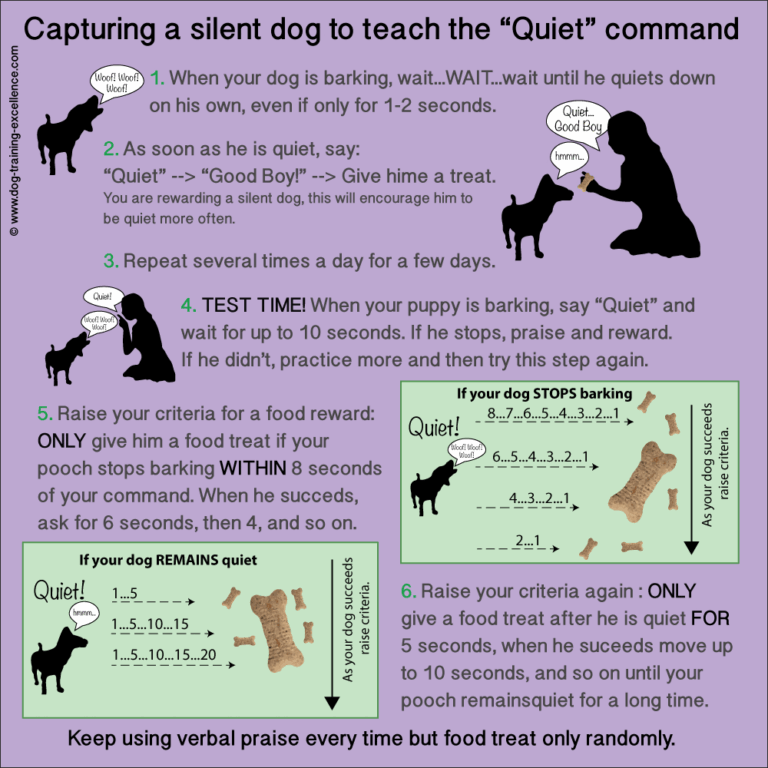
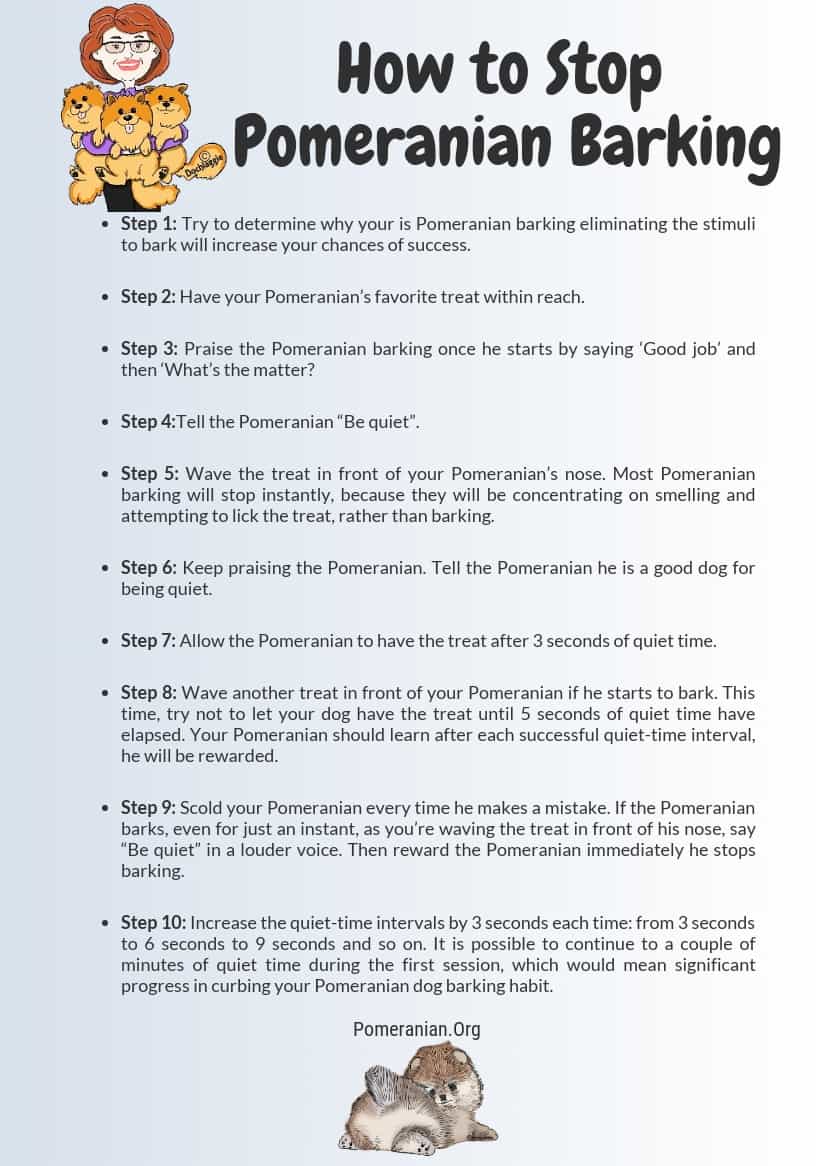
2. Teach a quiet cue
Wait for a brief pause in barking. Say “quiet” in a calm voice, then offer a small treat. At first, reward even one or two seconds of silence.
Gradually increase the quiet time before giving the reward. Do not repeat the cue again and again. If your dog does not understand it yet, make the situation easier.
3. Reward calm behavior
Notice your Pomeranian when it is resting quietly. Give a treat, gentle praise, or a favorite toy while the dog is calm.
This teaches an important lesson: silence and relaxation also earn good things. Many owners only react when barking begins, which allows calm behavior to go unnoticed.
4. Teach an alternative behavior
Ask your Pomeranian to do something simple when a trigger appears. Useful choices include:
• Looking at you.
• Sitting on a mat.
• Touching your hand.
• Going to a bed.
• Finding treats on the floor.
For example, when someone knocks, guide your dog to its mat and reward it there. With practice, the mat becomes a safe job that replaces rushing and barking at the door.
5. Use gradual exposure
If your Pomeranian barks at dogs, people, or sounds, keep the trigger far enough away that your dog can still think and eat treats. Reward calm behavior, then slowly reduce the distance over time.
This method is called desensitization and counterconditioning. It changes the emotional response instead of forcing the dog to face the trigger too quickly.
6. Avoid punishment
Shock collars, yelling, leash corrections, and physical punishment may stop a bark for a moment. They can also increase fear, stress, and defensive behavior.
Veterinary behavior groups generally support reward-based training because it improves learning while protecting the human-dog bond. If barking feels severe, work with a certified professional who uses humane methods.

Daily activities that can reduce barking
Exercise alone may not solve why do Pomeranians bark so much. Your dog needs a balanced routine that includes movement, thinking, rest, and social learning.
Try adding these activities:
• Take two or three short walks instead of one long walk.
• Let your dog sniff during walks instead of rushing.
• Use a food puzzle or scatter kibble in a safe area.
• Practice basic cues for five minutes at a time.
• Rotate toys so they stay interesting.
• Play gentle games such as find it or hide and seek.
• Give your dog a quiet rest area.
• Practice short periods of independence while you remain nearby.
A Pomeranian that is tired in a healthy way often has more patience. Still, too much stimulation can also cause barking. Some small dogs become overtired and loud after busy outings, so include calm breaks.

Mistakes that can make barking worse
Many caring owners accidentally reward barking. This is easy to do because barking is loud and stressful.
Common mistakes include:
• Giving food while the dog is barking.
• Picking up the dog every time it reacts.
• Shouting from across the room.
• Allowing window barking for hours.
• Using inconsistent rules between family members.
• Expecting instant results after one training session.
• Taking a fearful dog into overwhelming situations.
One lesson stands out in behavior work: consistency matters more than intensity. A calm, simple routine repeated every day is usually more effective than a harsh correction used once in a while.
It also helps to teach every family member the same response. If one person rewards barking and another person punishes it, your Pomeranian receives mixed information.
When to contact a veterinarian or behavior professional
Contact your veterinarian if barking begins suddenly, becomes much worse, or appears with signs of illness. A medical exam can help rule out pain, hearing loss, neurological problems, or other health concerns.
Professional help is also wise when your dog shows:
• Snapping or biting.
• Severe fear.
• Panic when left alone.
• Repeated destruction.
• Trouble sleeping.
• Aggression toward people or animals.
• No improvement after several weeks of consistent training.
A certified veterinary behaviorist or qualified positive-reinforcement trainer can create a plan for your home. Medication may sometimes be part of treatment for serious anxiety, but it should only be used under veterinary guidance.

A simple seven-day plan for quieter behavior
This plan can help you begin without overwhelming your dog.
-
Track every barking episode for two days.
-
Identify the top one or two triggers.
-
Block visual access to the most common trigger.
-
Choose one calm behavior, such as sitting on a mat.
-
Practice the behavior when no trigger is present.
-
Add a mild version of the trigger and reward calm responses.
-
Increase the challenge slowly and keep sessions short.
Do not judge progress by complete silence. Look for smaller improvements, such as shorter barking, faster recovery, or more frequent eye contact with you.
If your Pomeranian barks for ten minutes today and five minutes next week, that is meaningful progress. Behavior change is more like building a path than flipping a switch.
Frequently Asked Questions About Why Do Pomeranians Bark So Much
Why do Pomeranians bark at everything?
Pomeranians are alert dogs that notice small sounds and movements. They may bark at people, animals, cars, or noises because they feel excited, concerned, territorial, or eager for attention.
Can you train a Pomeranian to stop barking?
You can teach a Pomeranian to bark less and respond more calmly. Reward-based training, trigger management, and teaching an alternative behavior are more effective than yelling or punishment.
Are Pomeranians naturally aggressive because they bark?
No. Barking does not automatically mean aggression. A Pomeranian may bark because it is afraid, excited, frustrated, protective, or simply trying to communicate.
Why does my Pomeranian bark when I leave?
Your dog may be bored, frustrated, or experiencing separation-related distress. If barking comes with pacing, destruction, drooling, or panic, speak with a veterinarian or behavior professional.
Do Pomeranians bark more than other small dogs?
Many Pomeranians are very vocal, but individual dogs differ. Genetics, early socialization, training, health, home setup, and daily activity all affect barking levels.
Should I use a bark collar on my Pomeranian?
Bark collars are not a good first choice, especially for barking caused by fear or anxiety. They may suppress the sound without solving the emotional cause and can create more stress.
[CodeImg is intentionally omitted from the FAQ section.]
Conclusion
The answer to why do Pomeranians bark so much is rarely just one thing. Their alert nature, small size, strong personality, need for attention, fear, boredom, and health can all play a role.
Start by watching the trigger and your dog’s body language. Then manage the environment, reward calm behavior, teach a simple alternative, and seek veterinary help when barking changes suddenly or comes with distress.
With patience and steady practice, your Pomeranian can learn that it does not need to report every sound. Try one small training step today, and explore more reward-based dog behavior resources as you build a calmer life together.

Pet Care Writer & Researcher
Daniel writes practical guides on daily care, feeding, and safety, turning complex topics into simple, actionable advice.