Can You Complain About A Barking Dog: What To Do
Can You Complain About A Barking Dog? Learn your rights, complaint steps, and practical ways to resolve noisy-neighbor issues peacefully.
Yes, you can complain about a barking dog when the noise is ongoing, excessive, or violates local rules.
A barking dog can disrupt sleep, work, health, and peace at home. The right response depends on where you live, how often the dog barks, and whether the owner has a fair chance to fix the problem. This guide explains how to complain about a barking dog safely, legally, and with the best chance of getting results.
When Can You Complain About a Barking Dog?
You can usually complain about a barking dog when the noise is persistent, unreasonable, or disturbing your normal use of your home. Most cities and counties have noise rules that cover repeated animal noise.
One short burst of barking is rarely enough for official action. A stronger complaint usually involves barking that:


• Continues for long periods
• Happens late at night or very early in the morning
• Occurs every day or several times a week
• Prevents sleep, work, study, or rest
• Continues after the owner has been informed
• Violates a local noise or animal control law
The exact rule may use terms such as “excessive,” “habitual,” “unreasonable,” or “continuous.” Some areas set a time limit, while others judge the noise by its effect on nearby residents.

Check Your Local Barking Dog Laws
Local law controls most barking dog complaints in the United States. The rule may come from your city, county, homeowners association, apartment lease, or state law.
Search your local government website for terms such as:
• Barking dog ordinance


• Animal noise complaint
• Noise control code
• Animal control services
• Nuisance dog complaint
Some cities require barking to continue for a set period. For example, a local rule may focus on barking that lasts 10 or 15 minutes without stopping. Other rules may cover repeated barking over several days.
Read the full rule before filing a complaint. A city may require you to identify yourself, keep a noise log, submit recordings, or speak with the dog owner first.
Rules for Renters and Homeowners
If you rent, check your lease and contact your landlord or property manager. Many leases ban conduct that seriously disturbs other residents, even when the issue is not covered in detail by local law.
Homeowners may also need to check homeowners association rules. An HOA can have stricter noise standards than the city, but it must still follow its governing documents and applicable law.
Should You Talk to the Dog Owner First?
In many cases, a calm conversation is the best first step. The owner may not know the dog barks while they are away. Dogs may bark because of boredom, fear, separation distress, pain, territorial behavior, or outside triggers.
Choose a safe time and use neutral language. You could say:
“I wanted to let you know that your dog has been barking for long periods during the afternoon and late at night. It has made it hard for us to sleep. Could we work together on a solution?”
Avoid shouting, threats, insults, or accusations. A friendly conversation can solve the problem faster than a formal complaint.
Do not approach the owner if you feel unsafe. Skip direct contact when there has been aggression, harassment, violence, or a serious dispute. In that situation, contact animal control, a landlord, or law enforcement for the appropriate type of help.

How to Document a Barking Dog Complaint
Good records make a complaint clearer and more credible. They also help you explain the pattern without relying on memory.


Keep a simple barking log that includes:
• Date
• Start and stop times
• Approximate length of each barking period
• Location of the dog
• Type of disturbance
• Effect on your home or daily life
• Steps you have already taken
For example:
| Date | Time | Duration | Effect |
|---|---|---|---|
| March 4 | 11:40 p.m. | 35 minutes | Woke the household |
| March 6 | 6:10 a.m. | 20 minutes | Interrupted sleep |
| March 8 | 2:00 p.m. | 50 minutes | Prevented remote work |
Record only what you can honestly observe. Do not exaggerate the length or frequency of the barking.
Can You Record the Barking?
You may be able to record noise from your own property, but privacy laws vary. A short audio or video clip can show the sound level and timing. It may not prove the entire pattern by itself.
Do not trespass, place recording devices on another person’s property, or record private conversations. Some states have consent rules for recorded conversations, although ordinary outdoor barking is not the same as a private conversation.
Ask the agency handling your complaint what evidence it accepts. A log from more than one affected household may carry more weight than repeated emotional messages from one person.
How to File a Barking Dog Complaint
The correct agency depends on your location. Start with your city or county website, then follow its complaint process.
Common options include:


-
Contact animal control for a nuisance animal complaint.
-
Contact code enforcement for a local noise violation.
-
Contact the landlord or property manager if the dog lives in a rental.
-
Contact an HOA board if community rules apply.
-
Contact the nonemergency police line when the noise is occurring and local rules direct police to handle it.
-
Call emergency services only when there is an immediate threat to people, such as an attack or serious danger.
When you file, provide clear facts:
• The address where the dog lives
• The dates and times of the barking
• How long each episode lasts
• Whether you contacted the owner
• Copies of your log or recordings
• Names of other witnesses, when appropriate
• Any effect on sleep, work, health, or safety
Keep your complaint focused on the noise. Claims about the owner’s character usually weaken the report.

What Happens After You Complain About a Barking Dog?
The process differs by city. An agency may first send an educational notice to the dog owner. It may explain the local rule and give the owner time to correct the problem.
If the barking continues, the agency may ask for a formal written statement, witness forms, recordings, or a longer noise log. An officer may visit the area or try to hear the barking directly.
Possible outcomes include:
• A warning
• Mediation between neighbors
• A written compliance order
• A civil citation or fine
• A court hearing
• An animal welfare investigation if neglect or abuse is suspected
A complaint does not always lead to immediate removal of the dog. In many places, the goal is to stop the nuisance while allowing the owner to keep the animal.
What If the Agency Does Nothing?
Ask the agency for its next step and case number. Then follow up in writing with updated records.
You may also try community mediation. A neutral mediator can help neighbors agree on steps such as keeping the dog indoors at night, using training, blocking visual triggers, or arranging daytime care.
If the issue involves a landlord or HOA, use the formal process in the lease or governing documents. Legal advice may be useful if the disturbance is severe, prolonged, or connected to a property dispute.
Common Reasons Dogs Bark
Understanding the cause can make a solution easier. Barking is normal communication, but constant barking often points to an unmet need or a stressful trigger.
Common causes include:
• Separation anxiety when the owner leaves
• Boredom and lack of exercise
• Fear of people, cars, sounds, or other animals
• Territorial behavior
• A desire for attention
• Pain, illness, or age-related confusion
• Poor training or inconsistent boundaries
• Outdoor triggers such as delivery workers or wildlife
Punishing a dog for every bark may not solve the cause. It can increase fear and make the behavior worse. Positive training, exercise, enrichment, veterinary care, and professional behavior support may work better.
Practical Ways Owners Can Reduce Barking
If you are the dog owner, take the complaint seriously. Even if the barking seems normal to you, sound travels through walls and yards.
Helpful steps may include:
• Use a camera to learn when and why the dog barks.
• Give the dog daily walks and mental activities.
• Close blinds or add privacy fencing to reduce visual triggers.
• Bring the dog indoors during quiet hours.
• Teach a calm “quiet” cue with rewards.
• Avoid yelling, since dogs may treat yelling as more barking.
• Ask a veterinarian about pain, illness, or anxiety.
• Work with a qualified positive-reinforcement trainer.
• Use a behavior specialist for severe separation anxiety or fear.
Anti-bark collars require care. Shock-based devices can cause fear and may not address the cause of barking. Ask a veterinarian or qualified behavior professional about safer options first.
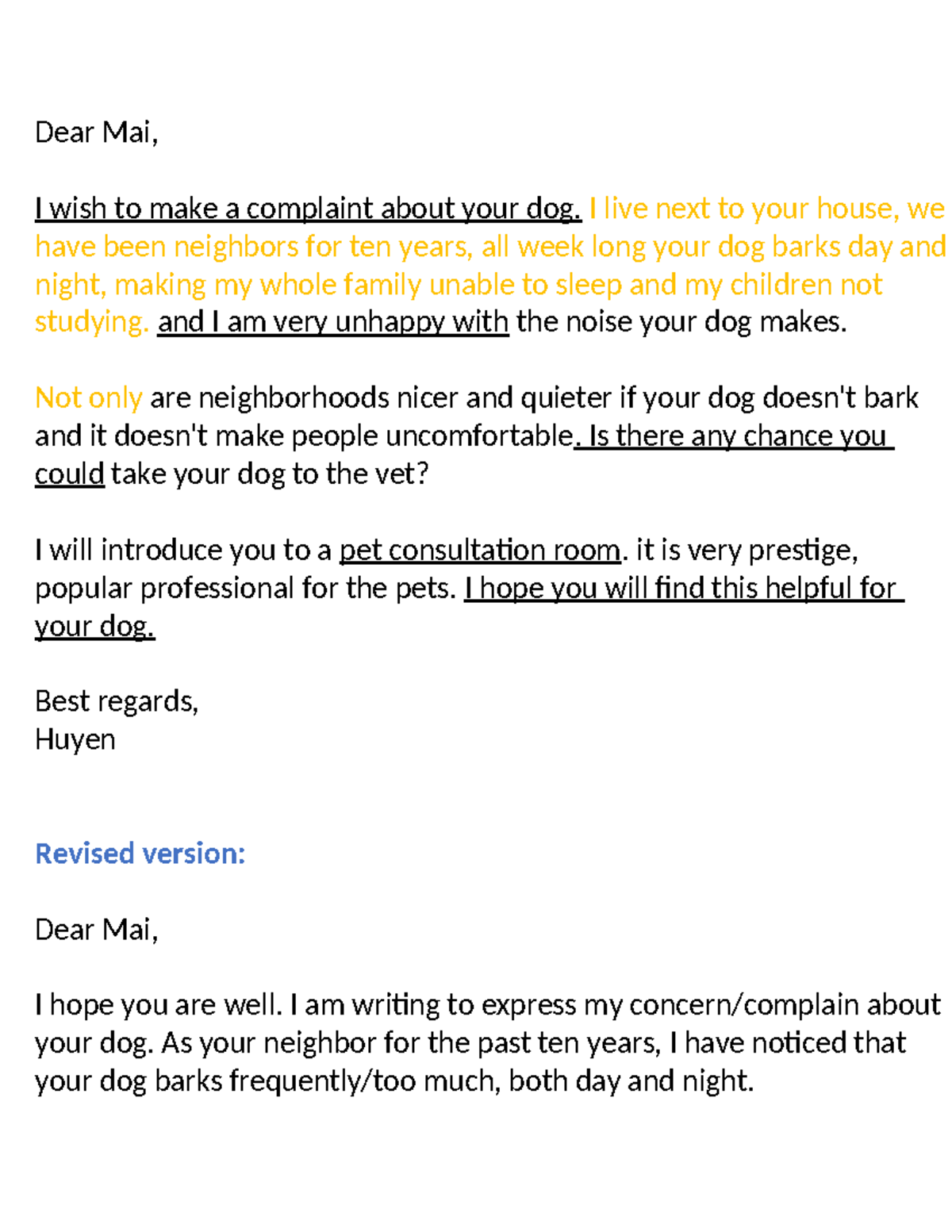
Mistakes to Avoid When Complaining About a Barking Dog
A valid concern can lose strength if handled poorly. Avoid actions that create a second dispute.
Do not:
• Threaten the owner or the dog
• Enter the owner’s property
• Harm, poison, or frighten the dog
• Make repeated angry calls
• Post personal information online
• File false reports
• Use recordings that capture private conversations without understanding local law
• Assume the dog is abused based only on barking
• Demand immediate removal when the law requires notice and a hearing
One mistake I often see in neighbor disputes is waiting too long and then submitting an angry report with no dates or times. A short, calm log is usually more useful than a long story filled with frustration.
Can a Barking Dog Complaint Become a Legal Case?
Yes, but the path varies. A city may issue a civil citation, or a court may hear a nuisance claim. A landlord may enforce lease terms, and an HOA may use its own complaint process.
A private lawsuit is usually more complex and expensive. Depending on state law, a person may claim private nuisance when unreasonable noise substantially interferes with the use and enjoyment of their property. Courts often consider the noise level, frequency, time, duration, location, and effect on the affected person.
Before taking legal action, gather evidence and review lower-cost options. Mediation, written notice, and agency enforcement may resolve the issue more quickly.
How to Make a Strong and Fair Complaint
The best complaint is specific, respectful, and supported by facts. Think of it as building a clear timeline, not starting a neighborhood battle.
Use this approach:
-
Confirm the barking pattern.
-
Check local laws and private rules.
-
Speak with the owner if safe.
-
Keep a detailed log.
-
Collect lawful recordings or witness statements.
-
File with the correct agency.
-
Follow up using the case number.
-
Update the agency if the problem continues.
-
Stay calm and avoid retaliation.
Your goal is not to punish the dog. It is to restore reasonable peace while giving the owner a fair chance to correct the problem.

Frequently Asked Questions About Complaining About a Barking Dog
Can you complain about a barking dog anonymously?
Some agencies accept anonymous reports, but others require your name or a signed statement. Anonymous complaints may be harder to enforce because officials may need a witness or formal testimony.
How long does a dog have to bark before you can complain?
There is no single national time limit. Local rules may cover nonstop barking, repeated barking, nighttime noise, or a pattern that unreasonably disturbs neighbors.
Can you complain about a barking dog during the day?
Yes. Daytime barking can still violate a local noise rule if it is excessive or persistent. Quiet-hour rules are often stricter at night, but daytime noise is not automatically acceptable.
What if the dog barks only when the owner is away?
You can still report the disturbance if it is frequent or severe. A camera, barking log, and recordings from your property can help show when the owner is not present.
Can animal control take the dog away?
Usually, not after one ordinary complaint. Removal is more likely in cases involving serious neglect, abuse, dangerous behavior, or repeated violations after official orders.
Can you complain about a barking dog if you live in an apartment?
Yes. Contact your landlord or property manager, animal control, or code enforcement as appropriate. Review your lease because it may include rules about repeated noise and nuisance behavior.
What should you do if the dog owner becomes aggressive?
Stop direct contact and move to a formal process. Save threatening messages, contact the property manager or agency, and call the police nonemergency line unless there is an immediate danger.
Conclusion
You can complain about a barking dog when the noise is persistent, unreasonable, or covered by local rules. Start by checking the law, speaking with the owner when safe, and keeping a clear record of dates, times, and effects.
A calm complaint supported by facts is more effective than anger or threats. Document the problem, contact the right agency, and follow up with patience. If you have faced a barking dog issue, share what worked for you or explore your local animal control and noise rules for the next step.

Pet Care Writer & Researcher
Daniel writes practical guides on daily care, feeding, and safety, turning complex topics into simple, actionable advice.