How To Get My Dog To Stop Barking At Me: Expert Tips
Learn how to get my dog to stop barking at me with humane training tips, clear communication, and simple steps for calmer behavior.
Teach your dog what to do instead, reward quiet behavior, and remove the trigger causing the barking.
Learning how to get my dog to stop barking at me starts with understanding the message behind the sound. Your dog may be asking for food, play, attention, space, or help. With calm training, steady routines, and humane rewards, you can reduce the barking without fear or punishment.
Why Is My Dog Barking at Me?
Barking is normal dog communication. The goal is not always to stop every bark. Instead, you want to understand the cause and teach your dog when silence is the better choice.
When a dog barks directly at you, common reasons include:
• Attention seeking: Your dog wants petting, play, food, or eye contact.
• Excitement: Your arrival, leash, toy, or meal may trigger loud barking.
• Frustration: Your dog may bark when a door stays closed or a toy is out of reach.
• Fear or stress: A dog may bark because your movement, voice, or approach feels unsafe.
• Pain or illness: Sudden barking can signal discomfort or a health problem.
• Habit: If barking has worked before, your dog may keep using it.
For example, if barking makes you toss a ball, your dog learns that barking controls the game. Even saying “Stop!” can reward the behavior because your dog receives attention.
A useful rule is simple: ask what happened right before the barking. That moment often reveals the trigger.

How to Get My Dog to Stop Barking at Me
The most effective plan combines prevention, teaching, and rewards. Do not wait for a long barking episode. Start when your dog is calm, then practice in small steps.
1. Find the reason first
Keep a short barking log for several days. Write down the time, place, trigger, and what happened after the barking.
Look for patterns such as:
• Barking when you sit down
• Barking near the food bowl
• Barking when you pick up your keys
• Barking when you stop playing
• Barking when you touch a collar or leash
• Barking when you walk past a resting spot
This record helps you choose the right solution. A dog barking for play needs a different plan from a dog barking out of fear.
2. Check for health problems
Contact your veterinarian if barking begins suddenly, becomes intense, or comes with other changes. Watch for limping, hiding, poor appetite, restlessness, confusion, coughing, or sensitivity to touch.
Older dogs may bark more because of hearing loss, pain, or changes in brain function. A health check is especially important when training does not match the dog’s past behavior.
3. Stop rewarding the bark
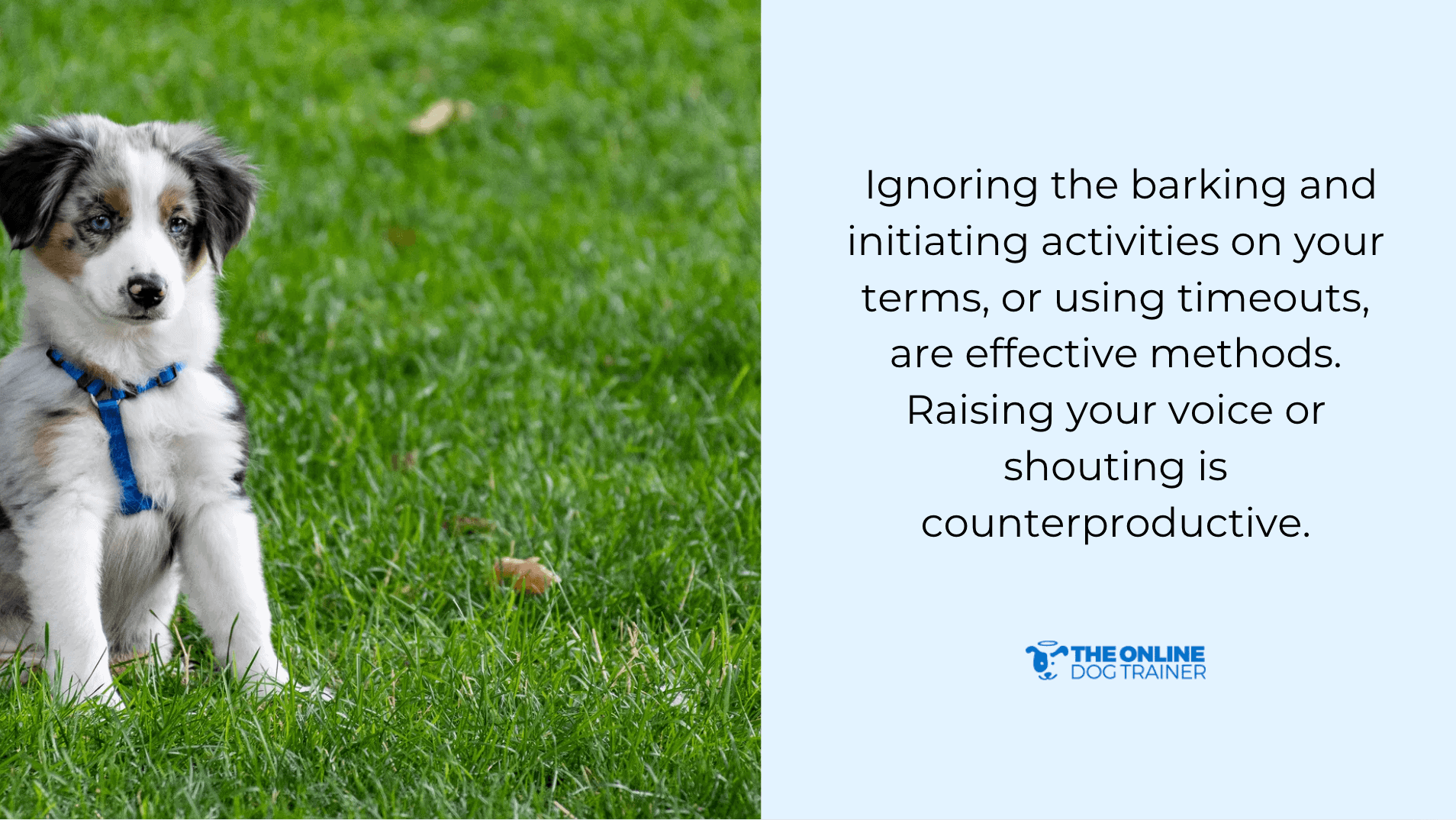
If your dog barks for attention, avoid giving the exact reward during the barking. Do not yell, push, stare, or immediately provide a toy.
Wait for one or two seconds of quiet. Then calmly reward that silence with attention, a treat, or a short game. This teaches your dog that quiet behavior works better than barking.
Timing matters. If you wait too long, your dog may not understand what earned the reward. At first, reward even a brief pause.
4. Teach an alternative behavior
Dogs learn faster when you show them what to do. Useful alternatives include:
• Sit
• Touch your hand with the nose
• Go to a mat
• Bring a toy
• Look at you
• Lie down quietly
Practice these behaviors when your dog is relaxed. Then use them before known barking triggers. For example, ask your dog to sit before serving dinner or touch your hand before opening the door.
5. Use the “quiet” cue carefully
First, allow one or two barks. Then hold a treat near your dog’s nose. Most dogs pause to smell it. The moment your dog is quiet, say “quiet” in a calm voice and give the treat.
Repeat this many times. Soon, say “quiet” just before showing the treat. Keep sessions short and upbeat.
Do not shout the cue. Loud voices often sound like barking, which can make the problem worse.
A Step-by-Step Training Plan
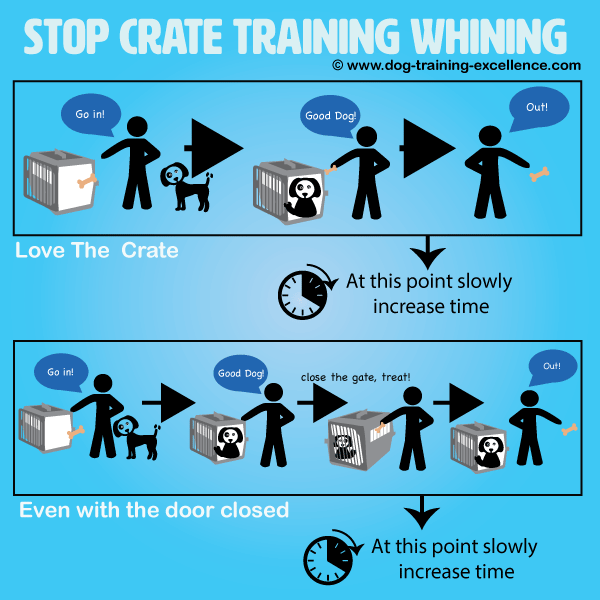
A clear routine makes it easier to learn how to get my dog to stop barking at me. Train for three to five minutes at a time. Several short sessions work better than one long session.
Step 1: Reward calm moments
Carry small treats during normal routines. When your dog sits, lies down, or watches you without barking, quietly give a reward.
You are not rewarding “nothing.” You are rewarding self-control. Over time, your dog learns that calm behavior brings good things.
Step 2: Add a simple cue
Choose one cue, such as “quiet,” “enough,” or “settle.” Use the same word each time.
Say it once. Then wait. Repeating the cue teaches your dog that the first request does not matter.
Step 3: Practice with mild triggers
Use a trigger at a low level. For example, if your dog barks when you pick up the leash, hold the leash without going outside.
Reward quiet behavior. Put the leash down. Repeat until your dog remains calm.
Step 4: Increase the challenge slowly
Once your dog succeeds, take one small step forward. Pick up the leash, walk to the door, touch the handle, and then return.
If barking starts, the step was too hard. Make the trigger easier and try again.
Step 5: Reward calm choices in daily life
Use praise, treats, play, sniff walks, and access to favorite places. Rewards do not always need to be food.
A dog who loves the backyard may earn a calm release outside. A dog who loves tug may earn a short game after sitting quietly.
What Not to Do When Your Dog Barks
Some common responses create more barking. They may seem natural, but they can confuse your dog or increase stress.
Avoid these methods:
• Yelling: Your dog may think you are joining the noise.
• Punishing fear: Fear-based barking often becomes stronger after punishment.
• Spray collars or shock collars: These tools can increase anxiety and may hide warning signs without changing the cause.
• Repeating commands: Saying “quiet” again and again can make the cue meaningless.
• Giving rewards during barking: Food, toys, and attention can strengthen the habit.
• Forcing contact: If your dog barks because of fear, reaching toward the dog may increase the threat.
Reward-based training is recommended by major veterinary behavior groups because it teaches the dog a safer response. It also protects trust between you and your pet.
I have seen one especially common mistake: people reward quiet behavior only after a major barking fit. The dog then practices barking for several minutes before finally receiving help. Reward calm behavior early, before the noise grows.
How to Handle Attention-Seeking Barking
Attention barking can be tiring because it often happens when you are busy. Your dog may bark while you work, cook, watch television, or talk on the phone.
Start by meeting your dog’s needs before quiet activities. Provide exercise, sniffing time, training, water, and a comfortable rest area. Mental work can tire a dog as much as physical exercise.
Then create a predictable pattern:
-
Ask for a calm behavior, such as sitting on a mat.
-
Give a chew, food puzzle, or safe toy.
-
Ignore barking as long as your dog is safe.
-
Reward quiet behavior after a short pause.
-
Repeat the routine each day.
The first few days may be difficult. Some dogs bark more when a familiar reward stops. This is called an extinction burst. Stay consistent, but never ignore barking that suggests pain, panic, or danger.
How to Reduce Barking Caused by Fear
Fear barking needs patience. Your dog is not being stubborn. The barking is an attempt to create distance from something that feels unsafe.
Do not force your dog to face the trigger. Instead, keep enough space for your dog to notice the trigger without losing control.
Use this pattern:
• The trigger appears.
• You offer a high-value treat.
• The trigger moves away or disappears.
• The treats stop.
This process changes the dog’s emotional response over time. It is known as counterconditioning. Pairing the trigger with something good can make the trigger less frightening.
Watch your dog’s body language. A tucked tail, pinned ears, lip licking, yawning, shaking, freezing, or avoidance can signal stress. If your dog cannot eat, respond to you, or recover within a few minutes, increase the distance.
For serious fear, aggression, or bite risk, work with a veterinarian or a certified professional dog trainer who uses reward-based methods. A veterinary behaviorist may also recommend treatment for severe anxiety.
Manage the Environment
Training works faster when your dog has fewer chances to rehearse barking. Management is not a shortcut. It is part of good behavior training.
Try these practical changes:
• Close curtains if outdoor movement triggers barking.
• Use white noise to soften hallway or street sounds.
• Move your dog’s bed away from busy windows.
• Give a food puzzle before predictable busy times.
• Use a baby gate to create a calm area.
• Keep greetings low-key.
• Avoid leaving your dog alone for longer than it can handle.
• Provide daily sniff walks and short training games.
A dog with enough rest and activity often has more self-control. Still, exercise alone will not fix fear or separation anxiety. Too much intense exercise can also create a very fit dog who still barks.
When Barking May Be Separation Anxiety
If your dog barks mainly when you leave, the cause may be separation anxiety. Other signs include pacing, drooling, destructive behavior, house soiling, escape attempts, or barking that continues for a long time.
Do not punish these behaviors. They come from distress, not revenge.
Use a camera to observe what happens after you leave. Begin with very short absences that end before panic starts. Increase the time slowly, and consider professional help if your dog cannot remain calm.
A veterinarian can check for medical concerns and guide treatment. Severe cases may need a behavior plan and medication. Medication does not replace training, but it can help a distressed dog learn.
How Long Does It Take to Stop the Barking?
The timeline depends on the cause, the dog, the environment, and your consistency. A dog with mild attention barking may improve within days or weeks. Fear, reactivity, and separation anxiety often take longer.
Measure progress in small ways:
• Fewer barking episodes
• Shorter barking periods
• Faster recovery
• More eye contact
• Better response to “quiet”
• More calm behavior before a trigger
Avoid expecting perfect silence. A successful dog may still bark at unusual sounds or important events. The goal is a reasonable response, not a silent personality.
Common Mistakes That Slow Progress
Learning how to get my dog to stop barking at me also means knowing what can block improvement.
Inconsistent rules
If barking earns a treat one day and punishment the next, your dog receives mixed information. Everyone in the home should follow the same plan.
Training only during problems
It is hard for a dog to learn while highly excited. Practice calm cues every day when no trigger is present.
Moving too fast
If your dog barks at a guest from ten feet away, do not begin with the guest standing beside the dog. Start at a distance where your dog can still think.
Using too much emotion
Frustration is understandable, but it can raise your dog’s stress. Take a short break if you feel angry. Calm training is safer and more effective.
Forgetting rest
Overtired dogs may bark more. Make sure your dog has a quiet place to sleep without constant interruptions.
Frequently Asked Questions About How to Get My Dog to Stop Barking at Me
Why does my dog bark at me when I sit down?
Your dog may want attention, play, food, or access to something. Reward your dog for settling on a mat, and give attention during planned calm moments rather than during barking.
Should I ignore my dog when it barks at me?
Ignore attention barking when your dog is safe, but do not ignore signs of pain, panic, or danger. Wait for a brief quiet pause, then reward calm behavior.
Does yelling “quiet” make barking worse?
It can. Many dogs view yelling as excitement or attention, so use a soft voice and teach “quiet” with rewards.
How can I stop my dog from barking for food?
Feed your dog on a schedule and avoid giving food while barking. Ask for a sit or quiet pause, then place the bowl down when your dog is calm.
What if my dog barks at me because it is scared?
Give your dog space and avoid forcing contact. Identify the trigger, pair it with treats at a safe distance, and seek professional help if fear includes snapping or biting.
Will more exercise stop my dog from barking?
Exercise can help reduce boredom and excess energy, but it may not solve fear, pain, or separation anxiety. Combine activity with training, management, and veterinary care when needed.
When should I hire a dog trainer?
Seek help when barking is intense, sudden, linked to fear, or paired with aggression. Choose a qualified professional who uses reward-based methods and can work with your veterinarian.
Conclusion
The best way to learn how to get my dog to stop barking at me is to treat barking as communication, not misbehavior. Find the cause, protect your dog’s health, prevent rehearsal, and reward quiet alternatives such as sitting, touching your hand, or settling on a mat.
Progress comes from small steps and steady practice. Start today with one calm cue, one manageable trigger, and one reward for silence. If fear, pain, aggression, or separation anxiety is involved, contact your veterinarian or a qualified behavior professional for support.

Pet Care Writer & Researcher
Daniel writes practical guides on daily care, feeding, and safety, turning complex topics into simple, actionable advice.