Why Do Dogs Bark At Doorbells: Causes And Fixes
Why do dogs bark at doorbells? Learn the common reasons and proven ways to reduce barking and help your dog stay calm when visitors arrive.
Dogs bark at doorbells because the sound triggers excitement, alertness, territorial feelings, or learned visitor-related behavior.
If you wonder why do dogs bark at doorbells, you are not alone. This sharp sound can turn a calm dog into an instant alarm system. Understanding the reason behind the barking is the first step toward calmer greetings, safer visitors, and better training.
Why Do Dogs Bark at Doorbells?
Dogs bark at doorbells because the sound predicts something important. A person may be arriving, a stranger may be near the home, or the household routine may soon change. To a dog, the doorbell can feel like a message that says, “Something is happening now.”
Dogs also have far sharper hearing than humans. A doorbell may sound sudden and intense, especially in a quiet home. The noise can trigger a startle response before your dog has time to think.
The most common reasons include:
• Alerting the family that someone is outside
• Protecting the home from an unfamiliar person
• Feeling excited about guests
• Feeling nervous or unsure
• Copying the family’s reaction
• Expecting a walk, delivery, or social event
• Learning that barking makes people approach the door
The bark itself does not always mean aggression. It is a form of communication. Your dog may be saying, “I heard something,” “Who is there?” or “Please come see this.”
The Main Reasons Dogs Bark at Doorbells
Alert barking
Alert barking is one of the most common answers to why do dogs bark at doorbells. Dogs are naturally aware of changes around their home. A bell, knock, or sound at the gate can signal that someone has entered their space.
This behavior often starts with one or two sharp barks. Your dog may run to the door, stand tall, raise the tail, or look toward you. The goal may be to warn you rather than attack the visitor.
Territorial behavior
Dogs can view the home as a safe zone. When someone approaches the door, your dog may feel responsible for guarding it. This is called territorial behavior.
The behavior may become stronger when the visitor is unfamiliar. It can also be worse when your dog sees people through a window or hears them before you do. The dog may believe barking has helped keep strangers away in the past.
Excitement and anticipation
Some dogs bark because they love visitors. The doorbell may predict play, petting, walks, or attention. In this case, barking is linked to excitement rather than fear.
An excited dog may wag the tail, bounce, spin, whine, or bring a toy. These signs can appear alongside barking. Excitement barking still needs training because jumping or rushing the door can frighten guests.
Fear and uncertainty
Fear is another important part of why do dogs bark at doorbells. A sudden sound can make a dog feel trapped or unsure. The dog may bark to create distance from the person outside.
Fear-based barking often comes with different body signals:
• Ears pinned back
• Tail tucked or held low
• Lip licking or yawning
• Avoiding eye contact
• Hiding behind furniture
• Growling or snapping when the visitor comes close
A fearful dog does not need punishment. Punishment can increase stress and make the response stronger. The dog needs space, calm guidance, and gradual practice.
Learned behavior
Dogs repeat actions that produce results. If barking causes you to rush to the door, open it, speak loudly, or pick up the leash, your dog may learn that barking works.
This does not mean your dog is being stubborn. The behavior has become a habit. Each repetition can make the doorbell response faster and more intense.
Social facilitation
Dogs often react to the people around them. If family members shout, hurry, or show alarm when the bell rings, the dog may join the reaction. Your dog may read your body language as proof that the sound matters.
A calm human response can help lower the dog’s arousal. This does not fix the behavior on its own, but it removes one source of extra excitement.

How Doorbell Barking Becomes a Habit
The doorbell creates a chain of events. First, the dog hears the sound. Next, the dog runs to the door and barks. Then, the visitor may enter, leave, or move away.
From the dog’s point of view, barking may appear to cause the person to disappear. This can reward territorial barking. If the person enters, barking may also lead to attention and excitement.
This pattern is called reinforcement. A behavior becomes stronger when it brings a result the dog values. The reward does not have to be food. Access to the door, attention, play, and relief from fear can all reinforce barking.
In many homes, the doorbell is also rare. A rare event can carry more energy than a daily event. The less often the bell rings, the more dramatic the response may become.
A useful first step is to track what happens before and after each barking episode. Note the visitor, time, body language, and your response. This simple record can reveal whether the barking is driven mainly by fear, excitement, guarding, or habit.

How to Stop a Dog From Barking at the Doorbell
The best approach is not to demand instant silence. It is to change what the doorbell means and teach your dog what to do instead.
1. Manage the situation first
Prevent repeated rehearsals while training begins. Rehearsal makes the old response stronger.
You can:
• Keep your dog behind a baby gate
• Use a leash before opening the door
• Move your dog to a quiet room
• Ask visitors to text instead of ringing
• Place a note on the door asking delivery workers not to knock
• Use white noise to soften outside sounds
Management is not a failure. It gives your dog fewer chances to practice the unwanted behavior.
2. Teach a calm alternative
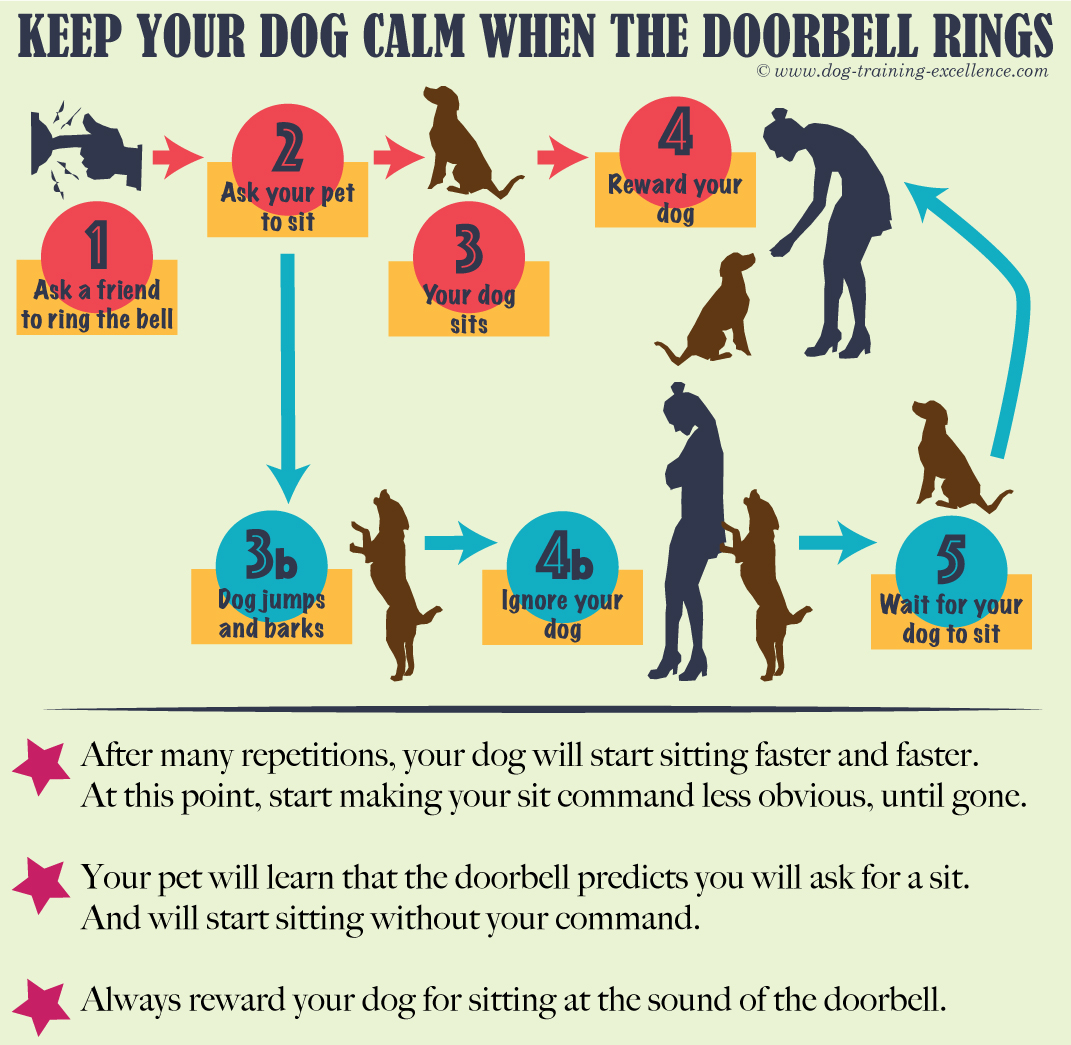
Choose a clear behavior, such as “go to mat” or “sit.” Practice it when no one is at the door. Reward your dog for moving to the mat and staying there.
Begin with short sessions. Give a treat for looking at the mat, then for walking to it, and finally for remaining there. Build the behavior before adding the doorbell.
The goal is to replace “run and bark” with “hear the bell and go to my spot.”
3. Practice with a recording
Use a quiet doorbell recording on your phone. Start at a low volume, far from your dog. Play it for one second, then give a high-value treat.
If your dog barks, pants, freezes, or rushes the door, the sound is too strong. Lower the volume or increase the distance. Training works best when your dog notices the sound but can still eat and respond.
Over time, slowly increase the volume. Then practice with a real bell while your dog stays on the mat. This process is called desensitization and counterconditioning.
4. Reward quiet moments
Wait for a brief pause in barking. Say a calm word such as “quiet,” then offer a treat. Do not repeat the cue while the dog is barking loudly.
At first, reward one second of silence. Later, wait for three seconds, five seconds, and longer. Small steps are more effective than expecting perfect silence at once.
5. Practice with a helper
Ask a trusted friend to stand outside. Keep your dog at a safe distance and prepare special treats. Have the helper ring once, then wait while you guide your dog to the mat.
Repeat only a few times. End the practice before your dog becomes overwhelmed. Several short sessions are usually better than one long session.

Mistakes to Avoid When Training Doorbell Barking
Many well-meaning owners make the barking worse without realizing it. They may yell “stop” while rushing toward the door. To the dog, this can sound like the family is barking too.
Avoid these common mistakes:
• Shouting or punishing the dog
• Forcing the dog to greet visitors
• Opening the door while the dog is lunging
• Practicing at a volume that causes panic
• Rewarding the dog only after a long barking episode
• Expecting progress after one or two sessions
• Using shock or other painful tools without professional guidance
Punishment may suppress a bark for a moment, but it does not teach the dog how to feel safe. It can also hide warning signs before a growl or bite. Reward-based training is safer and helps build a useful response.
One lesson I often see in doorbell cases is the value of timing. Owners tend to give treats after the dog is already frantic. Start earlier, when the dog first notices the sound. Calm behavior is easier to build before the dog crosses its stress threshold.

How to Tell Whether Barking Comes From Fear or Excitement
Knowing why do dogs bark at doorbells helps you select the right plan. Fear and excitement can look similar because both raise a dog’s energy level.
A fearful dog may retreat, hide, tremble, growl, or keep its body low. It may bark while trying to escape. Give this dog distance and avoid forcing contact with visitors.
An excited dog may pull toward the door, wag loosely, jump, whine, and seek attention. This dog needs impulse control and a predictable greeting routine.
Some dogs show both emotions. A dog may want to greet a guest but also feel unsure. When body language is unclear, treat the behavior with caution and give the dog more space.
If your dog has snapped, bitten, charged guests, or cannot calm down, contact a qualified veterinary behaviorist or reward-based behavior professional. A veterinarian can also check for pain, hearing changes, anxiety, or other medical factors that may affect behavior.
A Simple Doorbell Training Plan
Use this plan for five to ten minutes at a time:
-
Place your dog far enough from the door to remain calm.
-
Ask a helper to ring once or play a soft recording.
-
The moment your dog notices the sound, give a tasty treat.
-
Guide your dog to a mat or bed.
-
Reward the dog for staying there.
-
Repeat two or three times.
-
Stop while your dog is still relaxed.
Practice several days each week. Increase only one challenge at a time. You might raise the sound slightly, move closer to the door, or add a person outside. Do not increase all three at once.
Use small, soft treats that your dog loves. Cheese, cooked chicken, or a favorite commercial treat may work well, as long as the portions fit your dog’s diet.
Progress is not always steady. Your dog may improve indoors but bark at a real delivery. That does not mean training failed. Real visitors bring extra movement, voices, smells, and pressure.

When Professional Help Is Needed
Doorbell barking is often manageable at home, but some cases need expert support. Seek help if the barking is sudden, severe, or linked with aggressive behavior.
Professional guidance is especially important when:
• Your dog has bitten or tried to bite someone
• Your dog cannot take food near the door
• Your dog redirects aggression toward family members
• The barking lasts for a long time after the visitor leaves
• Your dog shows intense fear or panic
• The behavior began after illness, injury, or a major life change
Choose a professional who uses reward-based methods. Ask about their education, experience with fear and aggression, and training plan. Avoid anyone who promises a fast fix or relies mainly on pain, intimidation, or dominance claims.
A veterinary check is also wise when behavior changes quickly. Health problems can lower a dog’s tolerance and make normal sounds feel more threatening.

Frequently Asked Questions About Why Do Dogs Bark at Doorbells
Why do dogs bark at doorbells even when nobody is there?
Dogs may bark because they hear sounds that humans miss, such as footsteps, voices, or movement outside. They may also have learned that the doorbell predicts visitors, even when the visitor does not appear.
Is doorbell barking a sign of aggression?
Not always. Dogs bark at doorbells because of alertness, excitement, fear, or territorial behavior, and barking alone does not prove aggression. Look at the whole body, including posture, tail, ears, and ability to relax.
Should I yell at my dog to stop barking at the doorbell?
Yelling can increase excitement because your dog may think you are joining the alarm. Use management, reward quiet pauses, and teach a behavior such as going to a mat.
How long does it take to stop doorbell barking?
The time varies with the dog’s age, history, temperament, and the cause of the barking. Some dogs improve within weeks of steady practice, while fearful or aggressive responses may need months and professional support.
Can I train my dog to ignore the doorbell?
You can teach your dog to respond in a calmer way, but complete silence may not be realistic for every dog. A practical goal is one brief alert followed by moving to a mat or waiting calmly.
Why does my dog bark at the doorbell but not at knocks?
Different sounds have different pitches, volumes, and learned meanings. Your dog may have built a stronger association with the doorbell, or the tone may be more startling than a knock.
Conclusion
The answer to why do dogs bark at doorbells usually involves a mix of alertness, excitement, fear, territorial feelings, and learned habits. The bark is a signal, not a complete diagnosis. Watch your dog’s body language, manage the doorway, and reward a calm behavior that can replace rushing and barking.
Start with short practice sessions and use a gentle pace. If fear or aggression is involved, ask your veterinarian or a qualified behavior professional for help. With patience and consistent training, the doorbell can become an ordinary sound instead of a daily emergency. Try one small change today, and share your experience or explore more reward-based dog training resources.