Why Dogs Bark At Other Dogs: Causes And Solutions
Learn why dogs bark at other dogs, from fear and excitement to territorial behavior, plus practical tips to encourage calmer walks.
Dogs bark at other dogs to express excitement, fear, frustration, warning, or a wish to interact.
Understanding why dogs bark at other dogs takes more than labeling the behavior as “bad.” A bark is a message, and its meaning depends on your dog’s body language, distance from the other dog, past experiences, and the situation. This guide explains the most common causes, how to read the signals, and how to respond safely and kindly.

Why dogs bark at other dogs
Dogs bark because barking works as communication. It can warn another dog away, invite play, release stress, or get a person’s attention. The same sound may mean different things in different settings.
For example, a dog may bark at another dog from behind a fence because the fence creates frustration. The dog can see the other animal but cannot approach or move away. On a leash, a friendly dog may bark because it wants to say hello, while a fearful dog may bark to create space.
The key question is not only, “Why dogs bark at other dogs?” It is also, “What is the dog trying to achieve?”
Common reasons include:
• Fear or anxiety: The dog feels unsafe and wants the other dog to move away.
• Excitement: The dog becomes highly aroused when it sees a possible playmate.
• Frustration: A leash, fence, window, or car prevents normal movement.
• Territorial behavior: The dog is warning another animal away from home or property.
• Social invitation: The bark may be part of an attempt to greet or play.
• Learned behavior: The dog has discovered that barking makes the other dog disappear.
• Pain or illness: Discomfort can make a dog more reactive than usual.
• Poor social experience: Past fights, rough play, or limited early exposure can affect reactions.
Dogs do not bark simply to annoy people. Barking is often an emotional response. If the emotion is not addressed, punishment may stop the sound for a moment without changing the fear, excitement, or frustration underneath it.
How to read a dog’s bark and body language
The sound of a bark gives you only part of the story. Your dog’s body often provides better clues. Watch the whole animal, including the eyes, mouth, ears, tail, and movement.
A relaxed dog may have a loose body, soft eyes, a gently moving tail, and an open mouth. Its bark may come in short bursts, followed by pauses. The dog may look toward the other dog and then back at you.
A worried dog often shows more tension. Signs may include:
• A stiff body
• A tucked or very low tail
• Ears held flat or far back
• Lip licking or yawning
• Turning the head away
• Leaning backward
• Trying to hide behind the owner
• A hard stare
A dog that feels threatened may bark sharply while lunging forward. This does not always mean the dog wants to fight. Some dogs move toward what scares them because barking and lunging have worked as a “keep away” signal.
Excitement can look similar to aggression because the dog may jump, pull, whine, and bark. Look for a loose body, playful movement, a curved approach, and frequent pauses. Still, high excitement can become unsafe if the dog cannot calm down.
One practical lesson is to avoid judging the bark by volume alone. A loud bark does not always signal aggression, and a quiet dog is not always comfortable. Body language, context, and distance matter most.
Fear and anxiety as causes of barking
Fear is one of the most common reasons dogs bark at other dogs. A fearful dog may bark because it believes the other dog is a threat. The bark attempts to increase distance and restore a sense of safety.
Fear may develop after a frightening encounter. It can also come from limited social exposure during puppyhood, repeated bullying at a dog park, or a naturally cautious temperament. Some dogs are comfortable with small dogs but fear large dogs. Others react only when another dog approaches head-on.
A dog’s fear may grow through a cycle:
-
The dog sees another dog.
-
The dog feels worried.
-
The dog barks or lunges.
-
The other dog moves away.
-
The barking dog feels relief.
-
The dog learns that barking works.
This learning process is called reinforcement. The dog does not need to think through the lesson. Relief itself can strengthen the behavior.
Do not force a fearful dog to greet other dogs. Flooding a dog with close contact can increase distress and make future reactions worse. Instead, work below the dog’s reaction point, known as the threshold.
At a safe distance, offer a small treat when your dog notices another dog and remains calm. Over time, the sight of another dog can begin to predict something positive. This method is called counterconditioning, and it works best when paired with gradual exposure.
Excitement, play, and social frustration
Not every barking dog is afraid. Some dogs bark because they are thrilled to see another dog. They may pull hard, bounce on their front feet, whine, or spin in circles.
Excitement barking is common in young dogs and highly social dogs. It can also appear when a dog sees a familiar friend but cannot reach it. The leash may turn a friendly greeting into a noisy struggle.
The problem is that excitement can rise very quickly. Once a dog is overexcited, it may stop responding to its name or treats. At that point, asking for a difficult command often fails because the dog’s brain is focused on the other animal.
Try these steps:
• Increase the distance before your dog loses control.
• Reward brief moments of quiet and soft body language.
• Use a cheerful “let’s go” cue to move away.
• Practice calm greetings with one steady, suitable dog.
• Keep greetings short and end while both dogs remain relaxed.
• Avoid allowing your dog to drag you toward every dog it sees.
A common mistake is permitting pulling and barking during some greetings but correcting it during others. This mixed pattern can make the behavior stronger because the dog learns that barking might eventually produce access.
Clear rules help. Your dog can greet another dog only when the leash is loose and both animals appear comfortable. If either dog becomes tense, calmly create space.
Leash reactivity and barrier frustration
Leash reactivity describes an intense response to a trigger while a dog is restrained. The trigger may be another dog, a person, a bicycle, or a vehicle. Barking is often part of this response.
A leash removes choices. Dogs cannot curve away, pause freely, or approach at their own pace. Some dogs feel trapped. Others become frustrated because they cannot reach the dog they want to meet.
Fences and windows can create the same issue. A dog behind a fence may run back and forth while barking at passing dogs. This behavior can become a habit because the dog repeatedly practices it.
Helpful changes include:
• Walk at quieter times when possible.
• Cross the street before your dog reacts.
• Use parked cars, hedges, or distance as visual barriers.
• Avoid tight leash pressure when you can do so safely.
• Teach your dog to turn toward you on cue.
• Block access to windows if outside activity causes repeated barking.
• Replace fence running with supervised play, sniffing, or food puzzles.
Do not use a retractable leash in crowded areas with a reactive dog. It can make distance harder to control. A standard leash, well-fitted harness, and thoughtful route are often safer choices.
Territorial barking at home
Dogs may bark at other dogs near the home because they view the yard, porch, car, or house as important territory. The behavior is often stronger when the dog is behind a window or fence.
Territorial barking can include running to the boundary, stiff posture, raised hackles, and repeated barking after the other dog has passed. The dog may appear confident, but territorial behavior can also include fear.
Management is important because every repeated outburst gives the behavior more practice. Consider these changes:
• Close blinds during busy times.
• Use privacy film on lower windows.
• Bring the dog inside before it reaches the fence line.
• Add a solid barrier if visual access causes constant reactions.
• Supervise yard time instead of leaving the dog outside alone.
• Reward calm behavior before the barking starts.
Teaching a “quiet” cue can help, but it should not be the first step. First reduce the number of barking episodes. Then teach the dog that looking at you, moving away, or settling on a mat earns a reward.
Avoid shouting “quiet” from across the yard. Your dog may interpret your loud voice as joining the alarm. Calm movement and simple training usually work better.
When barking may signal aggression
Barking alone cannot prove that a dog is aggressive. Aggression refers to behavior intended to threaten or cause harm, while barking can have many causes.
Risk is more concerning when barking appears with:
• Repeated snapping
• Biting or attempted biting
• A rigid, forward body
• Direct, fixed staring
• Deep growling with little ability to disengage
• Guarding behavior
• A history of fights or bites
• Rapid escalation despite distance
A dog can be friendly in one setting and unsafe in another. For example, a dog may play well with familiar dogs but react strongly to dogs approaching its owner, food, car, or home.
Do not test the dog by bringing it closer to another dog. Safety comes first. Use distance, secure equipment, and controlled routes. If you are worried about a bite, arrange help from a board-certified veterinary behaviorist or a qualified reward-based behavior professional.
A veterinarian should also assess sudden behavior changes. Pain, hearing loss, vision problems, neurological disease, and other medical concerns can affect reactions. Behavior training is important, but it cannot replace medical care when health may be involved.
How to stop a dog from barking at other dogs
The most effective plan combines management, training, and an understanding of the dog’s emotion. There is no single trick that works for every dog.
Start with management. Prevent your dog from rehearsing the full barking episode whenever possible. Choose open walking areas, create distance, and avoid crowded dog parks if they make your dog less settled.
Next, find your dog’s threshold. This is the distance at which your dog can notice another dog but still eat, respond to its name, or look back at you. If your dog cannot take food or respond, move farther away.
Use this simple training process:
-
Spot another dog at a safe distance.
-
Mark your dog’s calm glance with a word such as “yes.”
-
Give a high-value treat.
-
Wait for your dog to look back at you.
-
Reward again while the other dog remains in view.
-
Leave before your dog becomes tense or starts barking.
Practice in short sessions. Five calm minutes can be more useful than a long walk filled with repeated reactions.
Useful skills include:
• Name response: Your dog turns toward you when called.
• Hand target: Your dog touches your hand with its nose.
• “Let’s go”: Your dog moves with you in another direction.
• Emergency U-turn: Your dog follows you away from a trigger.
• Settle: Your dog relaxes on a mat or beside you.
Use rewards your dog truly values. Tiny pieces of chicken, cheese, or another safe treat may work better than ordinary kibble during difficult situations. Reduce the treat size so the dog can eat many pieces without stomach upset.
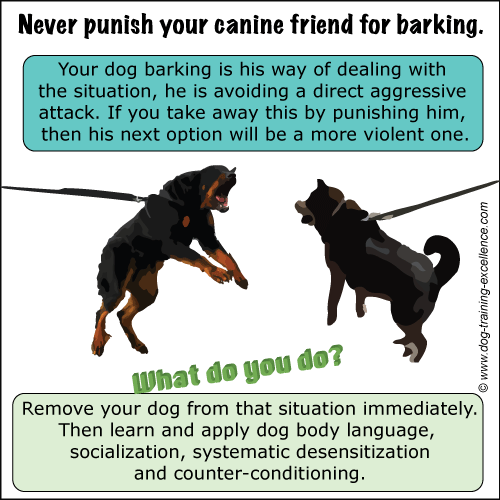
Never punish a dog for growling or barking caused by fear. Punishment may suppress warning signs without removing the fear. It can also damage trust and increase the risk of a sudden bite.

Mistakes to avoid when a dog barks
Many well-meaning owners make the same mistakes. They are understandable, but they can slow progress.
One mistake is moving too close too soon. Owners often think a dog must “get used to” other dogs. In reality, repeated exposure at an overwhelming distance can make the reaction stronger.
Another mistake is forcing greetings. Dogs do not need to greet every dog they pass. A calm walk with no contact may be a much better social experience.
Other common errors include:
• Tightening the leash and holding the dog in place
• Yelling or jerking the leash
• Allowing fence barking for long periods
• Using dog parks as the only form of socialization
• Rewarding the dog only after a full meltdown
• Expecting fast results after one training session
• Ignoring early signs such as staring or freezing
Watch for those early signs. A dog that notices another dog and becomes still is already communicating. Moving away at that moment is easier than waiting for barking and lunging.
Progress is rarely perfectly linear. Your dog may improve for weeks and then react during a stressful day. Heat, pain, fatigue, crowded spaces, and changes at home can lower a dog’s ability to cope. A setback does not mean the training failed.
A practical training plan for daily walks
A simple plan makes it easier to stay consistent. Before leaving home, prepare small treats, a comfortable harness, and a route with room to move.
During the walk:
• Scan ahead for dogs, people, and narrow paths.
• Notice your dog’s early stress signals.
• Create distance before barking begins.
• Reward your dog for looking at the trigger and returning attention to you.
• Keep your voice calm and movements smooth.
• End the session if your dog becomes too overwhelmed.
At home, practice the same skills without distractions. Say your dog’s name, reward eye contact, and walk a few steps together. Build from easy settings to more difficult ones.
A useful real-life lesson is that timing matters more than speed. Rewarding after the bark may accidentally teach, “Bark first, then check in.” Reward the first calm glance instead.
Track progress in a small notebook. Record:
• The distance from the other dog
• Your dog’s body language
• Whether your dog took treats
• How long recovery took
• What helped
This record can reveal patterns. You may learn that your dog reacts more in the evening, near the home, or after a busy day. Those details help you plan better walks.
When to contact a professional
Professional support is wise when the behavior is intense, sudden, worsening, or difficult to manage safely. It is especially important after a bite or attempted bite.
Choose a professional who uses reward-based methods and explains the plan clearly. A veterinary behaviorist can assess medical factors and may discuss medication when anxiety is severe. Medication does not replace training, but it can help some dogs learn when fear is too strong.
Avoid anyone who promises a guaranteed cure, relies on pain or fear, or describes dominance as the answer to every behavior problem. Good behavior work should improve safety while protecting the relationship between you and your dog.
The timeline varies. Some dogs show small changes within a few weeks. Others need months of careful practice. Age, health, genetics, learning history, and the owner’s ability to manage triggers all affect progress.
Frequently asked questions about why dogs bark at other dogs
Why does my dog bark at other dogs on walks?
Your dog may feel afraid, excited, frustrated, or protective. Leash restriction can make the reaction stronger because the dog cannot control the distance or choose how to move away.
Why does my dog bark at other dogs but not people?
Dogs respond to different triggers based on past experiences, body language, size, movement, and social learning. Your dog may feel comfortable with people but uncertain around dogs, or may have had a difficult experience with another dog.
Is barking at other dogs always a sign of aggression?
No. Barking can show fear, play interest, excitement, frustration, or a warning. Look at the dog’s full body language and history, and seek professional help if snapping, biting, or serious lunging occurs.
How can I stop my dog from barking at other dogs?
Create more distance, reward calm behavior, and teach skills such as “look at me” and “let’s go.” Avoid punishment and repeated close encounters, since both can increase fear or frustration.
Should I let my barking dog greet another dog?
Not while your dog is barking, lunging, or showing stiff body language. Wait for calm behavior and ask whether the other dog and owner are comfortable before allowing a brief, controlled greeting.
Why does my dog bark at other dogs through the window?
Window barking is often territorial behavior or frustration caused by a barrier. Reduce visual access, prevent repeated practice, and reward your dog for moving away or settling calmly.
Can pain cause a dog to bark at other dogs?
Yes. Pain or illness can lower a dog’s tolerance and make normal interactions feel threatening. A sudden change in barking or reactivity deserves a veterinary checkup.
Conclusion
Dogs bark at other dogs for many reasons, including fear, excitement, frustration, territorial behavior, and learned habits. The bark is only one part of the message. Body language, distance, setting, and past experience reveal what your dog may be feeling.
Start by keeping your dog below its reaction threshold. Create space, reward calm choices, prevent repeated outbursts, and avoid punishment that may increase fear. With steady practice and professional help when needed, many dogs can learn to pass other dogs with greater calm and confidence.
Begin with one quiet walk today, watch for early signs, and reward the behavior you want to see. For more practical dog behavior guidance, explore related training resources or share your experience in the comments.

Pet Care Writer & Researcher
Daniel writes practical guides on daily care, feeding, and safety, turning complex topics into simple, actionable advice.