What Is Considered A Large Breed Dog For Food: Explained
Learn what is considered a large breed dog for food, including weight guidelines, nutritional needs, and feeding tips for healthy growth.
In the United States, a dog is usually considered large breed for food purposes if its expected adult weight is about 50 pounds or more. Some U.S. dog food brands use 55 or 60 pounds as the cutoff, while others reserve “large breed” for dogs expected to weigh 70 pounds or more.
The key point is this: choose food based on expected adult size, not your dog’s current weight alone. A 25-pound puppy may grow into a 70-pound adult. That puppy may need a large-breed puppy formula even though it is still small today.

What weight counts as a large breed dog?
There is no single U.S. legal definition that every dog food company must use for “large breed.” In everyday feeding advice, the term often means a dog with an expected adult weight of 50 pounds or more.
Food labels may use different ranges:
| Food label or guideline | Common adult-weight range |
|---|---|
| Small breed | Usually under 20 pounds |
| Medium breed | About 20 to 50 pounds |
| Large breed | Often 50 pounds or more |
| Giant breed | Often 90 pounds or more |
These ranges are general. One brand may call a 50-pound dog large breed, while another may set its cutoff at 55 or 70 pounds. Always read the feeding guide on the specific package.
Why 50 pounds is a common cutoff
The 50-pound mark is a useful practical line because larger dogs often have different needs for:
- Joint support
- Calorie control
- Bone and muscle development
- Kibble size
- Calcium and phosphorus balance during growth
- Feeding amounts and meal planning
A 50-pound Labrador Retriever, a 75-pound German Shepherd, and a 110-pound Great Dane are all larger dogs, but they do not have identical needs. A giant breed may need more careful growth control than a typical large breed.
The expected adult weight matters most
For puppies, use the expected adult weight. Do not switch food simply because a puppy has crossed 50 pounds. A 55-pound adolescent dog may still be growing, and growth needs can continue until skeletal maturity.
If you do not know the expected adult size, ask your veterinarian to estimate it. Breed, sex, parents, current age, growth pattern, and body condition can all affect the estimate.
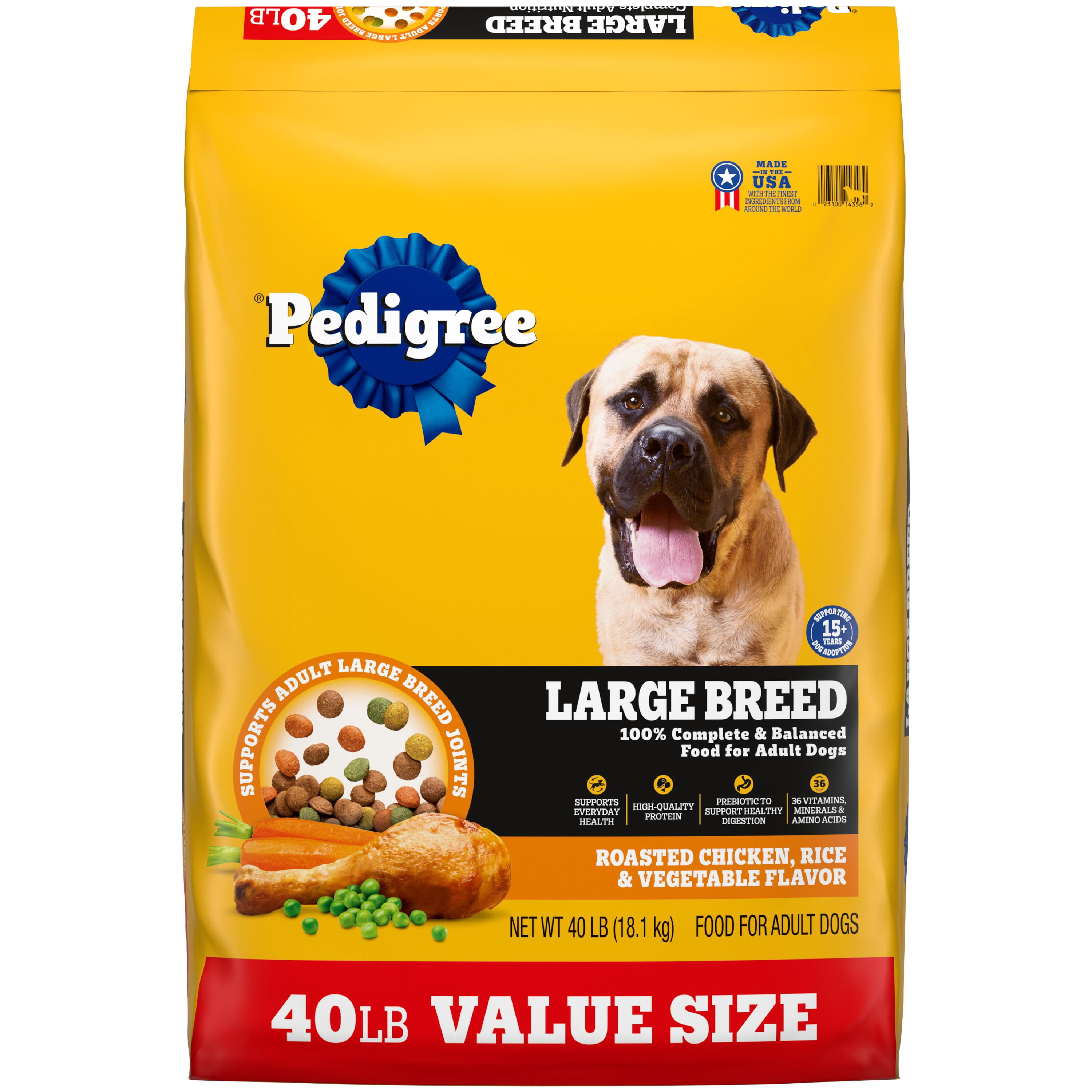
How do large-breed dog foods differ from regular food?
Large-breed dog food is generally designed to provide controlled calories and nutrients that support larger bodies. The goal is not to make a dog grow as fast as possible. The goal is steady growth without excess weight gain.
This matters most for puppies. Rapid weight gain can place extra stress on developing bones and joints. Large-breed puppy foods commonly have lower calorie density than some standard puppy foods and carefully controlled mineral levels.
Large-breed puppy food
Large-breed puppy food is intended for puppies that are expected to reach a higher adult weight. It may help owners manage:
- Calorie intake
- Calcium and phosphorus levels
- Protein and fat balance
- Kibble size
- Growth rate
The Association of American Feed Control Officials, or AAFCO, includes a specific nutrient profile for growth of large-size dogs. In that context, “large-size dogs” means dogs expected to weigh 70 pounds or more as adults. This is a nutrient-profile definition, not a universal rule that every brand must use for the words “large breed.”
That distinction can be confusing. A product labeled “large breed puppy” may be designed for dogs expected to weigh 50 pounds or more, while the AAFCO large-size growth profile specifically addresses dogs expected to reach at least 70 pounds.
Large-breed adult food
Adult large-breed food often focuses on:
- Moderate calorie density
- Adequate but not excessive fat
- Joint-support nutrients
- Appropriate protein
- Larger kibble pieces
- Weight control
A large dog that gains too much weight may face more strain on its hips, elbows, knees, and spine. Keeping the dog lean is usually more useful than choosing a food based only on marketing words.
The Merck Veterinary Manual and veterinary nutrition guidance commonly emphasize body condition, calorie intake, and life stage rather than breed labels alone.
Does a 50-pound dog need large-breed food?
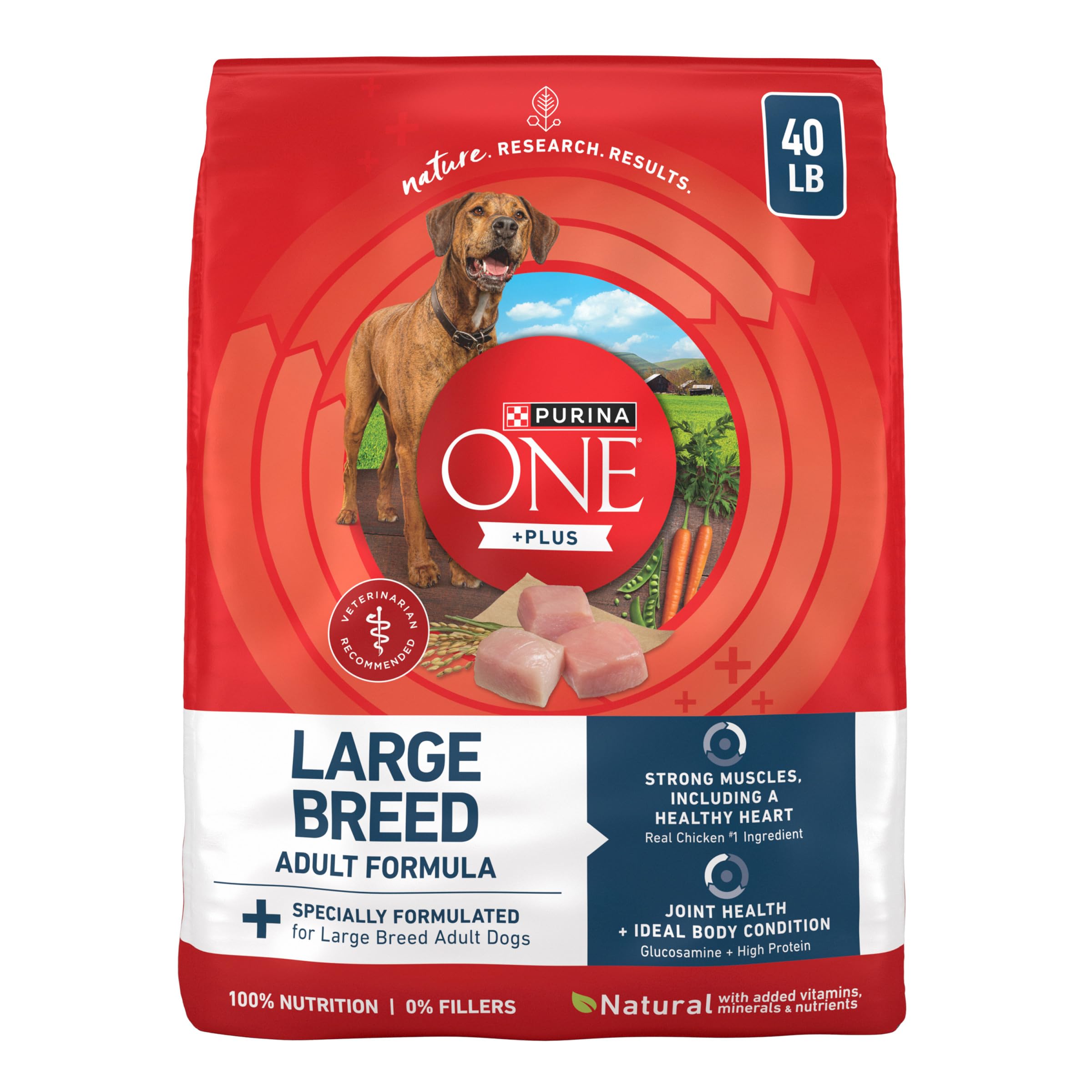
A 50-pound dog may benefit from a large-breed formula, but the answer depends on age, body condition, activity, health, and the specific food.
For an adult dog, a complete and balanced standard adult formula may meet nutritional needs if the dog maintains a healthy weight and has no special medical concern. Large-breed food is not automatically required just because a dog weighs 50 pounds.
For a growing puppy, the choice deserves more care. If the puppy is expected to reach 50 to 70 pounds or more, a large-breed puppy formula may be a sensible option. Check that the label provides a nutritional adequacy statement for growth, and follow the feeding directions closely.
A simple decision guide
| Your dog | Practical starting point |
|---|---|
| Adult under 50 pounds | Small or medium formula may fit |
| Adult around 50 to 70 pounds | Large-breed adult food may fit, but compare calories |
| Adult over 70 pounds | Large-breed or giant-breed food may be useful |
| Puppy expected to reach 50 pounds or more | Consider large-breed puppy food |
| Puppy expected to reach 70 pounds or more | Look for food suitable for growth of large-size dogs |
| Overweight large dog | Choose calories with your veterinarian, not just the label |
These are starting points, not medical rules. Two foods with the same “large breed” label may have very different calories per cup.
How do you choose food for a large-breed puppy?
Choose a food that matches the puppy’s life stage and expected adult size. Then control the portion so the puppy grows steadily and stays lean.
1. Check the nutritional adequacy statement
Look for a statement such as:
“Animal feeding tests using AAFCO procedures substantiate that this product provides complete and balanced nutrition…”
Or:
“Formulated to meet the nutritional levels established by the AAFCO Dog Food Nutrient Profiles…”
For a large-breed puppy, the label should clearly indicate that the food is suitable for growth of large-size dogs when that applies.
Do not rely only on phrases such as “premium,” “natural,” “healthy,” or “supports bones.” Those phrases do not replace the adequacy statement.
2. Compare calories per cup
Feeding directions are only estimates. Calorie content gives you a better way to compare foods.
For example, imagine two foods:
- Food A: 400 kilocalories per cup
- Food B: 320 kilocalories per cup
A puppy may need a different cup amount from each food even if both bags recommend feeding the same number of cups. Follow the package directions, then adjust with veterinary guidance if body weight or body condition changes too quickly.
3. Keep the puppy lean
You should be able to feel the ribs under a thin layer of fat. The dog should have a visible waist when viewed from above and an abdominal tuck when viewed from the side.
A heavy puppy is not healthier because it looks bigger. Excess body weight adds stress to developing joints.
4. Measure each meal
Use a standard measuring cup or, for greater accuracy, a kitchen scale. Free-feeding can make calorie control difficult, especially for large-breed puppies with strong appetites.
Most puppies do well with several measured meals each day. Ask your veterinarian when to reduce meal frequency as the dog matures.

How much should a large-breed dog eat?
The correct amount depends on calories, age, activity, body condition, metabolism, and health. Weight alone cannot determine the right portion.
Start with the food maker’s feeding chart. Find your dog’s current weight, age, and life stage. Divide the daily amount into meals, and count treats, table food, dental chews, and supplements as part of the total.
Use body condition to adjust portions
A healthy large dog should generally have:
- Ribs that are easy to feel
- A visible waist from above
- An abdomen that rises toward the hind legs
- No thick layer of fat over the ribs or lower back
If you cannot feel the ribs easily, the dog may be carrying too much weight. If the ribs, spine, or hip bones are prominent, the dog may need more food or a veterinary check.
Treats should not quietly add a large share of daily calories. A common veterinary recommendation is to keep treats to about 10% of daily calories, although individual needs vary.
Avoid rapid food changes
Change food over about seven days by gradually increasing the new food and decreasing the old food. A sudden switch can cause loose stool, gas, vomiting, or refusal to eat.
Contact a veterinarian if digestive signs are severe, last more than a short time, or occur with weakness, pain, blood in the stool, or repeated vomiting.
Do large dogs need special ingredients for their joints?
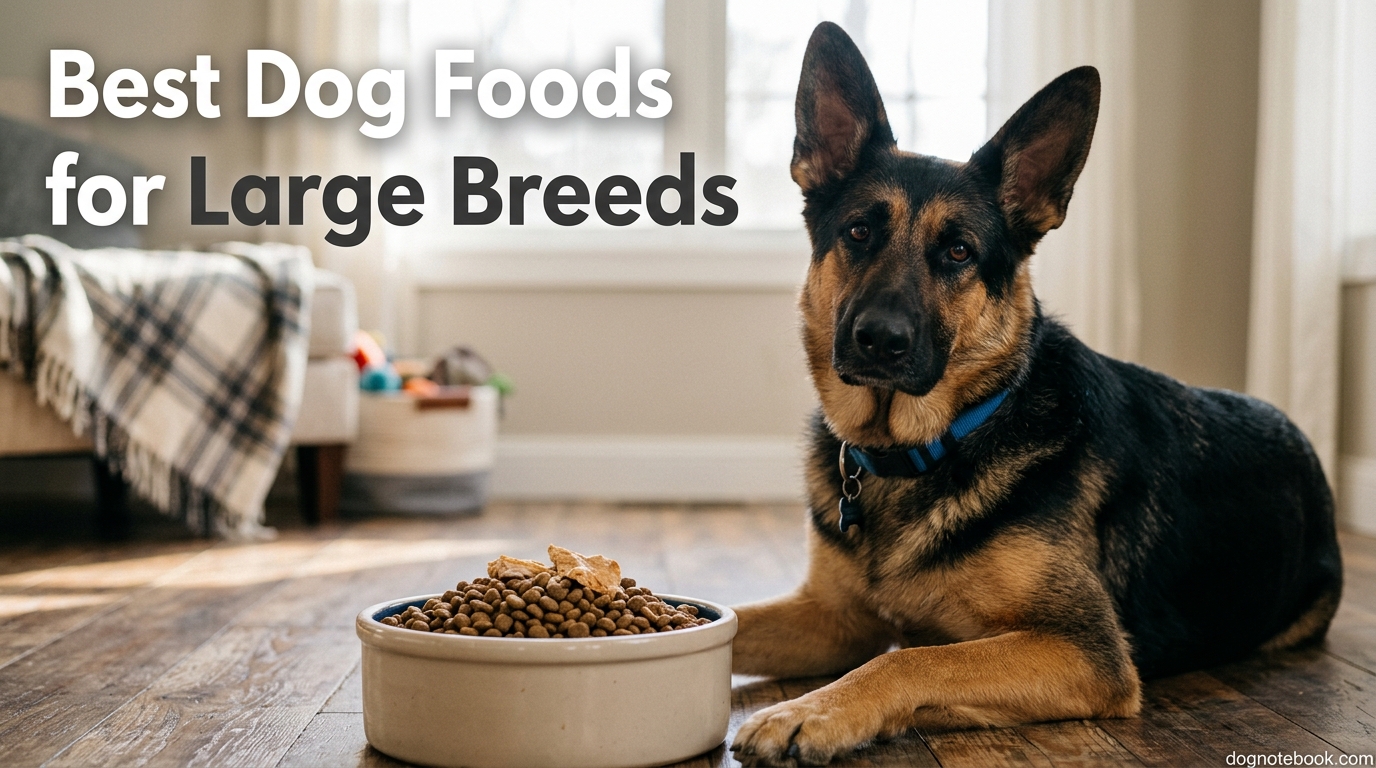
Large dogs may benefit from a complete diet that supports a healthy body weight, but no single ingredient can prevent every joint problem.
Some large-breed foods include glucosamine, chondroitin, omega-3 fatty acids, or added antioxidants. Evidence for supplements varies by product and condition. The amount listed on a label may not equal an amount shown to help a specific dog.
The strongest everyday joint strategy is often simple:
- Keep the dog lean.
- Provide regular, suitable exercise.
- Avoid forced or high-impact activity in growing puppies.
- Use a complete diet for the correct life stage.
- Ask a veterinarian about pain, limping, stiffness, or trouble rising.
Do not add calcium or mineral supplements to a large-breed puppy’s food unless a veterinarian recommends them. Extra calcium can upset the nutrient balance of a complete puppy diet.

Large-breed dog food mistakes to avoid
Choosing food by current weight only
A young dog’s current weight does not show how large it will become. Use expected adult weight when selecting puppy food.
Feeding too much because the dog is still growing
Growth does not mean unlimited food. Overfeeding can lead to excess fat and rapid growth. Follow the feeding chart and monitor body condition.
Assuming “large breed” has one official meaning
The phrase varies by brand. Check the package’s adult-weight range, life-stage statement, calories, and feeding directions.
Adding calcium “for strong bones”
Complete commercial diets already contain calcium. Extra supplements can create an imbalance, especially in puppies.
Ignoring kibble size
Some large dogs eat more comfortably with larger pieces. However, kibble size is a convenience feature, not proof that the food is nutritionally better.
Treating a medical problem with a regular large-breed food
A dog with kidney disease, food allergy, pancreatitis, obesity, or another condition may need a therapeutic diet. Ask a veterinarian before making a major dietary change.
When should you ask a veterinarian about your dog’s food?
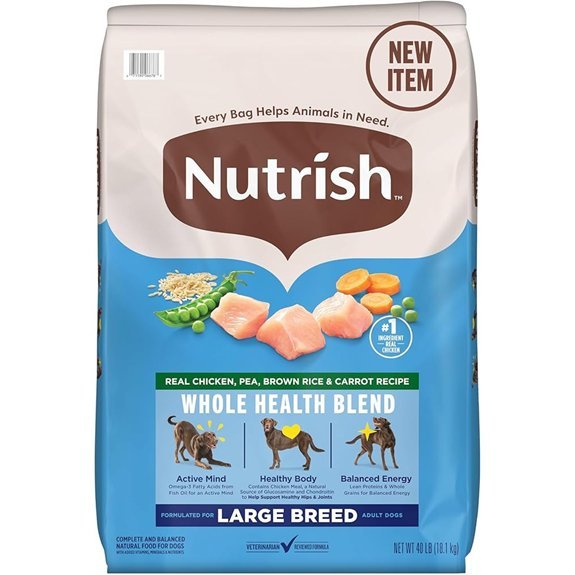
Ask a veterinarian for help when your dog:
- Is gaining or losing weight without a clear reason
- Has repeated vomiting or diarrhea
- Shows pain, limping, stiffness, or difficulty standing
- Has a poor appetite for more than a brief period
- Is a large-breed puppy with an unusual growth pattern
- Needs a diet for a diagnosed illness
- Is pregnant, nursing, or recovering from surgery
- Has signs of a food reaction, such as chronic itching or ear problems
A veterinarian can estimate ideal weight, assess body condition, review the food label, and calculate a more suitable calorie target.
Frequently asked questions
Is a 40-pound dog considered large breed for food?
Usually not. A 40-pound dog is often placed in the medium-size range, but breed shape and the food company’s definition can differ. Check the product’s feeding guide and choose based on adult size and life stage.
Is a 50-pound dog medium or large?
It can be either, depending on the brand. Many U.S. food companies treat 50 pounds as the beginning of the large-breed range. Others use 55 or 60 pounds.
Does a large dog need large-breed dog food?
Not always. An adult large dog may do well on a complete and balanced adult food if it stays at a healthy weight. Large-breed formulas can be useful for calorie control, kibble size, and joint-focused nutrition, but the label alone does not guarantee a better diet.
What is the difference between large-breed and giant-breed food?
Giant-breed food is usually aimed at dogs with a much higher adult weight, often around 90 pounds or more. The exact cutoff varies. Giant-breed puppies may need especially careful control of calories and minerals during growth.
Can large-breed puppies eat regular puppy food?
They can, but the food must be appropriate for their expected adult size. For puppies expected to become large or giant dogs, a food made for large-size growth may make calorie and mineral control easier. Ask your veterinarian if the expected adult weight is unclear.
Conclusion
For most U.S. feeding decisions, a large-breed dog means a dog expected to weigh about 50 pounds or more as an adult. Because food companies use different cutoffs, read the full label instead of relying on the words “large breed.”
For puppies, focus on expected adult weight, controlled growth, measured meals, and a food that is complete and balanced for the correct growth stage. For adult dogs, body condition and calorie intake matter at least as much as the breed category.
The best next step is to check your dog’s expected adult weight, life stage, current body condition, and the food’s calorie and nutritional adequacy statements before choosing a formula.

Pet Care Writer & Researcher
Daniel writes practical guides on daily care, feeding, and safety, turning complex topics into simple, actionable advice.