Why Do Dogs Bark At Black People: Causes And Solutions
Why do dogs bark at black people? Learn how fear, poor socialization, and learned cues—not race—can shape barking, plus humane training tips.
Dogs may bark at Black people because of fear, limited socialization, visual novelty, or learned reactions—not race itself.
When people ask, “why do dogs bark at Black people,” they often want a simple answer. The truth is more careful: dogs do not understand human race as people do, and no good evidence shows that Black skin causes barking. A dog may react to unfamiliar features, clothing, movement, past experiences, or signals from its owner. Understanding the real trigger helps you protect everyone, reduce fear, and avoid blaming the person being targeted.
Why do dogs bark at Black people?
The question “why do dogs bark at Black people” can feel personal and upsetting, especially when it happens more than once. However, barking is a dog’s behavior, not proof of a person’s character or danger. It usually means the dog feels alert, unsure, afraid, excited, or protective.
Dogs notice patterns through sight, smell, sound, and movement. They may react to details such as:
• A person’s height, hairstyle, beard, hat, or clothing
• Strong contrast between skin, clothing, and the background
• A quick approach or direct eye contact
• A deep voice, cane, umbrella, or work uniform
• Limited contact with people from a wide range of backgrounds
• A past event that the dog connected with a person’s appearance
• Tension from the owner or people nearby
Skin color alone is not a proven cause of barking. The safer and more accurate explanation is that a dog may respond to a person who looks or moves in a way the dog has not learned to accept.

Dogs do not think about race like humans do
Humans use social categories, including race, to understand identity and history. Dogs do not have the same human concept of race. They see shapes, colors, movement, faces, scents, and body language.
That does not mean dogs see all people in the same way. A dog can notice visual differences. For example, a dog may react to a person wearing dark clothes in low light, then bark at a Black person more often because of a specific pattern it has learned. The trigger may be clothing, lighting, hair, movement, or context rather than skin color.
This distinction matters. Saying that a dog “does not like Black people” gives the behavior a human motive that may not exist. It can also excuse poor training or place unfair blame on the person who is being barked at.
Research on dog behavior supports a more careful view. Dogs learn through association, reinforcement, early social exposure, and emotional responses. Research directly proving that dogs bark at Black people because they are Black is lacking. Claims should therefore stay modest and evidence based.

Common reasons a dog may bark at a Black person
Limited socialization
Puppies need safe exposure to many kinds of people, places, sounds, and surfaces. If a dog grows up around a small group, unfamiliar people may seem threatening.
A dog that has mostly seen white people, for example, may show uncertainty around a Black person. This does not mean the dog understands race. It may simply have a narrow learning history and react to a new combination of face, hair, clothing, voice, and movement.
Good socialization is calm and positive. It is not forcing a dog to greet everyone. The dog should be able to observe from a safe distance and leave if it feels overwhelmed.
Fear and uncertainty
Many dogs bark when they want space. A bark can mean, “Please move away,” rather than, “I want to attack.” Fear may appear with a stiff body, tucked tail, lowered head, lip licking, yawning, or avoiding eye contact.
Some dogs bark at people who approach the home, car, yard, or owner. A Black person who walks past a window may become the focus of this fear, especially if the dog has practiced the same behavior many times.
Visual contrast and unfamiliar features
Dogs have different visual abilities from humans. They rely heavily on movement and contrast, especially in dim light. A dark coat, hood, hat, sunglasses, or high-contrast outfit may stand out.
Hair can also change a familiar outline. A dog may react to braids, locs, twists, a large afro, a beard, or a head covering if it has not seen those features before. The same dog may react to any unusual hat, helmet, mask, or hairstyle.
This is one reason the question “why do dogs bark at Black people” cannot be answered by skin color alone. Several visual details may appear together, and people may notice the race of the target while overlooking the other triggers.
Learned associations
Dogs connect events that happen close together. If a dog barked at a person in a dark jacket and the owner pulled the leash, the dog may learn that people in similar clothing predict stress. If the person happened to be Black, the dog may later react to a related appearance.
This is called associative learning. It can be changed, but punishment often makes it worse. Yelling, leash jerks, or forced greetings can teach the dog that unfamiliar people really are dangerous.
Owner behavior and social cues
Dogs watch their handlers closely. A person may tighten the leash, hold their breath, stare, or move away when a Black person approaches. The dog may read that tension as a warning.
This does not mean the owner is always aware of their behavior. Bias can operate without conscious intent. A dog may then repeat a response that receives attention, distance, or protection.
Territorial behavior
Dogs often bark at people near their home, fence, car, or family. This behavior can happen with delivery workers, neighbors, guests, or people walking past the property.
When a Black person is the person outside, the dog may bark at that individual because of territory and context. The same dog may be friendly in a park or quiet street.
How to tell what is really triggering the barking
Look for patterns instead of guessing. Keep a simple record for one or two weeks, if it is safe to do so.
Write down:
• Where the barking happened
• How far away the person was
• What the person wore or carried
• Whether the dog was behind a window, fence, leash, or car door
• The dog’s body language
• What happened before and after the bark
• Whether the dog reacts to other unfamiliar people
Compare several situations. Does the dog bark at Black people in every setting, or only near the house? Does it also bark at people with hats, large bags, beards, umbrellas, or dark coats? Does the reaction stop when the person sits down or turns away?
This kind of observation can reveal the real cause. It also prevents people from making a harmful assumption based on one upsetting event.
Never use a person as a “test.” Do not ask someone to approach a fearful dog so you can study its reaction. Safety comes first, and the person being targeted should not be placed in an uncomfortable or unsafe role.

What to do if a dog barks at you
If a dog barks at you, remember that the behavior is not your fault. You do not need to prove that you are friendly or help train someone else’s dog.
Use these steps:
- Stay calm and avoid sudden movements.
- Turn your body slightly to the side.
- Avoid staring directly into the dog’s eyes.
- Do not run, reach toward the dog, or wave your arms.
- Keep your hands still and close to your body.
- Ask the owner to secure the dog and create more distance.
- If the dog is loose, place a barrier such as a car, bench, or gate between you.
- Report a serious safety concern to local animal control or the proper authority.
You can say, “Please hold your dog,” or “I need more space.” A responsible owner should respond without blaming you.
If a dog repeatedly targets you in a shared building, workplace, or neighborhood, document the dates and circumstances. A property manager, employer, or animal control office may be able to help.

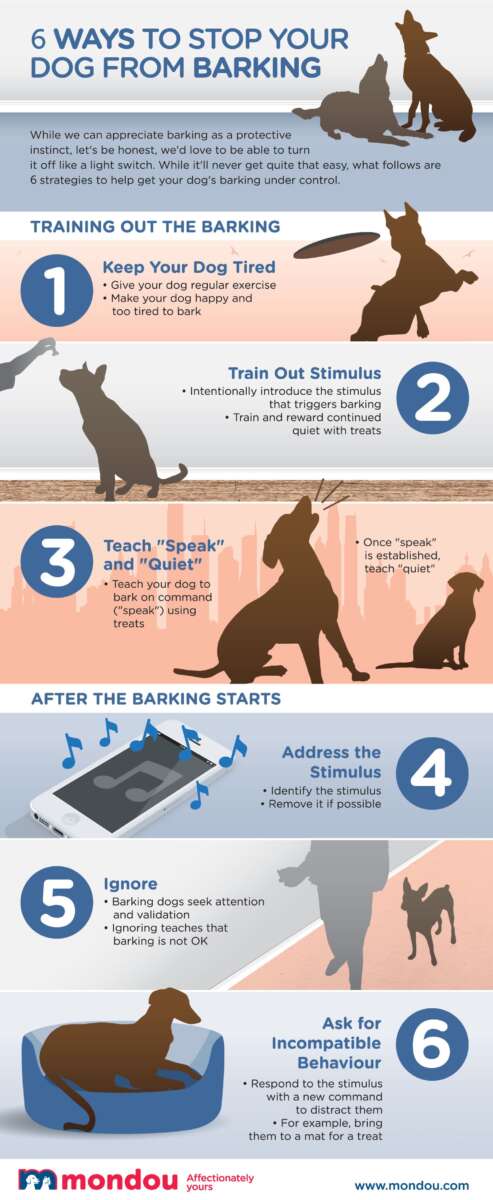
How owners can stop a dog from barking at people
The goal is not to force a dog to love everyone. The goal is to help the dog remain calm and safe around unfamiliar people.
Start with distance
Find the distance at which the dog notices a person but can still eat treats and respond to its name. This may be across a street or at the far end of a park.
If the dog is barking, lunging, freezing, or refusing food, you are too close. Move away and try again later.
Pair people with good things
When the dog notices a person, calmly offer a high-value treat. Stop the treats when the person is gone or out of view. Over time, the dog may learn that unfamiliar people predict safety and rewards.
Do not ask the person to approach. The person can remain still while the owner manages distance. This is known as desensitization and counterconditioning.
Teach a replacement behavior
Practice “look at me,” “find it,” “let’s go,” or “go to your mat” in a quiet place first. Then use the skill before the dog becomes upset.
Reward calm behavior. A dog cannot bark and focus fully on a simple cue at the same time, but the cue must be taught before a stressful event.
Avoid punishment and forced contact
Shock collars, harsh leash corrections, yelling, and forced greetings can increase fear. They may suppress the bark without changing the emotion beneath it.
A quiet dog is not always a relaxed dog. Watch for stiffness, hiding, growling, snapping, or sudden stillness. These signs need attention, not punishment.
Get professional help
A veterinarian should check sudden behavior changes because pain, hearing loss, vision changes, or illness can affect reactions. A qualified reward-based trainer or veterinary behaviorist can create a safe plan.
Look for professionals who explain their methods clearly and avoid claims that a dog is “racist” as a diagnosis. The focus should be on behavior, emotion, learning history, and safety.

A practical example
Imagine a dog that barks at Black pedestrians near an apartment entrance. The owner first assumes the dog dislikes Black people. A closer review shows that the dog also barks at people with large hairstyles, dark coats, backpacks, and hats. The dog is most reactive in the narrow entryway, where people appear suddenly.
The owner begins standing farther from the entrance, rewards the dog for looking calmly, and teaches a turn-away cue. After several weeks, the dog can watch people pass without barking.
The lesson is important. The first interpretation focused on race. The behavior plan focused on surprise, confinement, visual novelty, and fear. Better observation led to better training.
I cannot offer personal experience as a dog trainer or claim to have handled individual cases. However, this example reflects standard behavior principles used by veterinary behavior professionals and reward-based trainers. It also shows why careful assessment matters more than a quick label.

Mistakes to avoid
When discussing why do dogs bark at Black people, people can make the situation worse by using labels instead of solutions.
Avoid these mistakes:
• Treating barking as proof that a person is dangerous
• Blaming the Black person for the dog’s reaction
• Laughing while the dog barks or lunges
• Allowing a dog to rush up to strangers
• Punishing a dog without finding the trigger
• Forcing a fearful dog to accept petting
• Assuming one dog represents all dogs
• Ignoring repeated signs of fear or aggression
• Claiming that dogs can detect a person’s moral character
• Using racist stereotypes to explain animal behavior
Dogs can be affected by human bias, household habits, and social patterns. That does not make their behavior a reliable judgment of anyone’s identity or worth.

What experts and research suggest
Modern dog behavior work places strong emphasis on learning, emotions, genetics, health, and environment. Professional veterinary groups generally support reward-based training and advise against methods that cause fear or pain.
Studies on canine vision show that dogs process color and contrast differently from humans. Research on socialization shows that early, safe exposure can influence how dogs respond to unfamiliar people. Research on fear and aggression also shows that distance, control, and positive associations can help change behavior.
There are limits to the evidence. Direct research on dogs barking specifically at Black people is limited, and individual cases differ. It would be inaccurate to present a single cause as proven.
The most trustworthy answer to “why do dogs bark at Black people” is therefore conditional: some dogs may react more often to Black people because of limited exposure, visual differences, context, fear, or owner cues. The evidence does not support the idea that Black people naturally cause barking or that dogs possess a special racial instinct.
Frequently Asked Questions
Why do dogs bark at Black people but not white people?
A dog may have more experience with white people and less experience with Black people. The difference may also involve hair, clothing, movement, voice, lighting, location, or the owner’s reaction. It does not prove that skin color itself is the cause.
Can dogs sense that someone is Black?
Dogs can notice visual and scent differences, but they do not understand race in the same human social way. There is no reliable evidence that dogs have an innate ability to identify Black people as a special category and react negatively.
Does barking mean a dog is racist?
No. “Racist” describes a human social belief and system, not a standard canine diagnosis. A dog may show fear, poor socialization, learned association, territorial behavior, or excitement toward certain people.
Should a Black person try to pet a dog that barks at them?
No. The person should not feel pressured to interact with a barking or fearful dog. The owner should create distance, secure the dog, and manage the behavior with professional guidance.
How can I train my dog not to bark at Black people?
First, identify the actual trigger and work below the dog’s fear threshold. Use distance, treats, calm exposure, and reward-based cues, and consult a veterinarian or qualified behavior professional if the dog lunges, snaps, or cannot settle.
Can a dog’s behavior be changed?
Often, yes. Training can reduce fear and barking, but progress varies by age, health, genetics, learning history, and environment. Management may remain necessary even after improvement.
Should I punish my dog for barking at people?
Punishment can increase fear and may make the dog more dangerous. Reward calm behavior, increase distance, and use a humane training plan instead.
Conclusion
The best answer to “why do dogs bark at Black people” is not that dogs dislike Black people. Barking usually reflects fear, unfamiliarity, visual cues, limited socialization, territory, learned associations, or owner signals. Race may appear linked to the pattern, but that does not make race the cause.
Owners should observe carefully, avoid punishment, create space, reward calm behavior, and seek qualified help when needed. People who are targeted by barking deserve safety and respect, not blame. Apply these steps in real situations, learn from reputable veterinary behavior resources, and share your experience or questions in the comments.

Pet Care Writer & Researcher
Daniel writes practical guides on daily care, feeding, and safety, turning complex topics into simple, actionable advice.